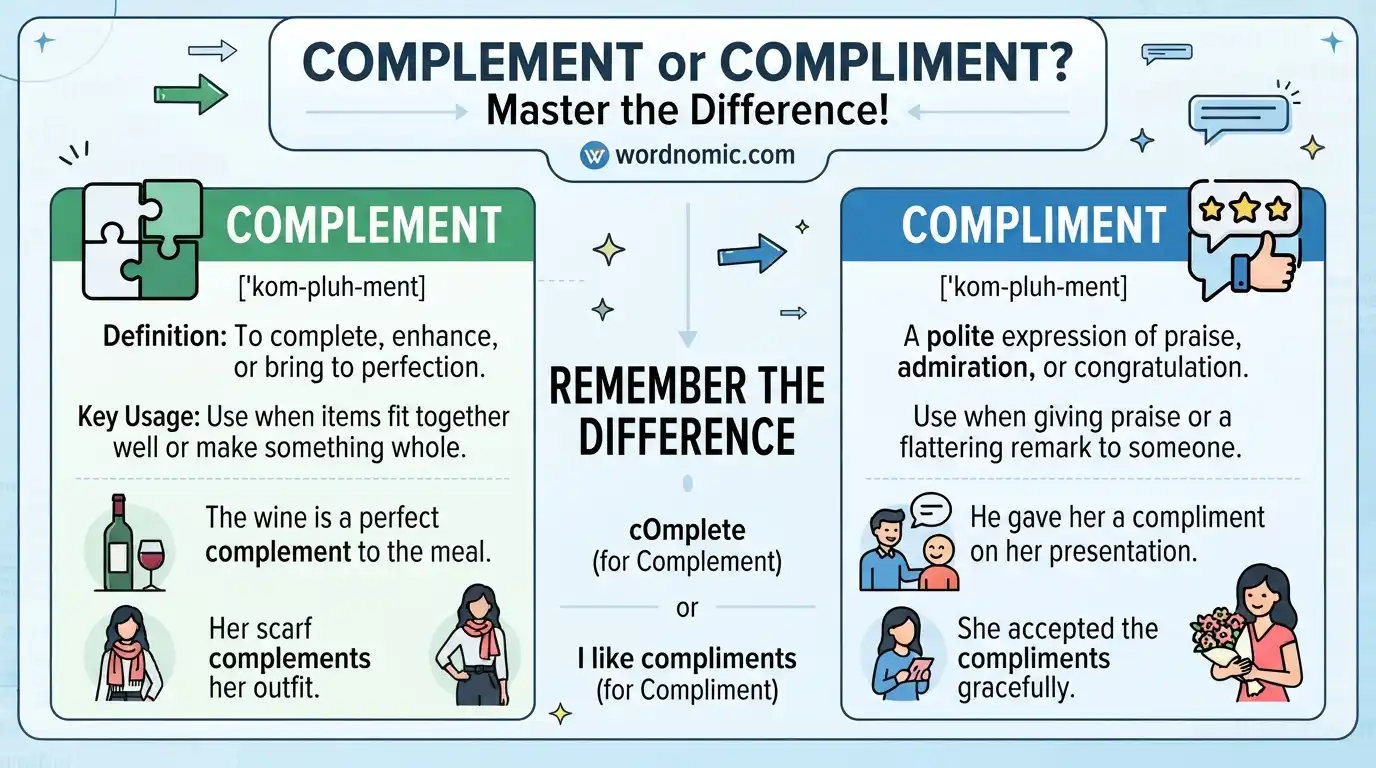
Have you ever wanted to say something nice about someone but stopped because you were not sure whether to write complement or compliment? These two words sound almost the same, but they have different meanings.
The good news is that the difference is easy to learn. Compliment is usually about praise. For example, if you tell someone, “Your dress looks great,” you are giving them a compliment.
Complement means something that completes, matches, or works well with something else. For example, “The sauce complements the meal” means the sauce goes well with the meal.
This small spelling difference can change the meaning of a sentence. That is why people often confuse these words in emails, school work, business writing, and everyday messages.
In this guide, you will learn the meaning of both words, how to use them, common mistakes, easy examples, and a simple trick to remember the difference.
Complement or Compliment – Quick Answer
Compliment means praise or a kind remark.
Complement means something that completes or goes well with something else.
A simple way to remember them is:
- Compliment = praise
- Complement = complete or match
Examples
- “She gave me a nice compliment about my shoes.”
- “The blue curtains complement the white walls.”
So, if you are talking about praise, use compliment.
If you mean that something matches, completes, or improves another thing, use complement.
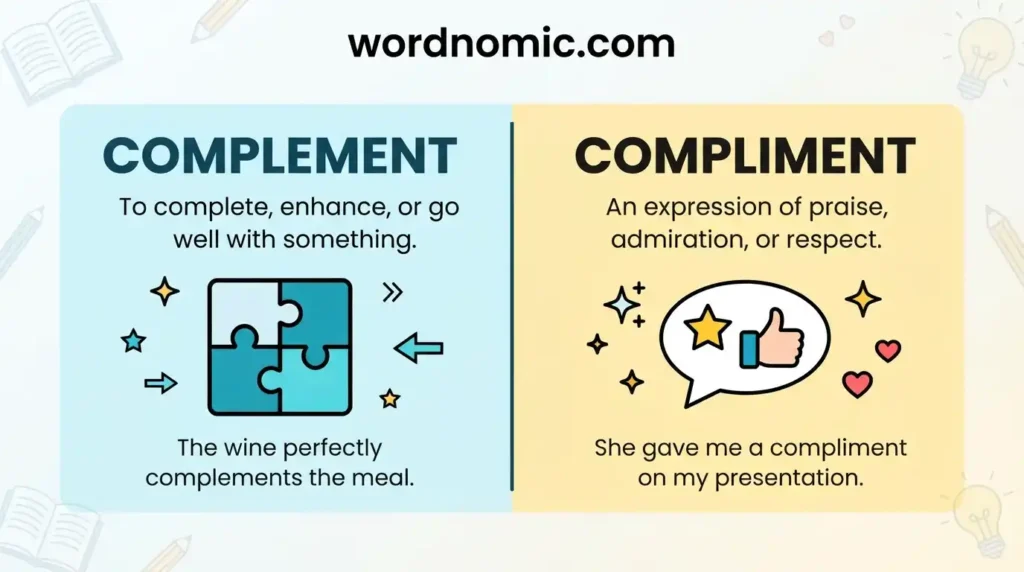
What Does Compliment Mean?
A compliment is a kind or positive comment about someone or something.
You can compliment a person on their clothes, work, skills, appearance, or actions.
Examples
- “He gave me a compliment about my new haircut.”
- “Your teacher complimented you on your work.”
- “She received many compliments on her dress.”
The word can be used as both a noun and a verb.
Compliment as a noun
A noun names the praise itself.
“She gave me a nice compliment.”
Here, compliment means a kind comment.
Compliment as a verb
As a verb, it means to praise someone.
“My manager complimented me on my work.”
Here, complimented means praised.
What Does Complement Mean?
A complement is something that completes, matches, or works well with something else.
It can describe colors, food, clothes, people, skills, ideas, and many other things.
Examples
- “The wine complements the food.”
- “Her shoes complement her dress.”
- “The new system complements the existing software.”
It can also be used as a noun.
“The sofa is a perfect complement to the room.”
Here, the sofa adds something that makes the room work well as a whole.
Complement as a verb
As a verb, complement means to complete or improve something by adding a useful part.
“The bright flowers complement the garden.”
The flowers match the garden and make it look better.
The Main Difference Between Complement and Compliment
The easiest difference is the meaning.
Compliment is connected to praise.
Complement is connected to completion, matching, or adding value.
Think of these simple memory tricks:
Compliment → praise
Complement → complete
The word complement has an e, just like complete. This can help you remember its meaning.
A quick test
Ask yourself:
Am I praising someone?
If yes, use compliment.
Am I saying that two things match or work well together?
If yes, use complement.
Main Differences at a Glance
| Word | Meaning | Usage | Example |
| Compliment | Praise or kind words | Talking about praise | She gave me a compliment. |
| Compliment | To praise | Used as a verb | He complimented my work. |
| Complement | Something that completes or matches | Talking about things that work well together | The colors complement each other. |
| Complement | To complete or improve | Used as a verb | The sauce complements the dish. |
Complement or Compliment: Easy Memory Trick
Here is one of the easiest ways to remember these words.
Compliment has an “i”
Think of I like your work.
A compliment is often something positive that you say to another person.
“I like your new jacket.”
That is a compliment.
Complement has an “e”
Think of complete.
Complement has an e, just like complete.
If something completes or matches something else, use complement.
“The red shoes complement the dress.”
This trick will not cover every grammar detail, but it works well for everyday writing.
Origin and History
Both words have a long history in English, but they came from different roots.
Compliment came into English through French and is linked to words connected with polite behavior and expressions of respect or praise.
Complement also came through French and ultimately traces back to Latin. Its meaning is linked to the idea of completing or filling something.
Over time, English developed different meanings for the two words.
Today, their spellings are very close, but their meanings remain different.
British English vs American English
There is no major British vs American spelling difference between these words.
Both British and American English use:
- compliment for praise
- complement for something that completes or matches
For example:
“She complimented my presentation.”
This spelling works in both forms of English.
Likewise:
“The colors complement each other.”
This spelling is also the same in British and American English.
The main challenge is not regional spelling. It is choosing the correct word based on meaning.
Which One Should You Use?
Choose the word based on what you want to say.
Use “compliment” when:
- You praise someone.
- Someone says something nice.
- You talk about a kind comment.
- You praise someone’s work or appearance.
Example:
“My boss complimented me on my report.”
Use “complement” when:
- Two things match.
- One thing completes another.
- Something adds value to another thing.
- Two parts work well together.
Example:
“The colors complement each other.”
In school writing
Use compliment when discussing praise.
Use complement when discussing things that complete or match each other.
In business writing
You might write:
“Thank you for the compliment.”
But you might also write:
“This new service complements our current products.”
Both words are correct, but they express different ideas.
Common Mistakes
1. Wrong: “She gave me a complement.”
Correct: “She gave me a compliment.”
The person is giving praise, so compliment is correct.
2. Wrong: “The colors compliment each other.”
Correct: “The colors complement each other.”
The colors match or work well together, so use complement.
3. Wrong: “He complement my work.”
Correct: “He complimented my work.”
The person praised the work, so the verb is complimented.
4. Wrong: “The sauce compliments the meal.”
Correct: “The sauce complements the meal.”
The sauce goes well with the meal, so complements is correct.
5. Wrong: “Thank you for the complement.”
Correct: “Thank you for the compliment.”
You are thanking someone for praise.
6. Wrong: “Her shoes compliment her dress.”
Correct: “Her shoes complement her dress.”
The shoes match or work well with the dress.
10 Everyday Examples
Here are some simple examples that show the difference clearly.
- She gave me a compliment about my new haircut.
- He complimented me on my presentation.
- Thank you for the compliment.
- The blue shirt complements his eyes.
- The sauce complements the chicken perfectly.
- These colors complement each other well.
- My teacher complimented me on my homework.
- The new curtains complement the furniture.
- She received a compliment from her manager.
- The two skills complement each other.
Real-Life Usage
These words appear often in everyday communication.
In conversations
You may use compliment when you praise someone.
“I love your shoes.”
That is a compliment.
You may use complement when talking about things that match.
“Those shoes complement your outfit.”
In emails
A business email might say:
“Thank you for your kind compliment.”
Here, the writer is talking about praise.
Another email might say:
“The new tool complements our current system.”
Here, the writer means that the new tool works well with the current system.
At school
Students may write:
“The teacher complimented her essay.”
But they might also write:
“The colors complement the design.”
At work
A manager may compliment an employee for good work.
A company may describe two products as complementary because they work well together.
On social media
People often give compliments in comments.
“You look great!”
That is a compliment.
People may also talk about colors or styles that complement each other.
Related Search Questions
What is the difference between complement and compliment?
Compliment means praise or a kind remark. Complement means something that completes, matches, or works well with something else.
For example, “She complimented my dress” means she praised it. “The shoes complement the dress” means the shoes match or work well with it.
Is “compliment” the correct word for praise?
Yes. Compliment is the correct word when you mean praise or a kind remark.
For example:
“He gave me a compliment.”
You can also use it as a verb:
“She complimented my work.”
Is “complement” related to “complete”?
Yes. This is a useful memory trick. Complement is connected to the idea of completing something or adding something that makes another thing work better.
For example:
“The sauce complements the meal.”
The sauce adds something that works well with the meal.
How do you use complement in a sentence?
Use complement when one thing completes, matches, or improves another.
Example:
“The dark furniture complements the light walls.”
The furniture and walls work well together.
How do you use compliment in a sentence?
Use compliment when someone gives praise.
Example:
“My friend complimented me on my new shoes.”
Here, the friend said something positive about the shoes.
Can compliment be a verb?
Yes. Compliment can work as both a noun and a verb.
As a noun:
“She gave me a compliment.”
As a verb:
“She complimented my work.”
The verb form changes to complimented in the past tense.
Are complement and compliment pronounced the same?
In standard English, the two words are usually pronounced very similarly, which is one reason people confuse them. Their meanings and spellings are different, even though their sounds are close.
Usage and Search Trends
People often confuse these words because they look and sound almost the same. This is a common type of English word confusion.
The confusion appears in many types of writing, including emails, school assignments, social media posts, and everyday messages.
There is no need to use made-up search volume or trend numbers to understand the topic. The main search need is simple: people want to know which spelling matches the meaning they have in mind.
A useful rule is:
Praise = compliment
Match or complete = complement
Comparison Table
| Feature | Compliment | Complement |
| Main meaning | Praise | Complete or match |
| Related idea | Kind words | Completing something |
| Part of speech | Noun and verb | Noun and verb |
| Example noun | “That was a nice compliment.” | “It is a good complement to the design.” |
| Example verb | “She complimented my work.” | “The colors complement each other.” |
| Memory clue | Think of praise | Think of complete |
| British English | Same spelling | Same spelling |
| American English | Same spelling | Same spelling |
FAQs
1. Which is correct, complement or compliment?
Both words are correct, but they have different meanings. Use compliment for praise or kind words. Use complement when something completes, matches, or works well with something else.
2. How can I remember complement vs compliment?
Think of complement and complete. Both contain an e. If something completes or matches another thing, choose complement. If someone gives praise, choose compliment.
3. Is “compliment” always about people?
No. A compliment can also describe praise given about something, such as a meal, design, performance, or piece of work. For example, “The restaurant received many compliments about its food.”
4. Can you compliment an object?
Yes. You can compliment something by saying something positive about it. For example, “Everyone complimented the new office design.” Here, people praised the design.
5. Can two things complement each other?
Yes. Complement is often used when two things work well together. For example, “The red and black colors complement each other.” It means they look good together or create a good combination.
6. Is “compliment” a noun or a verb?
It can be both. As a noun, it means praise: “She gave me a compliment.” As a verb, it means to praise: “She complimented my work.”
7. Are complement and compliment interchangeable?
No. They are not interchangeable because their meanings are different. Replacing one with the other can change the meaning of a sentence or make the sentence incorrect.
Conclusion
Choosing between complement or compliment becomes easy once you focus on the meaning.
Use compliment when you mean praise. If someone says something nice about your clothes, work, skills, or appearance, that is a compliment. You can also use compliment as a verb when someone praises you.
Use complement when you mean complete, match, or work well with something else. Colors can complement each other. Food can complement a meal. Two skills can also complement each other.
A simple memory trick can help. Think of compliment as praise. Think of complement as connected to complete.
There is no major British or American spelling difference between these words. The main issue is choosing the right word for the meaning.
So remember:
Compliment = praise.
Complement = complete, match, or add to something.
Once you learn this small difference, you can use both words with confidence in everyday, school, and professional writing.











