Carbon dioxide, or CO₂, often causes confusion in chemistry. The molecule contains two polar C=O bonds, so it may seem that CO₂ should also be polar. But that is not the case.
So, is CO2 polar or nonpolar? CO₂ is nonpolar.
The reason is the shape of the molecule. Carbon dioxide has a linear shape. The carbon atom sits between two oxygen atoms, and the C=O bonds point in opposite directions. Each C=O bond is polar because oxygen attracts electrons more strongly than carbon. However, the two bond dipoles are equal and point in opposite directions. They cancel each other.
This gives CO₂ a net dipole moment of zero. That makes the whole molecule nonpolar.
Understanding this idea is useful because molecular polarity depends on more than just the bonds. You also need to look at the molecule’s shape. Below, you will see why CO₂ is nonpolar, how its Lewis structure helps, and how it compares with a polar molecule such as H₂O.
CO2 Polar or Nonpolar – Quick Answer
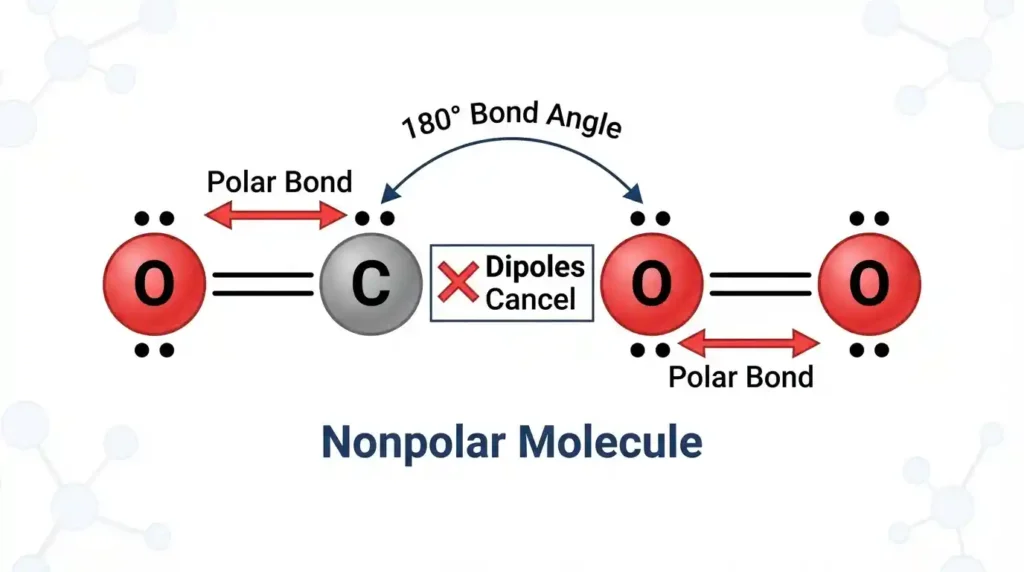
CO₂ is a nonpolar molecule.
Each carbon-oxygen bond in CO₂ is polar. However, CO₂ has a linear molecular shape with a 180° bond angle. The two C=O bond dipoles point in opposite directions and cancel each other.
Therefore:
- C=O bonds: Polar
- Molecular shape: Linear
- Bond angle: 180°
- Net dipole moment: 0
- Overall molecule: Nonpolar
This is the key difference between bond polarity and molecular polarity. A molecule can have polar bonds and still be nonpolar if its bond dipoles cancel.
Why Is CO₂ Nonpolar?
To understand why carbon dioxide is nonpolar, look at three things:
- Its chemical bonds
- Its molecular shape
- Its dipole moments
1. CO₂ Has Polar C=O Bonds
CO₂ contains one carbon atom and two oxygen atoms:
O=C=O
Oxygen is more electronegative than carbon. This means oxygen pulls the shared electrons toward itself.
As a result, each C=O bond has a partial charge:
- Carbon has a partial positive character.
- Oxygen has a partial negative character.
So, each individual C=O bond is polar.
2. CO₂ Has a Linear Shape
CO₂ has two regions of electron density around the central carbon atom. These regions move as far apart as possible.
This gives the molecule a linear geometry with a bond angle of 180°.
The basic structure looks like this:
O ← C → O
The two oxygen atoms sit directly opposite each other.
3. The Bond Dipoles Cancel
The two C=O bonds have equal bond dipoles because the molecule has the same oxygen atom on both sides.
One bond dipole points toward one oxygen. The other points toward the other oxygen.
Because they point in opposite directions, they cancel.
The result is:
Net dipole moment = 0
That is why the entire CO₂ molecule is nonpolar.
CO₂ Bond Polarity vs Molecular Polarity
This is one of the most important ideas to remember.
A polar bond does not always mean the entire molecule is polar.
For CO₂:
- The C=O bonds are polar.
- The molecule is linear.
- The two bond dipoles cancel.
- The molecule has no net dipole.
- Therefore, CO₂ is nonpolar.
So if you are asked, “Are the bonds in CO₂ polar?”, the answer is yes.
If you are asked, “Is CO₂ a polar molecule?”, the answer is no.
A Simple Rule
Think of it this way:
Polar bonds + symmetrical shape = possibly nonpolar molecule
For CO₂, the symmetry causes the two bond dipoles to cancel.
Lewis Structure of CO₂
The Lewis structure of carbon dioxide is:
O=C=O
Carbon is the central atom. It forms a double bond with each oxygen atom.
Each oxygen has two lone pairs, while carbon has no lone pairs in the basic Lewis structure.
This arrangement gives carbon two electron groups. According to VSEPR theory, these groups arrange themselves 180° apart.
Therefore, CO₂ is linear.
The linear shape is the main reason its bond dipoles cancel.
What Is the Shape of CO₂?
CO₂ has a linear molecular geometry.
Its structure can be shown as:
O=C=O
The bond angle is:
180°
The two oxygen atoms are directly opposite each other.
This symmetry is important when deciding whether CO₂ is polar or nonpolar.
If CO₂ had a bent shape, the two C=O dipoles would not cancel completely. But because the molecule is linear, they cancel.
What Is a Dipole Moment?
A dipole moment describes the separation of positive and negative charge in a molecule.
You can think of a bond dipole as an arrow showing where the electrons are being pulled.
For CO₂, there are two bond dipoles:
C=O ← and C=O →
They have equal strength but point in opposite directions.
When added together, they give:
0 net dipole moment
CO₂ therefore has no overall molecular dipole. Chemistry references commonly use CO₂ as a classic example of a molecule with polar bonds but no net dipole.
CO₂ vs H₂O: Why One Is Nonpolar and One Is Polar
Water is a useful comparison.
Both CO₂ and H₂O contain oxygen. Both also have polar bonds. But their shapes are different.
CO₂ is linear.
H₂O is bent.
In CO₂, the bond dipoles point in opposite directions and cancel.
In H₂O, the bond dipoles point in directions that do not cancel. This gives water a net dipole moment, so H₂O is polar.
| Molecule | Bond Polarity | Shape | Overall Polarity |
| CO₂ | Polar C=O bonds | Linear | Nonpolar |
| H₂O | Polar O-H bonds | Bent | Polar |
| NH₃ | Polar N-H bonds | Trigonal pyramidal | Polar |
| CCl₄ | Polar C-Cl bonds | Tetrahedral | Nonpolar |
The key lesson is simple: molecular shape matters.
Main Differences: Polar vs Nonpolar CO₂
There is no separate “polar CO₂” form under the normal molecular structure. CO₂ itself is classified as nonpolar.
The confusion usually comes from comparing polar bonds with a polar molecule.
| Feature | CO₂ |
| Formula | CO₂ |
| Central atom | Carbon |
| Outer atoms | Two oxygen atoms |
| C=O bonds | Polar |
| Molecular shape | Linear |
| Bond angle | 180° |
| Symmetry | High |
| Dipole cancellation | Yes |
| Net dipole moment | 0 |
| Overall polarity | Nonpolar |
Origin and History of the Terms
The word carbon dioxide describes the chemical composition of the molecule.
“Carbon” refers to the carbon atom. “Dioxide” means that two oxygen atoms are present.
The terms polar and nonpolar describe how charge is distributed in a molecule.
In chemistry, polarity became an important way to explain how molecules behave. Scientists use ideas such as electronegativity, molecular geometry, and dipole moments to understand this behavior.
For CO₂, these ideas work together. The C=O bonds have unequal electron sharing, but the linear and symmetrical structure makes the two bond dipoles cancel.
British English vs American English
There is no meaningful British English vs American English difference in the chemistry terms used here.
Both forms use:
- carbon dioxide
- carbon dioxide molecule
- polar molecule
- nonpolar molecule
- dipole moment
- molecular geometry
- electronegativity
The spelling nonpolar is common in American chemistry writing. You may also see non-polar in some writing.
The chemistry meaning stays the same.
Which One Should You Use: Polar or Nonpolar?
If you are answering a chemistry question about CO₂, use:
CO₂ is nonpolar.
If the question asks about the bonds, you can say:
The C=O bonds are polar.
If the question asks about the molecule as a whole, say:
The CO₂ molecule is nonpolar because its bond dipoles cancel.
For a school or college answer, a strong short response is:
CO₂ is nonpolar because it has a linear shape, and the two polar C=O bond dipoles cancel each other.
This answer gives both the classification and the reason.
Common Mistakes About CO₂ Polarity
Mistake 1: Saying CO₂ is polar because oxygen is more electronegative
Incorrect: CO₂ is polar because oxygen pulls electrons toward itself.
Correct: Each C=O bond is polar, but the whole CO₂ molecule is nonpolar.
Why: The two bond dipoles cancel because of the molecule’s linear shape.
Mistake 2: Thinking polar bonds always make a polar molecule
Incorrect: Every molecule with polar bonds must be polar.
Correct: Molecular shape must also be considered.
Example: CO₂ has polar C=O bonds but is nonpolar.
Mistake 3: Forgetting the shape of CO₂
Incorrect: CO₂ has a bent shape.
Correct: CO₂ is linear.
Why: The two electron groups around the central carbon arrange themselves 180° apart.
Mistake 4: Saying CO₂ has a net dipole
Incorrect: CO₂ has a net dipole pointing toward oxygen.
Correct: CO₂ has no net dipole moment.
Why: The two equal bond dipoles point in opposite directions and cancel.
Mistake 5: Confusing CO₂ with H₂O
Incorrect: CO₂ and H₂O are both polar because both contain oxygen.
Correct: CO₂ is nonpolar, while H₂O is polar.
Why: CO₂ is linear, while H₂O has a bent shape.
Mistake 6: Calling the C=O bonds nonpolar
Incorrect: CO₂ is nonpolar, so its C=O bonds must also be nonpolar.
Correct: The C=O bonds are polar.
Why: Oxygen and carbon do not attract the shared electrons equally.
10 Everyday and Study Examples
Here are simple examples you may see in chemistry questions:
- CO₂ is a nonpolar molecule.
- The C=O bonds in CO₂ are polar.
- Carbon dioxide has a linear molecular shape.
- The bond angle in CO₂ is 180°.
- The two bond dipoles in CO₂ cancel each other.
- CO₂ has a net dipole moment of zero.
- Molecular geometry helps explain why CO₂ is nonpolar.
- A molecule can have polar bonds and still be nonpolar.
- CO₂ and H₂O have different molecular shapes and different polarities.
- The symmetry of CO₂ causes its bond dipoles to cancel.
Real-Life and School Usage
This question often appears in chemistry classes, homework, quizzes, and exams.
A teacher may ask:
“Is CO₂ polar or nonpolar?”
A short answer is:
“CO₂ is nonpolar because its two polar C=O bonds cancel due to its linear shape.”
You may also see a question such as:
“Explain why CO₂ is nonpolar.”
For this question, mention three points:
- C=O bonds are polar.
- CO₂ has a linear shape.
- The two bond dipoles cancel.
In an exam, this is usually much better than simply writing “nonpolar” without an explanation.
Related Search Questions
Is CO₂ a polar molecule?
No. CO₂ is a nonpolar molecule. Its C=O bonds are polar, but the molecule is linear and symmetrical. The two bond dipoles point in opposite directions and cancel, giving CO₂ a net dipole moment of zero.
Are the bonds in CO₂ polar?
Yes. Each C=O bond is polar because oxygen attracts the shared electrons more strongly than carbon. However, the two polar bonds cancel at the molecular level because they point in opposite directions.
Why is CO₂ nonpolar even though it has polar bonds?
CO₂ has a linear shape. Its two C=O bond dipoles have equal strength and point in opposite directions. Their vector sum is zero, so the molecule has no overall dipole.
What is the shape of CO₂?
CO₂ has a linear shape with a bond angle of 180°. The carbon atom is in the center, with an oxygen atom on each side.
Does CO₂ have a dipole moment?
CO₂ has no net molecular dipole moment. Its individual C=O bonds have dipoles, but those dipoles cancel each other because of the molecule’s linear structure.
Is CO₂ polar or nonpolar in Lewis structure questions?
CO₂ is nonpolar. Draw the Lewis structure, determine that the molecule is linear, and then check the bond dipoles. Because they point in opposite directions and cancel, the molecule has no net dipole.
Is CO₂ more like H₂O or CCl₄ in polarity?
CO₂ is like CCl₄ in one important way: both molecules are nonpolar even though they contain polar bonds. H₂O is different because its bent shape prevents its bond dipoles from canceling.
Usage and Search Trends
People commonly search this topic in short question forms such as:
- “is CO2 polar or nonpolar”
- “is CO2 polar”
- “is carbon dioxide polar”
- “why is CO2 nonpolar”
- “CO2 polarity”
- “CO2 dipole moment”
- “CO2 molecular geometry”
- “is CO2 a polar molecule”
These searches all point to the same basic chemistry concept: molecular polarity depends on both bond polarity and molecular geometry.
Exact search-volume or ranking data is not included here because reliable current numbers were not established.
CO₂ Polarity Comparison Table
| Question | Answer |
| Is CO₂ polar? | No |
| Is CO₂ nonpolar? | Yes |
| Are C=O bonds polar? | Yes |
| What is CO₂’s shape? | Linear |
| What is the bond angle? | 180° |
| Do the bond dipoles cancel? | Yes |
| Does CO₂ have a net dipole? | No |
| What is its net dipole moment? | 0 |
| Why is it nonpolar? | Its equal bond dipoles cancel |
The Easy Way to Remember CO₂ Is Nonpolar
Use this simple three-step test:
Step 1: Check the bonds
CO₂ has polar C=O bonds.
Step 2: Check the shape
CO₂ is linear.
Step 3: Check the dipoles
The two dipoles point in opposite directions, so they cancel.
Final answer: CO₂ is nonpolar.
This method can also help with many other molecules. Do not look only at the atoms or bonds. Always check the molecular shape.
FAQs
1. Is CO₂ polar or nonpolar?
CO₂ is nonpolar. The C=O bonds are individually polar, but CO₂ has a linear shape. The two bond dipoles have equal strength and point in opposite directions. They cancel each other, so the molecule has no net dipole moment.
2. Why are the C=O bonds polar?
The C=O bonds are polar because oxygen is more electronegative than carbon. Oxygen pulls the shared electrons closer to itself. This creates an unequal distribution of electron density across each C=O bond.
3. Why does CO₂ have a linear shape?
The central carbon has two regions of electron density involved in bonding. These regions repel each other and move as far apart as possible. This creates a straight-line structure with a 180° bond angle.
4. Does symmetry make CO₂ nonpolar?
Yes. The two sides of CO₂ are symmetrical. Each C=O bond has an equal dipole, but the dipoles point in opposite directions. Because they cancel, the molecule has no overall dipole moment.
5. Is CO₂ more polar than water?
CO₂ and water have different overall polarity. CO₂ is nonpolar, while H₂O is polar. Water has a bent shape, so its O-H bond dipoles do not cancel. CO₂ is linear, so its C=O dipoles cancel.
6. What is the net dipole moment of CO₂?
The net dipole moment of CO₂ is zero. Each C=O bond has a dipole, but the two dipoles are equal and point in opposite directions. Their vector sum is therefore zero.
7. What is the easiest way to know if CO₂ is nonpolar?
Remember this: CO₂ has polar bonds but a linear shape. The two bond dipoles point in opposite directions and cancel. Therefore, the whole molecule is nonpolar.
Conclusion
So, is CO2 polar or nonpolar? CO₂ is nonpolar.
The most important point is that bond polarity and molecular polarity are not always the same. Carbon dioxide has two polar C=O bonds because oxygen attracts electrons more strongly than carbon. However, these bonds are arranged in a straight line.
CO₂ has a linear shape and a 180° bond angle. The two C=O bond dipoles have equal strength and point in opposite directions. Because they cancel, CO₂ has no net dipole moment. This makes the whole molecule nonpolar.
A simple way to remember the answer is:
Polar bonds + linear symmetry + dipole cancellation = nonpolar CO₂.
This also explains why you should not decide molecular polarity by looking at only one bond. Always check the bonds, molecular shape, and direction of the dipoles.
If you remember those three steps, you can answer most basic CO₂ polarity questions with confidence.

Emily Carter is an English grammar writer based in Portland, Oregon, with 7+ years of experience turning tricky grammar rules into simple, easy lessons.