You want to write about growing older, and you stop at one word. Do you spell it ageing or aging? The spelling looks odd either way if you stare at it too long.
People search for ageing or aging because English drops the e in some words but not others. This one causes real doubt, even for careful writers.
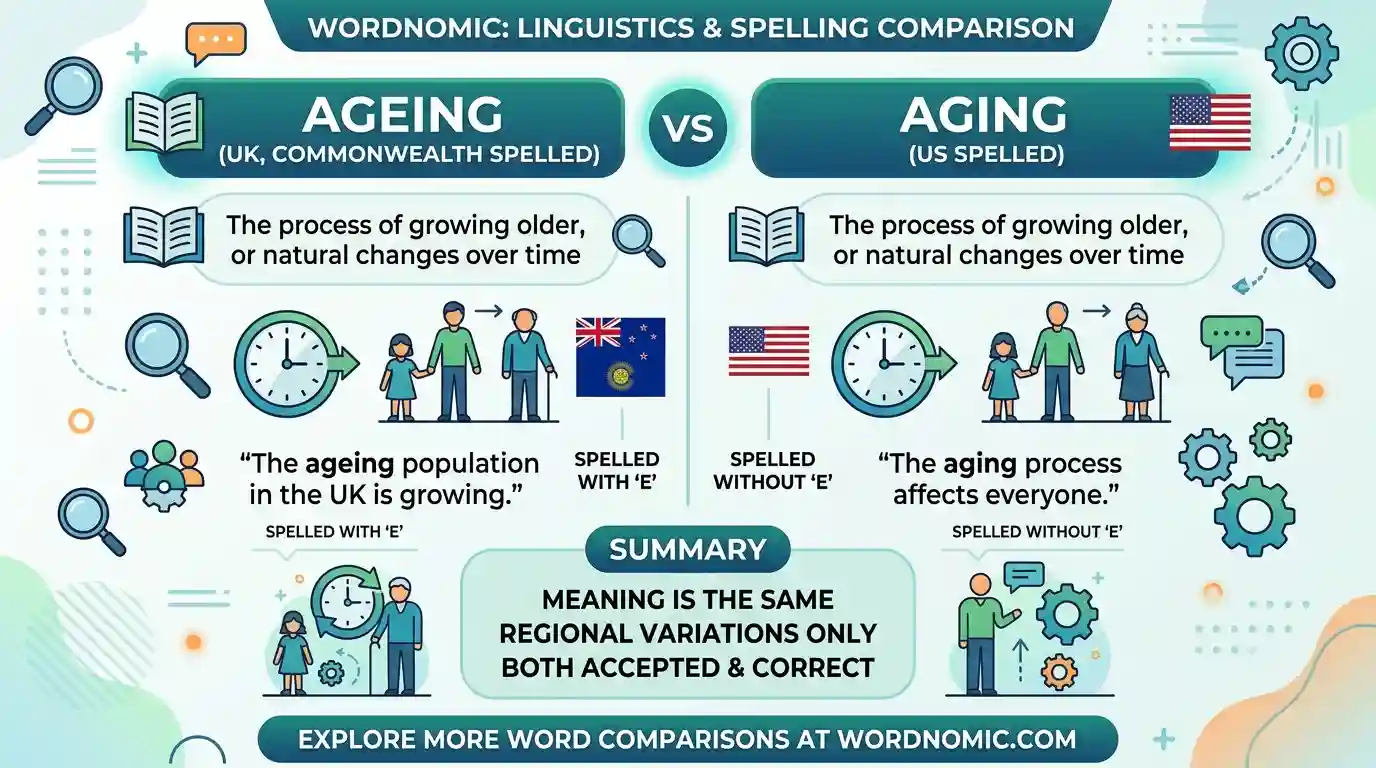
Here is the direct answer. Both spellings are correct. Ageing is the standard British spelling. Aging is the standard American spelling. They mean exactly the same thing.
You will learn why the e disappears in one version, how British and American English split on this word, and which one to use in your own writing. You will also see clear examples and common mistakes to avoid.
Ageing or Aging – Quick Answer
Both are correct. Ageing and aging both mean “growing older” or “the process of becoming old.”
- Use ageing in British English.
- Use aging in American English.
- Both are also used to describe wine, cheese, and other things that change over time.
The difference is regional spelling, not meaning. Pick one and stay consistent.
What Does Ageing or Aging Mean?
Ageing and aging come from the verb age. As a verb, age means to grow older or to mature over time. Add -ing, and you get the present participle or gerund form.
The word describes:
- The natural process of growing older: Skin changes as a person ages.
- A process happening now: She is ageing gracefully.
- A noun use for the whole process: Ageing is a normal part of life.
- Non-human uses: The wine improves with aging.
The spelling puzzle comes from one simple English rule. Normally, when you add -ing to a word ending in a silent e, you drop the e. Make becomes making. Ride becomes riding. So age should become aging.
British English usually breaks this rule for a small group of words, including age, to keep the g sounding soft, like a “j” sound, instead of hard, like in rag. Keeping the e signals that soft sound. American English follows the normal rule and drops the e.
Main Difference Between Ageing and Aging
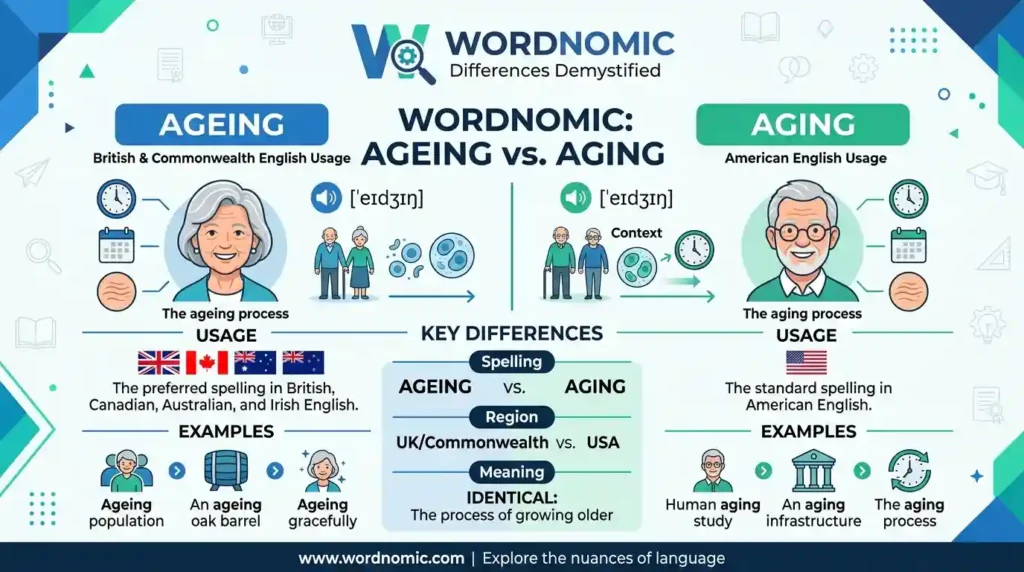
There is no difference in meaning, pronunciation, or grammar. Both words describe the exact same process.
The only difference is spelling convention by region:
- Ageing keeps the e from age. This is the standard British, Australian, and Irish spelling.
- Aging drops the e, following the normal English rule for adding -ing. This is the standard American spelling.
Major dictionaries list both forms. British dictionaries list ageing as the main entry. American dictionaries list aging as the main entry.
Origin and History
The word age comes from Old French aage or edage, which traces back to Latin roots related to time and a lifespan. English borrowed the word centuries ago, and it settled into its modern spelling by the late medieval period.
The -ing form followed general English spelling habits. Most silent e endings drop the e before -ing. Words like age, dye, and a few others became exceptions in British spelling to protect their pronunciation. Keeping the e in ageing stops the word from looking like it should rhyme with raging in a harder way, and it keeps the soft g sound clear.
American English simplified many of these exceptions over time, following Noah Webster’s push toward more regular, rule-based spelling in the 1800s. This is part of why American English uses aging, dyeing as dying in some contexts, and other shortened forms, while British English kept older, less regular spellings.
British English vs American English
Spelling: British English uses ageing. American English uses aging.
Meaning: No difference. Both describe the process of growing older.
Pronunciation: Both words sound the same. The e in ageing is silent and does not change how the word is spoken.
Usage: Ageing appears in UK, Australian, and Irish publications. Aging appears in US publications. Canadian English often uses aging, though some Canadian writers use ageing.
Common preference: Style guides in each region confirm the pattern. UK style guides such as those from Oxford recommend ageing. US style guides such as Merriam-Webster and the AP Stylebook use aging.
Which One Should You Use?
Here is simple guidance for common situations:
- Everyday writing: Either is fine if your reader understands both.
- Formal writing: Match the style guide you are told to follow.
- Academic writing: Check your journal or institution’s preferred English variety.
- Business writing: Match your company’s location and audience.
- British English: Use ageing.
- American English: Use aging.
- Online writing: Match the spelling style of the rest of your site or platform.
The most important rule is consistency. Do not switch between ageing and aging in the same document.
Common Mistakes With Ageing and Aging
1. Mistake: Mixing both spellings in one document
- Incorrect: Ageing affects the skin. Aging also affects joints.
- Correct: Ageing affects the skin. Ageing also affects joints.
- Why: Pick one spelling and use it throughout the whole piece.
2. Mistake: Dropping the e in British English
- Incorrect: The UK population is aging rapidly. (in a British-English document)
- Correct: The UK population is ageing rapidly.
- Why: British style guides expect the e to stay.
3. Mistake: Keeping the e in American English
- Incorrect: The US population is ageing rapidly. (in an American-English document)
- Correct: The US population is aging rapidly.
- Why: American style guides expect the e to drop.
4. Mistake: Confusing ageing with aging out
- Incorrect: He is ageing the foster system.
- Correct: He is ageing out of the foster system.
- Why: Age out is a phrasal verb that needs out to make sense.
5. Mistake: Using the wrong form as an adjective
- Incorrect: An age population needs more support.
- Correct: An ageing (or aging) population needs more support.
- Why: The -ing form works as an adjective before a noun; age alone does not.
6. Mistake: Treating one spelling as wrong
- Incorrect: “Aging” is a spelling mistake.
- Correct: Aging is correct in American English. Ageing is correct in British English.
- Why: Neither spelling is an error. They are regional variants.
Everyday Examples
- My grandfather is ageing well and still walks every day.
- The company studies aging in a new research lab.
- Fine wine benefits from careful aging in oak barrels.
- Her skin shows early signs of ageing around the eyes.
- The report warns that the aging population needs more housing.
- He worries about ageing alone without family nearby.
- Cheese aging takes weeks or months, depending on the type.
- The actor jokes about ageing in every interview.
- Aging pipes in the old building need to be replaced.
- Ageing gracefully means accepting change with confidence.
- The clinic offers treatments that slow visible skin ageing.
- Experts study how stress speeds up cellular aging.
Real-Life Usage
Conversations: People say things like “I’m ageing so fast this year” or “aging like fine wine,” often as a joke about getting older.
Emails: Business writers use the term in reports: “Our aging infrastructure needs investment” or “Ageing equipment causes delays.”
School: Students studying biology or health write about ageing or aging in essays about the human body and life stages.
Work: HR and healthcare documents often discuss an “ageing workforce” or “aging workforce,” depending on the country.
Social media: Skincare and wellness posts use both spellings constantly, such as “anti-ageing routine” in UK posts and “anti-aging routine” in US posts.
Formal writing: Government reports on population and health pick the spelling that matches their country’s English variety and keep it consistent throughout.
Related Search Questions
What does ageing mean?
Ageing means the process of growing older. It applies to people, animals, and things like wine or buildings that change over time.
Is ageing correct or aging?
Both are correct. Ageing is the British spelling. Aging is the American spelling. Neither one is a mistake.
What is the difference between ageing and aging?
There is no difference in meaning. The only difference is regional spelling: British English keeps the e, and American English drops it.
Which spelling is British: ageing or aging?
Ageing is the British spelling. It appears in UK dictionaries, newspapers, and government documents.
Which spelling is American: ageing or aging?
Aging is the American spelling. It follows the standard English rule of dropping a silent e before -ing.
How do you use ageing in a sentence?
Use it to describe growing older or a process happening over time: “The building shows signs of ageing” or “She is ageing well.”
Is anti-ageing or anti-aging correct?
Both are correct. Anti-ageing is standard in British English. Anti-aging is standard in American English. The meaning is identical.
Usage and Search Trends
No exact search numbers are included here, since real-time figures need a live source such as Google Trends. In general terms, both spellings stay in steady use worldwide, because English has many regional variants that overlap globally through the internet.
Skincare, health, and population topics keep both ageing and aging common in search behavior. Readers in the UK, Australia, and Ireland tend to search ageing. Readers in the US and much of Canada tend to search aging.
Comparison Table
| Term | Meaning | Usage | Example |
| ageing | Growing older; a gradual process of change | Standard in British, Australian, Irish English | The population is ageing quickly. |
| aging | Growing older; a gradual process of change | Standard in American English | The population is aging quickly. |
| age | The base verb or noun; a stage of life or number of years | Used in both varieties without spelling change | He will age well. She is 40 years of age. |
| age out | To become too old for a program or system | Phrasal verb, used in both varieties | Teens age out of the program at 18. |
FAQs
1. Is it “ageing” or “aging”?
Both are correct. Ageing is the British spelling, and aging is the American spelling. They mean the same thing and are pronounced the same way. Choose the version that matches your audience’s English variety, and stay consistent throughout your writing.
2. Why does British English keep the “e” in ageing?
British English keeps the e to protect the soft g sound in age. Without the e, the word could look like it should have a hard g sound. Some other words follow similar exceptions, though ageing is one of the clearest examples.
3. Do Americans ever spell it “ageing”?
It is uncommon but not unheard of. American style guides and dictionaries list aging as the standard form. Some American writers use ageing by habit or personal preference, but most US publications and editors correct it to aging.
4. What is the plural or noun form of ageing?
Ageing and aging already work as nouns describing the process itself, such as “Ageing is inevitable.” There is no separate plural form, since the word describes a process rather than a countable object.
5. Is “anti-ageing” spelled with an e?
In British English, yes: anti-ageing. In American English, it is spelled anti-aging, without the e. Both appear often in skincare and beauty marketing, depending on the target market’s English variety.
6. Does aging only apply to people?
No. Ageing and aging also describe non-human processes, such as wine, cheese, wood, and buildings changing over time. The word works the same way for objects and materials as it does for people.
7. Which spelling should I use for a global audience?
For a mixed or international audience, choose one spelling and stay consistent. Many global brands default to American spelling, aging, for wider reach, but British spelling, ageing, works well for UK-focused or Commonwealth audiences.
Conclusion
Ageing and aging are both correct spellings of the same word. They mean the process of growing older, and they apply to people, animals, and things like wine or buildings.
The only real difference is regional. British, Australian, and Irish English use ageing, keeping the e from age. American English uses aging, following the normal rule of dropping a silent e before -ing.
Simple guidance to remember:
- Use ageing for British English audiences.
- Use aging for American English audiences.
- Stay consistent within the same piece of writing.
- Neither spelling is wrong on its own; the context decides which fits.
When in doubt, match the spelling style already used in your document or by your target audience, and keep it the same from start to finish.

Emily Carter is an English grammar writer based in Portland, Oregon, with 7+ years of experience turning tricky grammar rules into simple, easy lessons.










