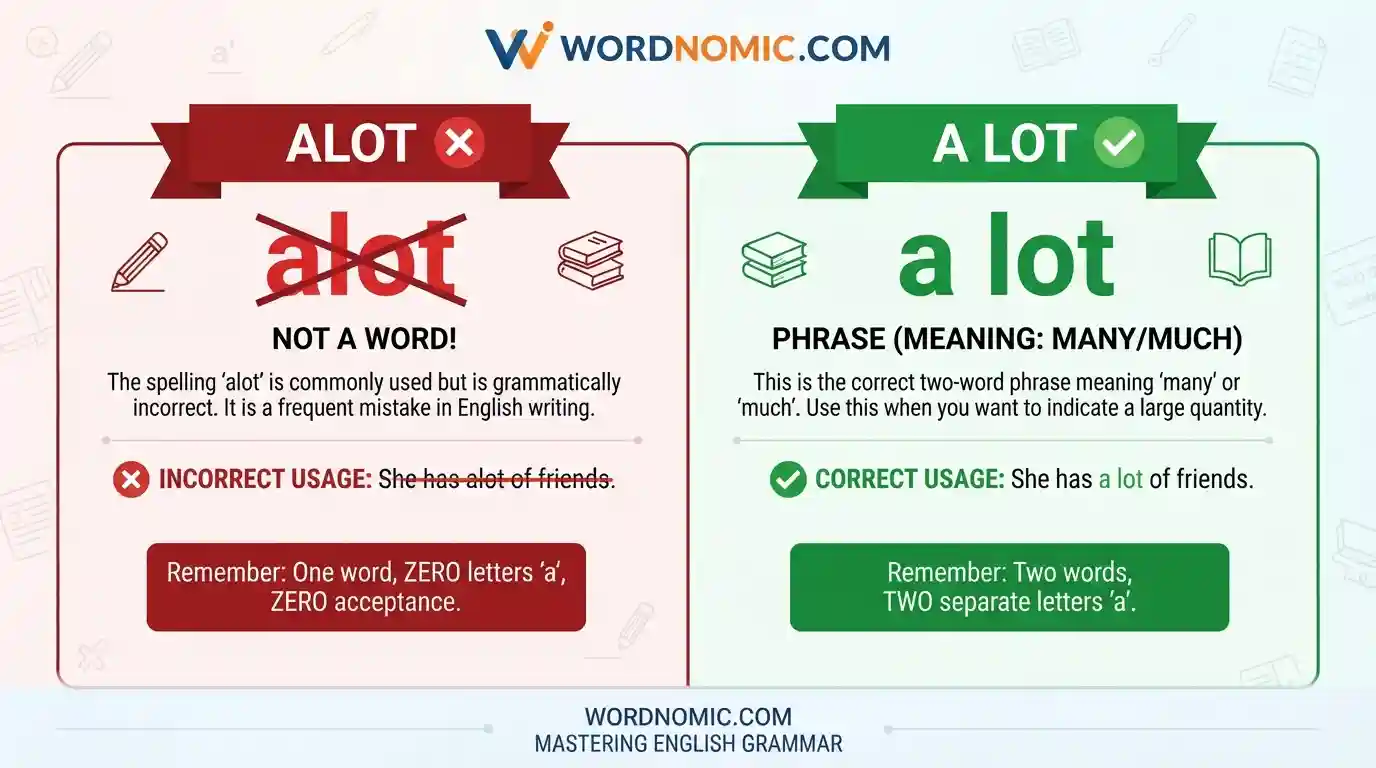
Seeing “alot or a lot” in a sentence can make you stop and wonder which form is correct. Many English learners make this mistake because the two forms look almost the same. They also sound very similar when people speak.
The good news is that the rule is simple. A lot is the correct form when you mean “many,” “much,” or “often.” It is written as two separate words.
Alot is not the standard spelling of this expression in modern English. You may see it in casual online writing, but you should not use it in school, work, email, or formal writing.
There is also a related word, allot, which has a completely different meaning. It means to give or share something for a particular purpose.
This guide explains the difference between a lot, alot, and allot, shows you how to use each form, and gives simple examples so you can avoid this common spelling mistake.
Alot or A Lot – Quick Answer
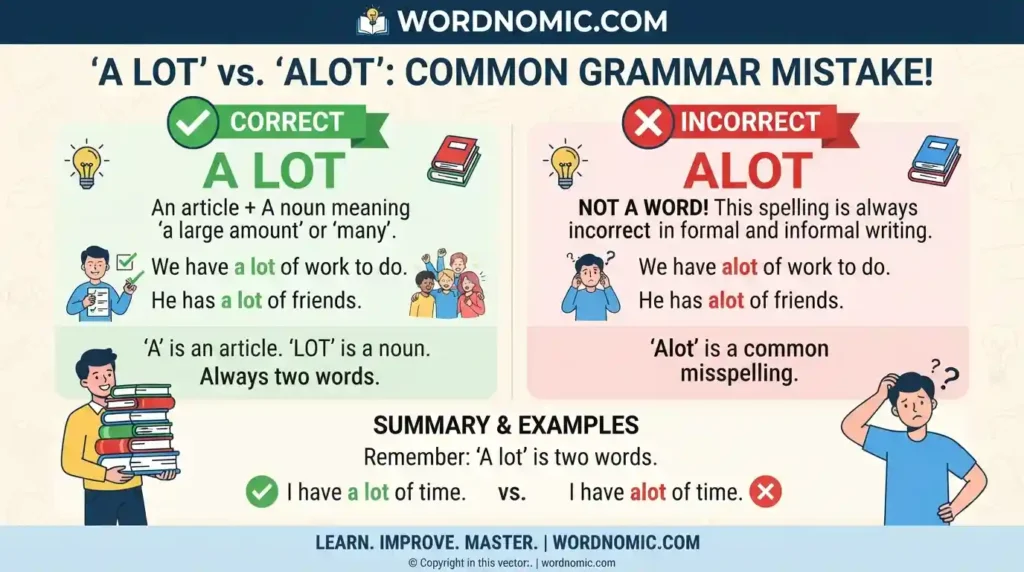
A lot is correct. Alot is incorrect in standard English.
Use a lot when you mean:
- many
- much
- often
- very much
Examples:
- I have a lot of work today.
- She talks a lot.
- We learned a lot from the class.
- There are a lot of people here.
Alot should not be used as the standard spelling.
Do not confuse a lot with allot. Allot is a real word, but it means to give or assign something.
What Does A Lot Mean?
A lot is a common English expression. It can describe a large amount, a large number, or something that happens often.
For example:
I have a lot of books.
Here, a lot of means many.
You can also say:
I like this song a lot.
Here, a lot means very much.
The meaning changes slightly based on how you use it in the sentence.
A Lot vs Alot
The main difference is simple:
A lot is the correct two-word form.
Alot is not the standard form.
| Term | Meaning | Usage | Example |
| a lot | Many, much, or very much | Correct | I have a lot of homework. |
| alot | No standard meaning | Incorrect spelling | Do not write “alot.” |
| allot | To give or assign | Correct verb | We will allot two hours to the task. |
The space in a lot matters. Do not remove it.
How to Use A Lot
There are several common ways to use a lot.
A Lot of + Noun
Use a lot of before a noun when you mean many or much.
Examples:
- I have a lot of friends.
- She drinks a lot of water.
- We need a lot of time.
- There are a lot of cars outside.
You can use it with both countable and uncountable nouns.
A Lot After a Verb
You can also put a lot after a verb.
Examples:
- I study a lot.
- He works a lot.
- They travel a lot.
- She smiles a lot.
Here, a lot often means frequently or very much.
A Lot With Feelings
You can use a lot to show strong feelings.
Examples:
- I miss you a lot.
- She loves her family a lot.
- We enjoyed the trip a lot.
- He likes football a lot.
Main Difference Between A Lot and Alot
The main difference is spelling and correctness.
A lot has two words:
a + lot
Alot has one word:
alot
The one-word form is a common spelling mistake. Standard English uses a lot.
For example:
❌ I have alot of homework.
✅ I have a lot of homework.
This rule is easy to remember: Always leave a space in “a lot.”
A Lot vs Allot
Many people also confuse a lot with allot.
These words do not have the same meaning.
A Lot
A lot means many, much, or very much.
She has a lot of books.
Allot
Allot is a verb. It means to give or assign something for a particular purpose.
The teacher allotted 20 minutes for the test.
Here, the teacher assigned 20 minutes to the test.
| Word | Meaning | Example |
| a lot | Many, much, very much | We have a lot of work. |
| allot | Give or assign | They allotted money for the project. |
| alot | Incorrect spelling | Avoid this form. |
Origin and History of A Lot
The expression a lot comes from the ordinary word lot.
A lot has been used in English for a group, share, or portion of something. Over time, the phrase a lot of became a common way to talk about a large amount or number.
Today, a lot is very common in everyday English.
The one-word spelling alot developed as a common spelling error, likely because the expression is often spoken quickly. However, modern standard English still writes it as two words.
British English vs American English
There is no important British English or American English difference in the spelling of a lot.
Both British and American English use:
a lot
Examples:
- I have a lot of work.
- She talks a lot.
- We learned a lot today.
Alot is not the standard spelling in either variety of English.
The word allot also has the same basic meaning in both British and American English.
Which One Should You Use?
Use a lot in almost all normal situations when you mean many, much, often, or very much.
Everyday Writing
Use:
I eat vegetables a lot.
School Writing
Use:
The experiment taught us a lot about the process.
Business Writing
Use:
This project requires a lot of planning.
Academic Writing
You can use a lot, but more formal alternatives may sometimes sound better.
For example:
The study collected a large amount of data.
Online Writing
You can use a lot freely.
Avoid alot, even in casual writing, if you want to use standard English.
Common Mistakes With A Lot
1. Writing Alot
Incorrect: I have alot of homework.
Correct: I have a lot of homework.
Why?
The expression is written as two words.
2. Writing Alot of
Incorrect: She has alot of friends.
Correct: She has a lot of friends.
Why?
Always keep the space between a and lot.
3. Confusing A Lot With Allot
Incorrect: The manager will a lot the money.
Correct: The manager will allot the money.
Why?
Allot means to give or assign something.
4. Using Allot When You Mean A Lot
Incorrect: I like this movie allot.
Correct: I like this movie a lot.
Why?
The phrase a lot can mean very much. Allot is a verb with a different meaning.
5. Joining A Lot in Formal Writing
Incorrect: We learned alot from the course.
Correct: We learned a lot from the course.
Why?
Joining the words creates a nonstandard spelling.
6. Adding “Of” After A Lot in the Wrong Place
Incorrect: I a lot enjoy this book.
Better: I enjoy this book a lot.
Why?
When a lot means very much, it normally comes after the verb or object.
10 Everyday Examples
- I have a lot of homework tonight.
- She reads a lot.
- We saw a lot of birds in the park.
- He talks a lot during class.
- There is a lot of food on the table.
- I learned a lot from my teacher.
- They have a lot of work to finish.
- My brother plays games a lot.
- She likes this song a lot.
- We spent a lot of time together.
Real-Life Usage
In Conversations
People use a lot very often in everyday speech.
“Do you travel a lot?”
“Yes, I travel a lot for work.”
In Emails
You can use a lot in friendly and normal work emails.
“Thank you a lot for your help.”
For a more formal tone, thank you very much may sound more natural.
At School
Students commonly use a lot when talking about quantity.
“I have a lot of homework today.”
At Work
You can use it in normal workplace writing.
“This task needs a lot of attention.”
On Social Media
A lot is common in casual posts and comments.
“I miss summer a lot!”
In Formal Writing
A lot is grammatically correct, but formal writing may sometimes use more specific words such as many, much, numerous, or a large amount.
Related Search Questions
Is Alot a Word?
Alot is not the standard spelling of the common English expression a lot. In normal writing, use a lot as two words.
There is a separate word, allot, which means to give or assign something. Do not use alot when you mean either of these standard forms.
Is A Lot One Word or Two?
A lot is two words.
The correct spelling is:
a lot
Not:
alot
The space should remain between a and lot.
Is A Lot Correct Grammar?
Yes. A lot is correct English.
You can use it to talk about a large amount, a large number, frequency, or strong feelings.
Examples include a lot of money, a lot of people, and I like it a lot.
Can I Use A Lot in Formal Writing?
Yes, but context matters. A lot is grammatically correct, but some formal writing may benefit from more exact words such as many, much, numerous, or a large amount.
For example, “many students” may sound more formal than “a lot of students.”
What Is the Difference Between A Lot and Allot?
A lot means many, much, often, or very much.
Allot is a verb that means to give or assign something.
Example:
We have a lot of work.
The manager will allot two hours to the task.
Is Alot Accepted in English?
Alot is not the standard spelling used in normal English writing. It may appear as a spelling mistake or in very casual online text, but you should use a lot in school, work, academic, and formal writing.
How Do You Remember A Lot?
Think of a lot as two separate words. The phrase contains the article a and the noun lot.
A simple memory trick is:
A lot has a space.
So write:
a lot
not:
alot
Usage and Search Trends
People often search for this topic using questions such as “alot or a lot,” “is alot a word,” “is a lot one word,” and “a lot vs allot.”
These searches show a common spelling and usage problem. The main rule remains simple: use a lot when you mean many, much, often, or very much.
There is no need to use made-up search-volume numbers to explain this rule. The standard spelling is clear.
A Lot vs Alot vs Allot Comparison
| Term | Correct? | Meaning | Example |
| a lot | Yes | Many, much, often, very much | I have a lot of work. |
| alot | No | Common spelling mistake | Do not write “alot.” |
| allot | Yes | To give or assign | They will allot enough time. |
FAQs
1. Should I write a lot or alot?
Write a lot. It is the standard spelling when you mean many, much, often, or very much. Alot is a common spelling mistake. For example, write “I have a lot of work,” not “I have alot of work.”
2. Is “alot” grammatically correct?
No. Alot is not the standard form in modern English. The correct expression is a lot, written as two words. This applies to both British and American English.
3. Why do people write “alot”?
People often write alot because a lot sounds like one unit when spoken. Fast speech can make the space between the words hard to notice. However, spoken sound does not change the standard spelling. In writing, keep a and lot separate.
4. What does “a lot” mean?
A lot can mean many, much, often, or very much. For example, “a lot of books” means many books, while “I like it a lot” means I like it very much.
5. Is “allot” the same as “a lot”?
No. Allot is a verb that means to give or assign something. A lot usually refers to a large amount, number, frequency, or degree. For example, “We have a lot of work” and “We will allot two hours for the work” have different meanings.
6. Can “a lot” be used with countable nouns?
Yes. Use a lot of with countable plural nouns and uncountable nouns. For example, “a lot of books” uses a countable noun, while “a lot of water” uses an uncountable noun.
7. Is “a lot” used in both British and American English?
Yes. A lot is standard in both British and American English. There is no major spelling difference between the two varieties. Alot is not the standard spelling in either one.
Conclusion
When choosing between alot or a lot, use a lot. It is the correct standard form when you mean many, much, often, or very much.
For example, write “I have a lot of work” and “She talks a lot.” In both cases, a lot must stay as two words.
Do not confuse a lot with allot. Although they look and sound similar, they have different meanings. Allot is a verb that means to give or assign something. For example, “The teacher allotted 30 minutes for the test.”
There is no special British or American spelling rule that changes a lot. Both forms of English use the same two-word spelling.
The easiest rule to remember is simple: a lot has a space. If you mean many, much, often, or very much, write a lot. Avoid alot in school, work, academic, and formal writing.