You finish a task and want to say what happened next. Do you write afterward or afterwards? Many people stop and stare at the screen. Both look right. Both sound right.
People search for afterward or afterwards because the two words look almost the same. One has an s. One does not. That small letter causes a lot of doubt in emails, essays, and reports.
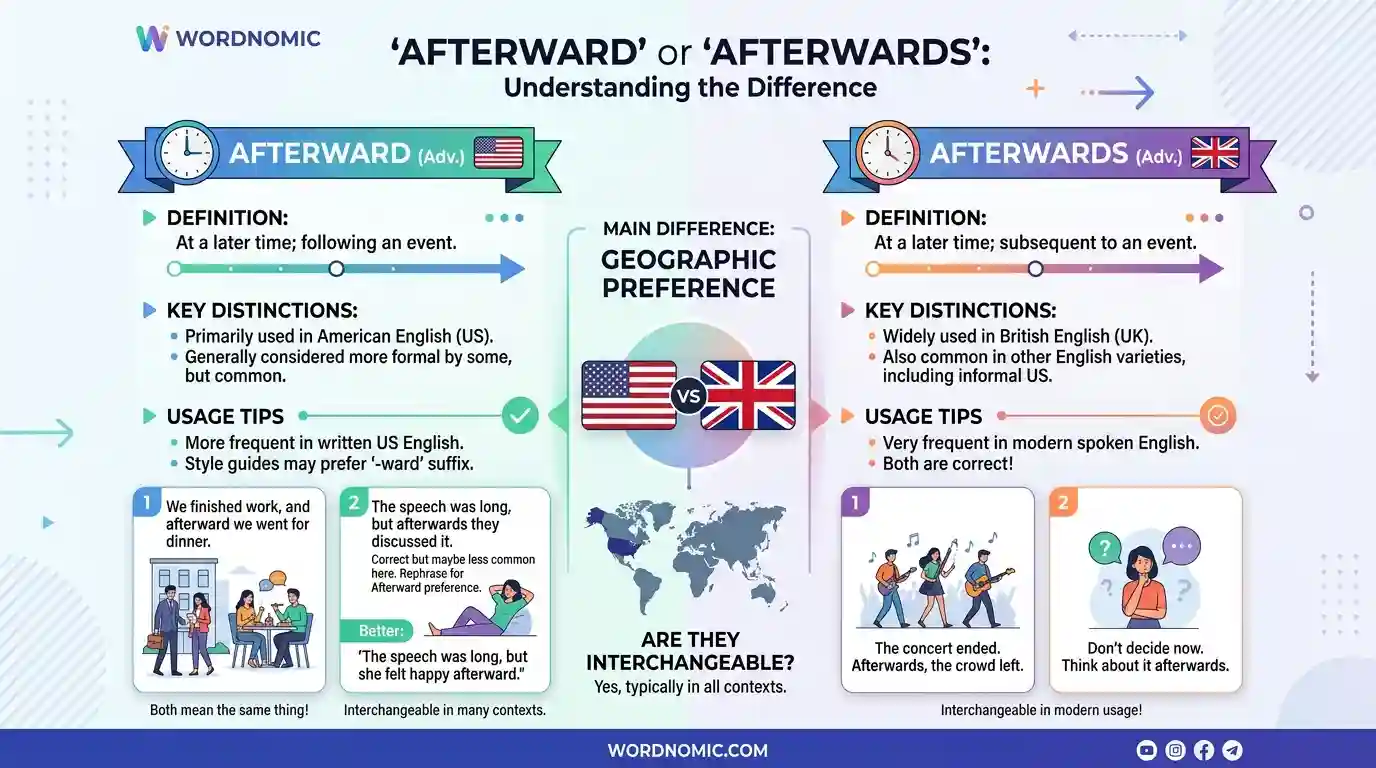
Here is the good news. Both spellings are correct. They mean the same thing, and they work the same way in a sentence. The main difference is where people prefer them. American writers lean toward afterward. British writers lean toward afterwards.
You will learn what each word means, how to use it, and where it came from. You will see clear examples, common mistakes, and simple advice on which one to pick. You will also learn how these words differ from afterword, a look-alike with a different meaning.
Afterward or Afterwards – Quick Answer
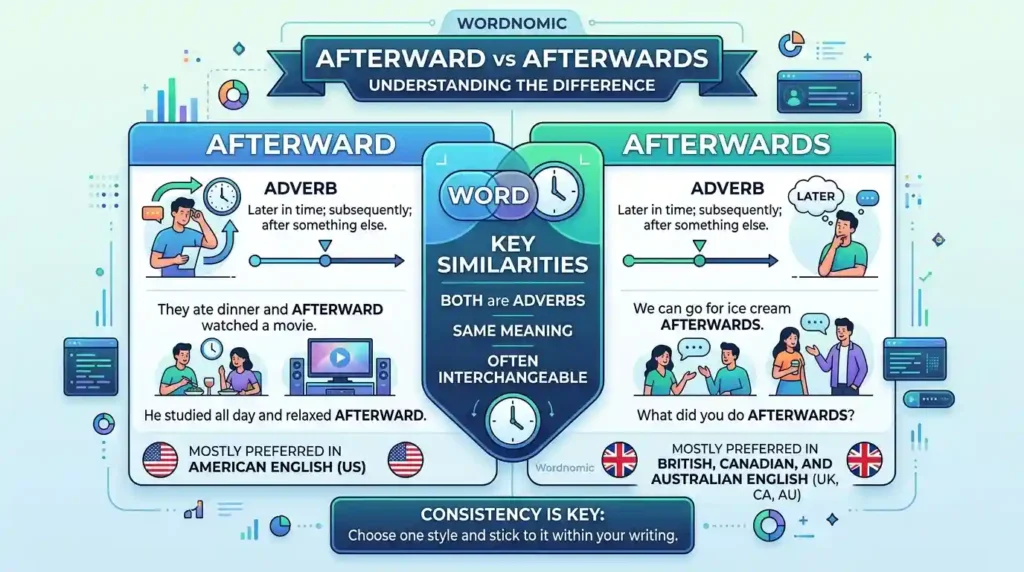
Both are correct. Afterward and afterwards mean “at a later time” or “after that.”
- Use afterward in American English.
- Use afterwards in British English.
- Pick one and use it the same way in the whole piece.
The difference is not about meaning. It is about regional habit. Neither word is a mistake.
What Do Afterward and Afterwards Mean?
Afterward and afterwards are adverbs. An adverb tells us how, when, or where something happens. These two words tell us when.
They mean “later” or “following that event.” They point back to something already named or understood.
- We ate dinner. Afterward, we watched a movie.
- She called me afterwards to say thanks.
The word does not need an object. You cannot follow it with a noun. If you need to name the event, use after instead.
- Wrong: We left afterward the show.
- Right: We left after the show.
- Right: The show ended. We left afterward.
Related phrases you may see include after that, later, then, subsequently, and following that. In everyday writing, afterward is simple and friendly. Subsequently sounds more formal.
Main Difference Between Afterward and Afterwards
There is no difference in meaning. There is no difference in grammar. Both are adverbs, and both go in the same places in a sentence.
The only real difference is preference:
- Afterward is more common in the United States.
- Afterwards is more common in the United Kingdom and in other places that follow British habits.
Many dictionaries list both as full, correct forms. Some note which one is more common in each region.
The words sound almost the same too. The s in afterwards adds a soft “z” sound at the end.
Why Do Both Forms Exist?
Both forms grew from the same old root. English speakers have used after with -ward for a very long time. The -ward ending shows direction or order, as in toward, forward, and backward.
The version with an s came from an old habit. English once added -s to many adverbs. You can still see this in words like always, sometimes, and besides.
Many “-ward” words have a twin with an s:
| Without S | With S |
| toward | towards |
| forward | forwards |
| backward | backwards |
| upward | upwards |
| downward | downwards |
| afterward | afterwards |
Over time, the two habits split by region. Americans mostly kept the shorter forms in these pairs. British writers kept the longer ones more often. The split is a pattern, not a strict rule, and you will see both forms on both sides of the Atlantic.
British English vs American English
Spelling: American English prefers afterward. British English prefers afterwards.
Meaning: No difference. Both mean “later.”
Pronunciation: The stress falls on the first syllable in both. The first vowel often differs a little, as it does in many words. British speakers usually say the first part with an “ah” sound. American speakers usually say it with the “a” of cat. British afterwards ends with a “z” sound.
Usage: Both forms appear in both countries. Americans do write afterwards, and Britons do write afterward. Regional preference is a lean, not a wall.
Common preference: Choose afterward for a US audience. Choose afterwards for a UK audience. Canadian, Australian, and other writers often follow whichever style guide they use.
Which One Should You Use?
Here is simple advice for each situation:
- Everyday writing: Use whichever feels natural. Both are fine.
- Formal writing: Follow your audience or style guide. Stay consistent.
- Academic writing: Check your school or journal rules. If none exist, match the rest of your spelling (color with afterward, colour with afterwards).
- Business writing: Match your company’s English. A US firm usually picks afterward. A UK firm usually picks afterwards.
- British English: Use afterwards.
- American English: Use afterward.
- Online writing: Think about your readers. Use the form your main audience expects.
The best rule is consistency. Do not use afterward in one paragraph and afterwards in the next.
Common Mistakes With Afterward and Afterwards
1. Mistake: Confusing afterward with afterword
- Incorrect: I read the author’s afterward at the end of the book.
- Correct: I read the author’s afterword at the end of the book.
- Why: An afterword is a short note at the end of a book. Afterward means “later.”
2. Mistake: Splitting the word in two
- Incorrect: We talked after ward.
- Correct: We talked afterward.
- Why: It is one word.
3. Mistake: Using it like a preposition
- Incorrect: We went home afterwards the game.
- Correct: We went home after the game.
- Why: Afterwards cannot take an object. Use after before a noun.
4. Mistake: Adding an apostrophe
- Incorrect: I’ll see you afterward’s.
- Correct: I’ll see you afterward.
- Why: Adverbs do not take apostrophes here.
5. Mistake: Mixing styles in one text
- Incorrect: We ate first. Afterward, we walked. Afterwards, we slept.
- Correct: We ate first. Afterward, we walked. Afterward, we slept.
- Why: Pick one form and keep it.
6. Mistake: Using afterwords for the adverb
- Incorrect: Let’s talk afterwords.
- Correct: Let’s talk afterward.
- Why: Afterwords is the plural of afterword. It is not the adverb.
Everyday Examples
- We cleaned the kitchen, and afterward we made tea.
- He felt sick afterwards, so he went to bed early.
- Call me right afterward.
- The team celebrated for hours afterwards.
- Nobody spoke about it afterward.
- Take the medicine with food, and rest afterwards.
- She won the race and cried afterward.
- I wasn’t hungry at first, but I ate a lot afterwards.
- The movie was slow. Afterward, we argued about the ending.
- Let’s get coffee soon afterwards, if you have time.
- The storm passed, and the sky cleared shortly afterward.
- We’ll finish the report first and talk about lunch afterwards.
Real-Life Usage
Conversations: People say “Let’s grab food afterward” or “Text me afterwards.” Speech rarely shows the spelling, so most people never think about it.
Emails: Writers use it to set the order of steps. “Please review the file. Afterward, send me your notes.”
School: Students use it in stories and essays to show order. “The class ended. Afterward, we walked home.”
Work: Managers write it in plans and meeting notes. “We will vote today and share results afterwards.”
Social media: Posts often say “So worth it afterwards” or “Crying afterward.” Short, casual, and either spelling is fine.
Formal writing: Reports and articles may use subsequently or later instead. When afterward(s) appears, it should match the style of the document.
Related Search Questions
Is it afterward or afterwards?
Both are correct. Afterward is the usual American form. Afterwards is the usual British form.
What does afterward mean?
It means “at a later time” or “after that.” It points back to an event that came before.
Is afterwards a real word?
Yes. It is a standard English word found in major dictionaries.
Which is correct: afterward or afterwards in British English?
Afterwards is the common British choice. Afterward is also understood and not wrong.
Is afterward or afterwards correct in American English?
Afterward is the common American choice. Afterwards is also accepted.
What is the difference between afterward and afterword?
Afterward means “later.” Afterword is a short closing note in a book.
How do you use afterward in a sentence?
Place it after an event or at the end of a clause: “We talked, and afterward we left.”
Usage and Search Trends
No exact numbers are given here, because any figure would need a current source. What we can say safely is the general pattern.
People often search for afterward or afterwards to check the spelling or the region. Writers in the US tend to prefer afterward. Writers in the UK tend to prefer afterwards. Both forms stay in regular use.
To see current interest, you can look up both words in a tool such as Google Trends, and compare results by country. Dictionaries and large text collections also show how each form is used.
Comparison Table
| Term | Meaning | Usage | Example |
| afterward | Later; after that | Preferred in American English | We ate, and afterward we napped. |
| afterwards | Later; after that | Preferred in British English | We ate, and afterwards we napped. |
| after | Following (a time or event) | Preposition, conjunction, or adverb; takes an object | We napped after lunch. |
| afterword | A closing note in a book | Noun; not about time | The afterword thanks the readers. |
FAQs
1. Is it “afterward” or “afterwards”?
Both are correct. They mean the same thing. Afterward is more common in American English, and afterwards is more common in British English. Choose the one that fits your audience, and use it the same way throughout your writing.
2. Is “afterwards” grammatically correct?
Yes. Afterwards is a proper adverb found in major dictionaries. The s is an old adverb ending, like the one in always or sometimes. It is not a plural and not a mistake. It is simply the preferred form in British English.
3. Do Americans say “afterwards”?
Yes, some do. Americans use both forms, but afterward is more common in the US. You will see afterwards in American books, news, and speech too. It does not sound wrong. It just leans British to many readers.
4. What is a synonym for afterward?
Common synonyms include later, then, after that, next, and subsequently. Later and then work in casual writing. Subsequently fits formal writing best. After that is clear and simple. Pick the one that fits your tone.
5. Can “afterward” start a sentence?
Yes. Many writers do this: “Afterward, we went home.” A comma usually follows it. This is a good way to show time order clearly. You can also place it at the end: “We went home afterward.”
6. What is the difference between “afterward” and “after”?
After can come before a noun: “after lunch.” Afterward cannot. It stands alone and means “after that.” So say “after the meeting” but “The meeting ended. Afterward, we left.” Using the wrong one makes the sentence sound broken.
7. Is “afterward” the same as “afterword”?
No. They sound alike but differ in meaning. Afterward is an adverb that means “later.” Afterword is a noun that means a short note at the end of a book. Check the -ward and -word endings.
Conclusion
Afterward and afterwards are both correct. They mean “later” or “after that.” They work the same way in a sentence, and neither one is a mistake.
The only real difference is habit by region. American English prefers afterward. British English prefers afterwards. Both forms grew from the same old root, and the s is an old adverb ending like the one in always.
Remember three simple rules:
- Match your audience: afterward for the US, afterwards for the UK.
- Stay consistent in the same piece of writing.
- Never use either word before a noun. Use after instead.
Also watch out for afterword. It is a real word, but it names a closing note in a book, not a time.
If you are unsure, pick the form that fits the rest of your spelling and move on. Your readers will understand you either way. The best choice is the one you use with care and keep the same from start to finish.