Have you ever wondered whether to use uncompleted vs incomplete? The two words look very similar, and both can describe something that is not finished. This makes them easy to confuse. However, they can carry slightly different meanings.
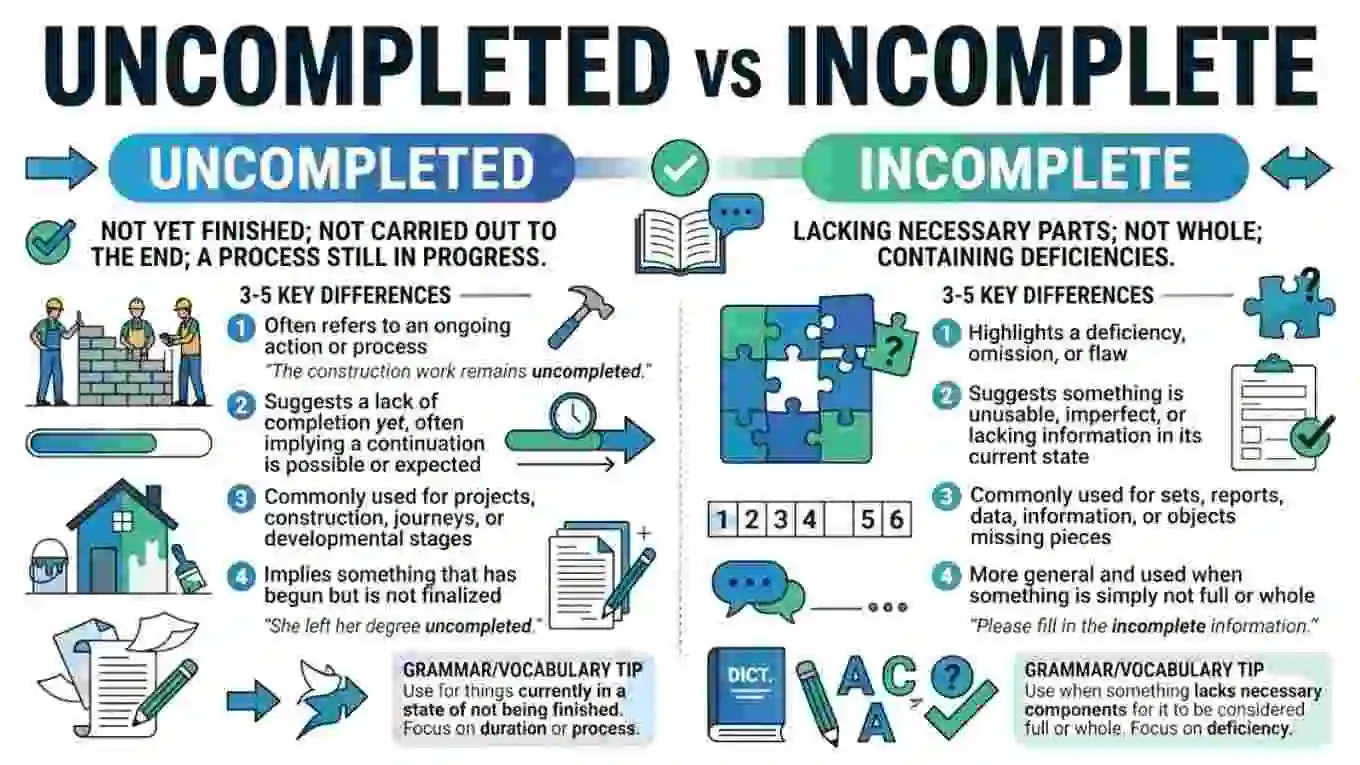
Uncompleted usually means that something has not been completed. It focuses on the action or task itself. For example, “The project is uncompleted” means the project has not been completed.
Incomplete means that something is missing a part or parts. It focuses more on the condition of the thing. For example, “The application is incomplete” means some information or sections are missing.
In many cases, the two words can overlap. However, incomplete is much more common in everyday English and formal writing. It is often the better choice when you want to say that something is missing information, parts, or details.
People search for uncompleted vs incomplete because both words can describe unfinished work. The difference is small, but it matters in some situations.
This guide explains their meanings, origins, British and American usage, common mistakes, everyday examples, and simple rules to help you choose the right word.
Uncompleted vs Incomplete – Quick Answer
The basic difference is:
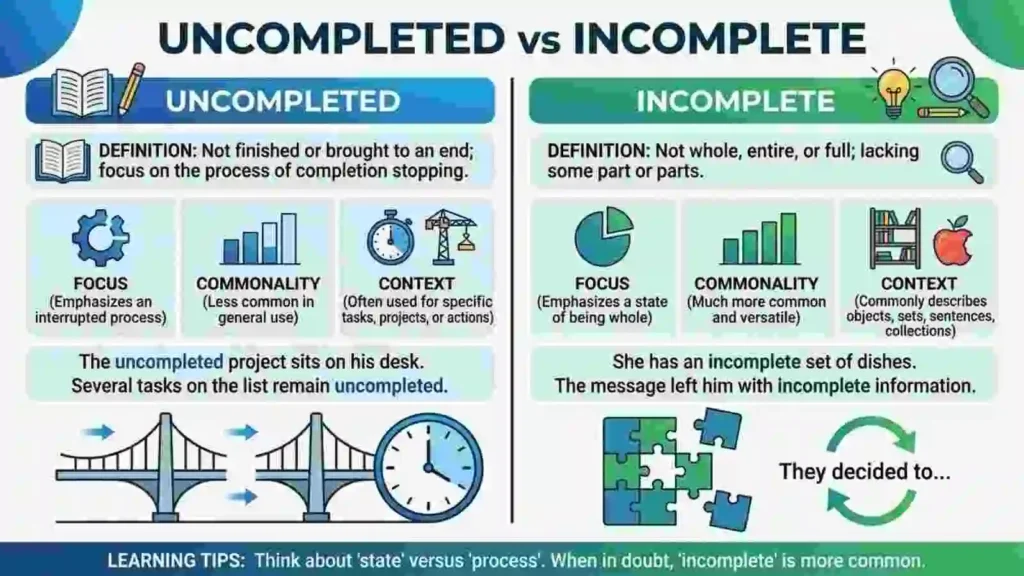
- Uncompleted = not completed or finished.
- Incomplete = not complete because something is missing.
Uncompleted
Uncompleted is formed from complete with the prefix un-.
It means something has not been completed.
The work remains uncompleted.
The task is still uncompleted.
The word focuses on the fact that the action of completing something did not happen.
Incomplete
Incomplete means not whole, finished, or fully supplied.
Your application is incomplete.
The report is incomplete because two pages are missing.
We received an incomplete answer.
Here, the focus is on what is missing.
Easy way to remember
Think:
Uncompleted = not completed
Incomplete = missing something
For example:
The task is uncompleted.
The task has not been finished.
The form is incomplete.
The form is missing information.
The Origin of Uncompleted vs Incomplete
Uncompleted and incomplete have different word structures, although both are based on the idea of something not being complete.
The origin of “complete”
The word complete comes from Latin completus, meaning “filled up” or “finished.”
It entered English through French and developed into the modern word complete.
Today, complete can mean:
- Finished
- Whole
- Having all parts
- Full
- Having nothing missing
For example:
The work is complete.
The set is complete.
The origin of “uncompleted”
Uncompleted uses the prefix un- with completed.
The prefix un- often means “not.”
So:
un + completed = uncompleted
The word literally means not completed.
It focuses on the lack of completion.
The origin of “incomplete”
Incomplete comes from Latin roots meaning “not complete.”
The prefix in- can mean “not.”
So:
in + complete = incomplete
It means something is not complete or whole.
Why are the words so similar?
Both words describe the opposite of complete.
The main difference comes from how English uses the two forms.
Uncompleted focuses on an action that has not been completed.
Incomplete often focuses on a thing that is missing something or lacks all its parts.
The words are not British and American spelling variants. They are separate words with related meanings.
British English vs American English Spelling
There is no spelling difference between uncompleted and incomplete in British and American English.
Both varieties use the same spellings:
uncompleted
incomplete
The main difference is not regional spelling. Instead, incomplete is generally more common and natural in many contexts.
Comparison table
| Word | British English | American English | Main meaning |
| uncompleted | uncompleted | uncompleted | Not completed |
| incomplete | incomplete | incomplete | Not whole or missing something |
| completed | completed | completed | Finished |
| complete | complete | complete | Finished or whole |
British English examples
The application is incomplete.
The work remains uncompleted.
American English examples
The application is incomplete.
The work remains uncompleted.
The spelling does not change.
Which word is more common?
Incomplete is much more common in both British and American English.
It is widely used in:
- Forms
- Reports
- Applications
- School work
- Instructions
- Business writing
- Technical writing
Uncompleted is less common and can sound formal or unusual in some sentences.
Which Spelling Should You Use?
There is no British-American spelling choice here. Instead, choose the word that best matches your meaning.
Use “incomplete” in most cases
Incomplete is usually the safest choice when something lacks information, parts, or details.
The application is incomplete.
The report is incomplete.
The answer is incomplete.
The information is incomplete.
These sentences sound natural in everyday and professional English.
Use “uncompleted” for unfinished tasks or work
Uncompleted can describe work or tasks that have not been completed.
Several tasks remain uncompleted.
The project was left uncompleted.
However, many writers would use unfinished or incomplete instead.
For example:
The project remains unfinished.
This often sounds more natural than:
The project remains uncompleted.
Use “unfinished” when talking about work
In everyday English, unfinished is often the most natural word for work that has not been finished.
I have some unfinished work.
The house is unfinished.
The story is unfinished.
For US audiences
Use incomplete for forms, records, answers, reports, and information that lacks something.
For UK audiences
The same basic rule applies.
For global English
Incomplete is usually the safest and clearest choice.
If you mean that work has not been finished, unfinished may sound more natural than uncompleted.
Common Mistakes with Uncompleted vs Incomplete
Mistake 1: Thinking they always mean exactly the same thing
The words overlap, but they are not always interchangeable.
Compare:
The application is incomplete.
This suggests that information or sections are missing.
The task is uncompleted.
This suggests that the task has not been completed.
Mistake 2: Using “uncompleted” in every situation
Incorrect or less natural:
Please send an uncompleted form.
Better:
Please send an incomplete form.
An incomplete form has missing information.
Mistake 3: Using “incomplete” when focusing on the action
Consider:
The work remained uncompleted.
This focuses on the fact that nobody completed the work.
You could also say:
The work remained unfinished.
That is often more natural in everyday English.
Mistake 4: Confusing “incomplete” with “incorrect”
These words do not mean the same thing.
Incomplete means something is missing.
Incorrect means something is wrong.
For example:
The answer is incomplete.
Some information is missing.
The answer is incorrect.
The answer is wrong.
Mistake 5: Assuming “uncompleted” is incorrect
Uncompleted is a real English word.
It means “not completed.”
However, it is less common than incomplete and unfinished in many situations.
Mistake 6: Using “incomplete” when nothing is missing
If a task simply has not been done, unfinished may be clearer.
I have an unfinished report.
This sounds more natural than:
I have an incomplete report.
The second sentence can suggest that parts or information are missing.
Uncompleted vs Incomplete in Everyday Examples
Both words can appear in everyday and professional writing, but incomplete is far more common.
In emails
Your application is incomplete. Please add your signature.
Several tasks remain uncompleted.
The first sentence points to missing information.
The second focuses on unfinished tasks.
Business writing
We cannot process the order because the form is incomplete.
The project remained uncompleted after the contractor left.
In school
Your answer is incomplete.
This means the answer does not include all the required information.
The assignment is uncompleted.
However, teachers will often say:
Your assignment is unfinished.
In news writing
The building project remains incomplete.
Several planned projects were left uncompleted.
Both can work, but the writer should choose based on the intended meaning.
On social media
My homework is still unfinished!
The form is incomplete. I forgot to add my address.
In formal writing
The project remained uncompleted due to a lack of funding.
Incomplete is especially common in formal documents.
Uncompleted vs Incomplete – Google Trends & Usage Data
Both terms appear in online searches, but they do not have the same level of popularity.
Incomplete is a common English word. It appears in many areas, such as education, business, forms, applications, data, reports, and science.
Uncompleted is much less common. People may search for it when checking whether it is a correct English word or when comparing it with incomplete and unfinished.
Common searches for “incomplete”
People may search for:
- incomplete meaning
- incomplete sentence
- incomplete information
- incomplete application
- incomplete answer
- incomplete data
- incomplete form
These searches often have a practical purpose.
Common searches for “uncompleted”
People may search for:
- uncompleted meaning
- uncompleted vs incomplete
- uncompleted work
- uncompleted project
- uncompleted sentence
These searches often show a spelling or word-choice question.
Search intent comparison
| Search term | Likely intent |
| incomplete meaning | Learn the definition |
| incomplete form | Understand a missing form section |
| incomplete application | Fix missing information |
| incomplete answer | Improve an answer |
| uncompleted meaning | Check word meaning |
| uncompleted vs incomplete | Compare word choice |
| uncompleted work | Describe unfinished work |
Exact Google Trends interest changes by country and time. For SEO work, compare these terms in your target country and date range.
Uncompleted vs Incomplete: Side-by-Side Comparison
| Feature | Uncompleted | Incomplete |
| Basic meaning | Not completed | Not complete |
| Main focus | Action not finished | Missing part or information |
| Commonness | Less common | Very common |
| Formal use | Possible | Very common |
| Forms | Less natural | Natural |
| Applications | Less common | Very common |
| Reports | Possible | Very common |
| Tasks | Possible | Possible |
| British spelling | uncompleted | incomplete |
| American spelling | uncompleted | incomplete |
Uncompleted vs Incomplete vs Unfinished
These three words are related, but they are not always equal.
Uncompleted
Means something has not been completed.
The project remains uncompleted.
Incomplete
Means something is missing a part or is not whole.
The project is incomplete because two sections are missing.
Unfinished
The project is unfinished.
Quick comparison
| Word | Main idea | Example |
| uncompleted | Not completed | The task is uncompleted. |
| incomplete | Missing something | The report is incomplete. |
| unfinished | Not finished | The report is unfinished. |
In everyday English, unfinished often sounds more natural than uncompleted when talking about work.
FAQs About Uncompleted vs Incomplete
1. What is the difference between uncompleted and incomplete?
Uncompleted means something has not been completed.
Incomplete means something is missing a part, detail, or piece.
2. Is uncompleted a correct English word?
Yes. Uncompleted is a valid English word. However, it is less common than incomplete and unfinished.
3. Is incomplete better than uncompleted?
In many cases, yes.
Incomplete is more common and natural, especially for forms, applications, reports, answers, and information.
4. Should I say “incomplete work” or “uncompleted work”?
Both can be used, but unfinished work is often the most natural phrase.
I have some unfinished work.
If you mean that parts of the work are missing, incomplete work can be useful.
5. Is “uncompleted” the same as “unfinished”?
They are very close.
Both can describe something that has not been finished. However, unfinished is much more common in everyday English.
6. Is incomplete the opposite of complete?
Yes.
complete = whole or finished
incomplete = not whole or missing something
No major regional difference exists.
Both British and American English use uncompleted and incomplete with the same spellings and basic meanings.
Conclusion
The difference between uncompleted vs incomplete is small, but understanding it can improve your writing. Uncompleted means that something has not been completed. It often focuses on an action, task, or project that did not reach completion.
Incomplete means that something is not whole or is missing information, parts, or details. It is much more common in everyday and formal English. You will often see it with words such as application, form, report, answer, information, and data.
For example, an incomplete application may be missing a signature or other details. An uncompleted task is a task that has not been finished. In many cases, however, unfinished is more natural than uncompleted, especially in casual English.
There is no British or American spelling difference between these words. Both varieties use uncompleted and incomplete.
The easiest rule is this: use incomplete when something is missing, and use uncompleted when you want to stress that something was not completed. When talking about ordinary unfinished work, unfinished is often the clearest choice.