You’re writing a warning sign, and you stop right before this word. Is it “unauthorised” with an s, or “unauthorized” with a z? Both look right, and you’ve probably seen both used before.
Let’s sort this out.
Quick Answer
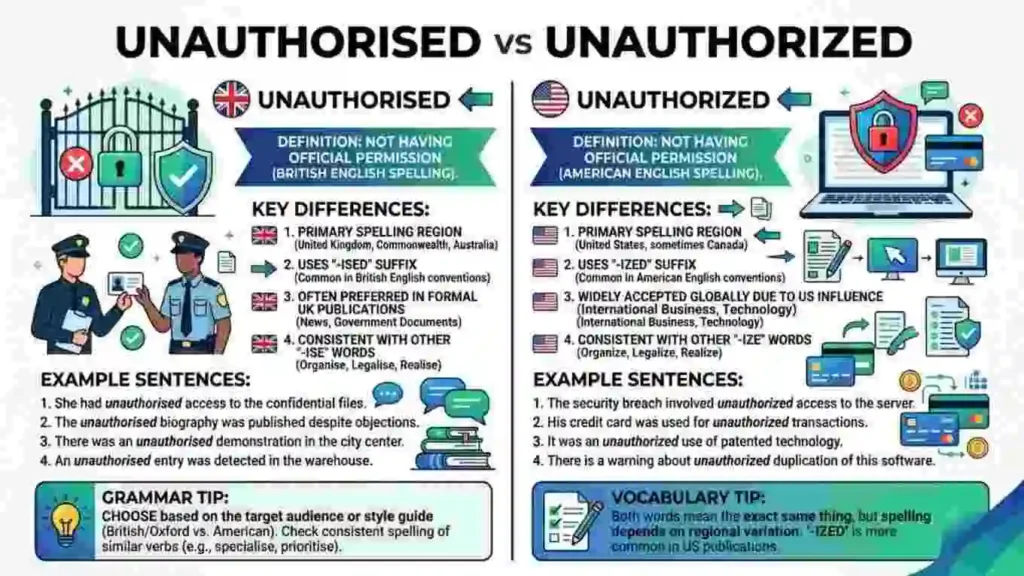
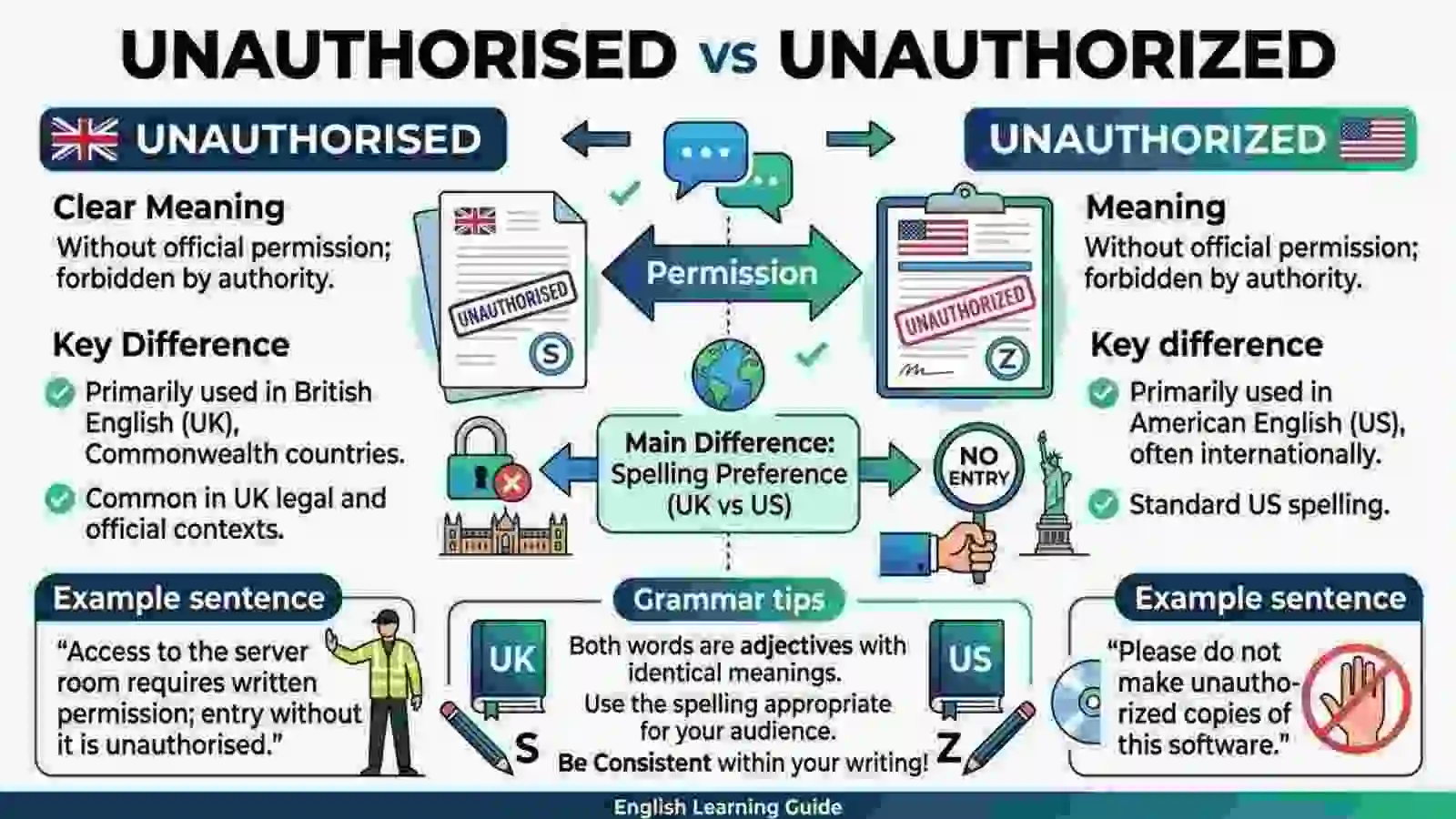
Unauthorized is the American way to spell it, with a z. Example: “Unauthorized access is not allowed.”
Unauthorised is the British way, with an s. Example: “Unauthorised entry is not allowed.”
Simple rule: American readers, use the z. British readers, use the s.
Where This Split Comes From
This word is just “authorize” or “authorise” with “un” stuck on the front to flip the meaning. So really, this comes from an older split, “authorize” versus “authorise,” and this word just followed along.
Both spellings go back to old French and Latin words tied to giving someone the right to do something. For a long time, English used the s form almost everywhere, since that’s how French spelled it, and English took a lot of words from French.
American English changed later, in the 1800s. A man named Noah Webster made an American dictionary and pushed for simpler, more even spelling. He picked z for words like this. British English mostly kept the older s form and never made that change.
Since “unauthorized” and “unauthorised” are just the flipped form of those older words, they picked up the same split without any extra work.
British vs American Spelling
This same pattern shows up across a whole group of words like this one.
| British English | American English | |
| Spelling | Unauthorised | Unauthorized |
| Base word | Authorise | Authorize |
| Used most in | UK, Australia, Canada, India | United States |
| Same pattern | Organise, Realise, Recognise | Organize, Realize, Recognize |
Which One Should You Pick?
Depends who’s reading it.
Writing for Americans? Go with “unauthorized,” z and all. That’s what most US writing and news sites use.
Writing for UK, Australian, or similar readers? “Unauthorised” is what looks right to them.
Writing for a mixed group of readers from many places? Either one works fine. Just pick one and stick with it the whole way through, don’t switch halfway.
Working somewhere that already has a set spelling rule? Follow that first, since the choice is already made for you there.
If you’re stuck and don’t know your reader, “unauthorized” with a z tends to be known a bit more around the world these days, mostly since so much US tech and media is everywhere. But “unauthorised” is just as correct, no doubt about that.
Where People Slip Up
Mixing both spellings in one page is the biggest sign of messy writing, more than picking just one alone. If you start with “unauthorised,” stay with it start to finish.
Some people also think one form is more “right” than the other. Neither is. This is just a style choice, not a grammar rule, and treating it like a strict rule just leads to too much second-guessing over something small.
And don’t forget, other words like this follow the same pattern. If you’re using British spelling here, “organised” and “recognised” should match that same style through your writing, not switch back to American spelling somewhere else on the page.
Real Examples
A UK workplace notice: “Unauthorised use of company gear is not allowed.”
The same notice in the US: “Unauthorized use of company gear is not allowed.”
British news: “Police looked into unauthorised access to the building.”
American news: “Police looked into unauthorized access to the building.”
A warning sign in the US: “Unauthorized people not allowed past this point.”
What the Search Data Shows
The split is pretty clean by place here. American writing sticks almost fully to “unauthorized.” UK, Australia, and Canada mostly stay with “unauthorised” in news, schools, and government writing.
Big tech sites lean American more often than not, mostly since so many big tech firms started in the US, and that spelling habit spreads out from there.
People who search both spellings at once are most times just double-checking, most of all in legal or work writing, where a small slip can look messy on something official.
More Word Pairs Like This
| British | American |
| Unauthorised | Unauthorized |
| Authorised | Authorized |
| Organised | Organized |
| Realised | Realized |
| Recognised | Recognized |
Common Questions
Is “unauthorised” wrong? Not at all. It’s just the standard British spelling, used the right way across the UK and much of the world outside the US.
Which one for a legal paper? Match your reader’s country. US papers lean toward “unauthorized.” UK papers lean toward “unauthorised.”
Do they mean different things? No, they mean the exact same thing. Just two spelling styles from two forms of English.
Why does American English use z here? It comes from Noah Webster’s push for simple American spelling back in the 1800s. He picked z, and it stuck.
Does this pattern show up in other words too? Yes, all over. “Organize/organise,” “realize/realise,” same story, same split.
Which spelling wins around the world overall? Pretty close, but “unauthorized” is a bit more common these days, mostly thanks to US tech and media reach.
Does it matter in texts or casual chats? Not really. Casual writing is easy on this one. Just try to pick one and stay with it if you can.
Why This Word Shows Up So Often in Serious Writing
Think about where you really see this word. Warning signs. Safety rules. Legal papers. Work emails about who can open what files. It’s not a word people use at the dinner table. It shows up mostly in writing where getting it right actually matters.
That’s part of why the spelling question feels bigger than it should. Nobody checks their spelling twice on a quick text, but a safety rule at a hospital, a bank, or a government building? That’s the kind of paper where a small slip looks careless, even though the meaning stays clear either way.
So if you work in safety, IT, HR, or legal writing, this word will come up again and again. It’s worth picking the right one for your reader once, so you’re not guessing every time you write a rule.
A Simple Trick to Remember Which Is Which
Here’s an easy way to lock this in for good. Think of “z” as the American letter, sharp and simple, kind of like how Americans tend to shorten a lot of their spelling. Think of “s” as the older, British choice, staying close to where the word started.
If that doesn’t stick, try this instead. American English dropped a bunch of extra or old letters over time, color instead of colour, center instead of centre, and z instead of s fits right into that same pattern. British English just kept things closer to the old way.
Once you link this word to that bigger pattern, you’ll stop seeing it as some odd rule on its own and start seeing it as just one more part of a rule you already half know.
What Happens If You Mix It Up Anyway
Not much, in truth. No one is going to get confused. The word means the same thing no matter which way you spell it, and most readers won’t even notice which one you picked.
The only real risk shows up in formal or official writing, where a small slip might make a paper look less clean than it should. A government notice that mixes both spellings, or a legal paper that switches back and forth, can quietly make the whole thing feel less careful, even though the meaning never truly changes.
So for casual writing, don’t stress over this one. For anything official, it’s worth the extra few seconds to pick one form and stay with it start to finish.
Wrapping Up
“Unauthorised” and “unauthorized” mean the exact same thing. The only real gap is which form of English you’re writing in, British keeps the older s, American switched to z a long time ago.
Use “unauthorised” for UK, Australian, or similar readers. Use “unauthorized” for American ones. Writing for everyone at once? Either spelling works, just don’t switch back and forth mid-page.
This one really comes down to history, not right or wrong. Once you know your reader, the choice pretty much makes itself.