You just knocked over a cup of coffee. You want to text a friend about it. Your fingers stop over the keyboard. Do you type “I spilt my coffee”? Or is it “I spilled my coffee”? Both look fine. Both sound fine too. So does it really matter which one you use?
This small question comes up a lot. It’s not really about right or wrong. It’s about a pattern found in a group of English words, one that can show where you learned to speak English. Some people learn “spilt.” Some people learn “spilled.” Neither one is wrong.
There’s also a small extra part to this word. It can be used in two ways: to tell what happened before now, and as a word that describes something already on the floor. Knowing both ways helps your writing feel more natural.
Here’s the fast answer first. Then you’ll see where both words come from, how each place uses them, and easy tips to help you pick with no stress.
Spilt vs Spilled – Quick Answer
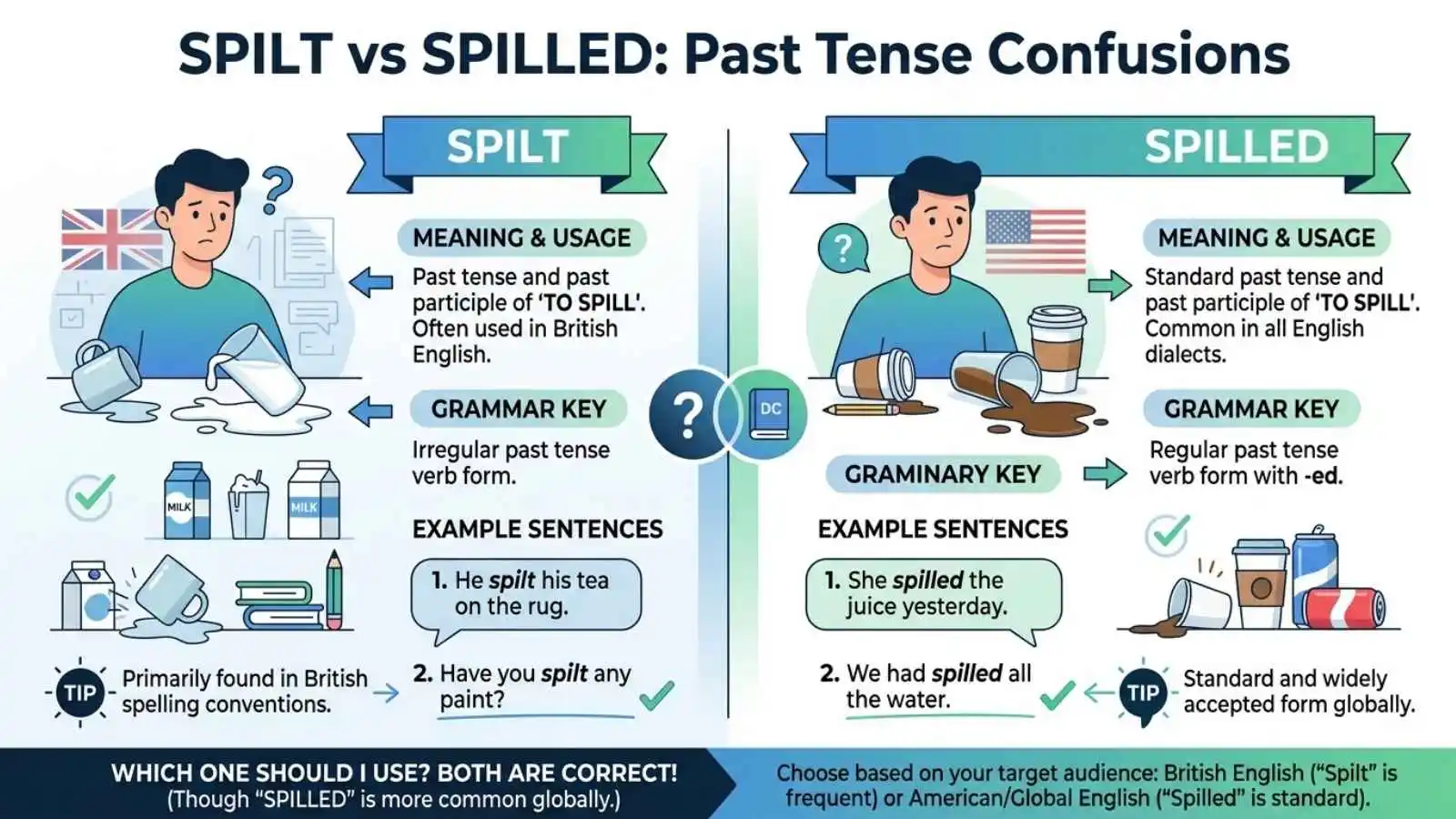
Both words are correct. They are just two different past forms of the word “spill.”
- Spilt → used more in British English and nearby countries
- Spilled → used more in American English
A few quick examples:
- “I spilt my coffee this morning.” (UK style)
- “I spilled my coffee this morning.” (US style)
- “There’s spilt milk all over the counter.” (UK style, also used as a describing word)
- “There’s spilled milk all over the counter.” (US style)
So no matter which one you pick, the meaning stays the same: something poured out by mistake.
Where Do These Words Come From?
The word “spill” is old. It comes from early English words about pouring out liquid. For a long time, many English verbs had two possible past forms: a short “-t” ending, or a longer “-ed” ending. Words like “burnt/burned,” “learnt/learned,” and “dreamt/dreamed” all follow this same pattern. “Spilt/spilled” fits right into this same group.
Over time, something interesting happened. British English kept many of the short “-t” endings. This is why words like “spilt,” “burnt,” and “learnt” stayed common there. American English slowly moved toward the “-ed” ending instead, so more words could follow one simple, easy rule.
This is not a hard, locked rule, though. Both forms are used in both places. British English still uses “spilled” sometimes. American English speakers will still see “spilt” once in a while, mostly in the phrase “no use crying over spilt milk.” This old saying has stuck around almost everywhere, no matter which spelling habit a place normally uses.
Is This a British vs. American Spelling Difference?
Sort of, but it’s a little different from something like “colour/color.” This is not a strict rule where one place always uses one form only. It’s more like a strong habit, one that leans one way in the UK and another way in the US, without ever fully locking either place into just one choice.
| Feature | British English | American English |
| More common past form | Spilt | Spilled |
| Less common, but still used | Spilled | Spilt |
| Used as a describing word | Spilt (like “spilt water”) | Spilled (like “spilled water”) |
| Old saying | “No use crying over spilt milk” | Same saying, often kept as “spilt milk” |
Notice how the old saying about crying over spilt milk tends to keep its British-style spelling almost everywhere, even in American writing. That’s a fun small fact worth knowing.
Which Word Should You Use?
Think about who is reading first.
Writing for UK, Australian, or other nearby readers? “Spilt” will feel more normal to them. Writing for American readers? “Spilled” is the safer, more expected choice. Not sure who is reading, or writing for people from many places? Either word works fine, since both are understood with no confusion.
If you already use other British-style words in your writing, like “burnt” or “learnt,” staying with “spilt” will keep your writing feeling the same all the way through. The same is true the other way for American spelling habits.
Common Mistakes with Spilt and Spilled
Mistakes
1: Thinking one form is wrong Some people think only “spilled” is correct, since it follows the normal “-ed” pattern most verbs use. This is not true. “Spilt” is just as correct, especially in British English.
2: Mixing both forms in one piece of writing Switching back and forth can look messy, even though both forms work fine on their own.
- Less clean: “I spilt my coffee, then spilled some water too.”
- Better: Pick one form and use it the whole way through.
3: Forgetting that “spilt milk” often stays the same Even in American writing, the well-known saying “no use crying over spilt milk” often keeps its older form, since it is such a well-known old phrase.
4: Spending too much time picking one Since both words are correct and both are understood everywhere, you do not need to think about this too hard. Pick one, stay with it, and move on.
Spilt and Spilled in Everyday Writing
A text to a friend might say: “Ugh, I spilled coffee all over my shirt right before the meeting.” (US style)
A news story might say: “Workers rushed to clean up the spilt chemicals before anyone got hurt.” (UK style)
A social media post might joke: “Spilled my whole drink trying to take this photo, worth it though. ” (US style)
Formal writing might say: “The report noted that fuel had spilt onto the road during transport.” (UK style)
Each version sounds normal in its own place, while meaning the exact same thing no matter which one shows up.
Spilt vs Spilled – Search Trends and Usage
Search patterns match up closely with how each place talks. American users search and use “spilled” much more, since it matches the normal verb pattern taught in most US schools. British, Australian, and other nearby users search “spilt” more, sticking with the shorter, older word many grew up hearing.
It’s interesting that the phrase “spilt milk” stays strong in search numbers even among American users. This is because the old saying has settled deep into everyday English almost everywhere. Outside of that one phrase, American writing leans heavily toward “spilled” in news, work, and daily writing.
Comparison Table: Word Variations
| Variation | UK Choice | US Choice |
| Past tense word | Spilt | Spilled |
| Past participle | Spilt | Spilled |
| Describing word | Spilt (like spilt water) | Spilled (like spilled water) |
| Common saying | “Spilt milk” | Often kept as “spilt milk” too |
FAQs:
Is “spilt” a real word, or just a typo of “spilled”? It is a real, correct word, not a typo. It is simply the more common form in British English.
Is “spilled” wrong in the UK? No. It is still used and understood there, just less often than “spilt.”
Why do some words have two past forms like this? English kept both a short “-t” ending and a normal “-ed” ending for a group of older verbs. Over time, British English kept more of the “-t” forms, while American English moved toward “-ed” almost everywhere.
Are there other words like this? Yes. “Burnt/burned,” “learnt/learned,” “dreamt/dreamed,” and “leapt/leaped” all follow this exact same pattern.
Why does “spilt milk” stay the same even in American writing? Old sayings often stay frozen in their first form. “No use crying over spilt milk” has stuck around with its older spelling almost everywhere, no matter local habits.
Which form should I use in a school paper? Match whatever your school or teacher expects. American schools usually expect “spilled,” while UK and nearby schools often accept “spilt” just as easily.
Does the meaning change between the two words? No. Both words mean the exact same thing: something poured out by mistake. Only the spelling and the place using it are different.
Conclusion:
“Spilt” and “spilled” are not a case of one right and one wrong. They are two correct past forms of “spill,” with British English leaning toward “spilt” and American English leaning toward “spilled.” Both are used and understood everywhere, and neither one will confuse a reader.
Writing for UK or nearby readers? “Spilt” fits well. Writing for American readers? “Spilled” is the safer pick. And if you are ever using the old phrase about crying over spilt milk, feel free to keep that classic spelling no matter where you are writing from.
Once you notice this pattern, you will start seeing it in other word pairs too, like “burnt/burned” and “learnt/learned.” Pick a style that matches your reader, stay with it, and you will never have to stop and guess again.

Emily Carter is an English grammar writer based in Portland, Oregon, with 7+ years of experience turning tricky grammar rules into simple, easy lessons.