You’re writing a review, a work update, or maybe just a text. You want to say something happens a lot, or without stopping. You reach for “continuously.” Or maybe “consistently.” Honestly, either one feels like it could work.
That’s the problem. These two words look similar, sound kind of similar, and both talk about something happening over time. But they don’t mean the same thing at all. Mixing them up can actually change the meaning of your sentence, sometimes in a pretty big way.
Let’s break this down so you never have to guess again.
The Short Answer
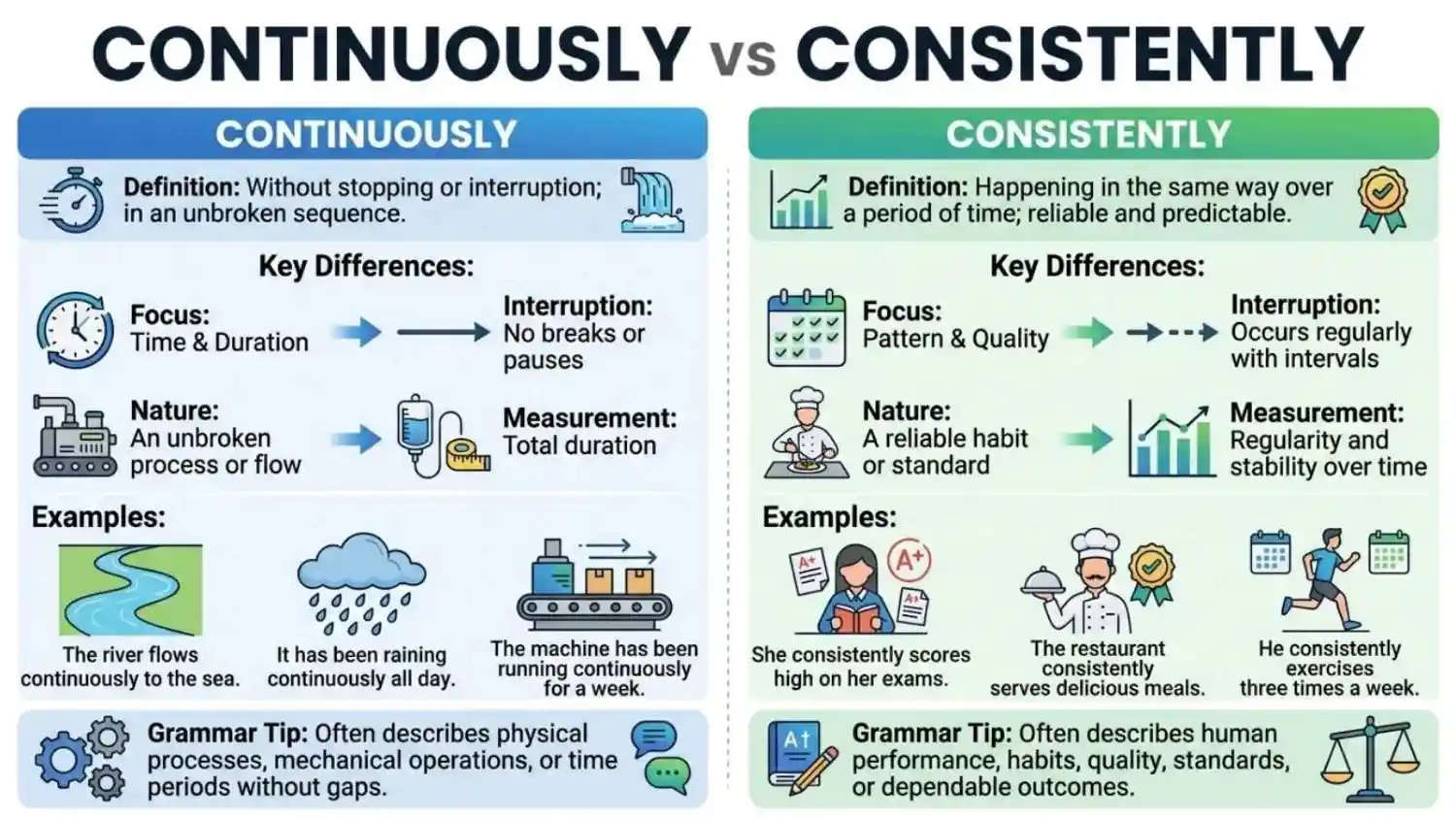
Continuously means something happens without any breaks. No pauses. No stopping. It just keeps going, nonstop.
Consistently means something happens the same way, over and over, but with gaps in between. It’s about being steady and reliable, not about never stopping.
Quick example:
- “The rain fell continuously for three hours.” (It never stopped, not even for a second.)
- “She goes to the gym consistently.” (She goes often and regularly, but obviously not every second of the day.)
See the difference? One is about nonstop action. The other is about steady, repeated habits.
Breaking It Down Further
Think of continuously as describing one long, unbroken stretch of time. If a machine runs continuously, it means the machine never shuts off, not for a second, not for a minute. It’s one single, ongoing action.
Think of consistently as describing a pattern that repeats the same way, again and again, but with normal breaks in between. If someone shows up to work consistently, that doesn’t mean they’re at work every hour of every day. It means every time they’re supposed to show up, they do, in a steady, predictable way.
A good way to picture it: continuously is a straight, unbroken line. Consistently is a row of matching dots, spaced evenly apart.
Where These Words Come From
Both words trace back to Latin, but they took slightly different paths to get their current meanings.
“Continuously” comes from “continuus,” meaning “uninterrupted” or “connected without a break.” This root is also where we get words like “continue” and “continuous,” all pointing toward the idea of something going on without stopping.
“Consistently” comes from “consistere,” meaning “to stand firm” or “to stay in one place.” Over time, this grew into the idea of staying the same, or being steady, rather than being unbroken. It’s less about time never stopping and more about behavior staying reliable.
So even from the very root of these words, you can see the split. One is about time with no gaps. The other is about steady behavior, even with normal gaps in between.
It’s kind of interesting how much a word’s meaning can trace back thousands of years to how people first used it. Nobody sat down and designed English on purpose. These meanings developed slowly, through everyday use, and somehow they still hold up today, even in a work email about server uptime.
A Side-by-Side Comparison
| Continuously | Consistently | |
| Meaning | Without any break | Repeated in a steady, reliable way |
| Time gaps | None | Normal gaps are expected |
| Best used for | Ongoing actions, like a sound or process | Habits, routines, and patterns |
| Example | “The alarm rang continuously.” | “He arrives consistently at 9 a.m.” |
Which One Should You Use?
Ask yourself one simple question: does this thing ever stop, even for a moment?
If the answer is no, it truly never pauses, use continuously. Think machines running, rain falling, or noise that doesn’t let up.
If the answer is that it happens often, in a steady pattern, but obviously has breaks, use consistently. Think habits, performance, grades, or behavior over time.
A quick trick: try swapping in the phrase “without stopping.” If that phrase fits, you want continuously. If “without stopping” sounds odd or wrong, you probably want consistently instead.
For example: “She studies without stopping” sounds a little extreme, almost impossible. But “She studies consistently” makes total sense. That tells you consistently is the right pick there.
What About “Continuous” and “Consistent”?
These are just the adjective forms of the same two words, and they follow the exact same rule.
Continuous describes something ongoing, without a break. “The continuous hum of the fridge kept me up at night.”
Consistent describes something steady and reliable, even with normal gaps. “Her consistent effort finally paid off.”
If you understand continuously and consistently, you already understand continuous and consistent too. The core meaning doesn’t change, just the part of speech.
Common Mistakes People Make
Using “continuously” to describe a habit. Wrong: “He continuously shows up late to meetings.” Better: “He consistently shows up late to meetings.” (Unless he’s late to one meeting that never ends, this should be “consistently.”)
Using “consistently” to describe something that truly never stops. Wrong: “The machine has been running consistently for six hours straight.” Better: “The machine has been running continuously for six hours straight.” (If it never turned off, that’s continuous, not just consistent.)
Assuming they’re interchangeable in formal writing. These two words carry different weight in reports, reviews, and instructions. Swapping them can confuse a reader, especially in technical or business writing where precision matters.
Overusing “continuously” for emphasis. Some people use “continuously” just to sound more dramatic, even when they mean “often” or “regularly.” This can make writing sound exaggerated or even inaccurate.
Using “consistently” when nothing is actually being repeated. “Consistently” only makes sense when there’s a pattern happening more than once. Saying something happened “consistently” one time doesn’t make sense, since consistency needs repeat instances to even apply.
Real-Life Examples
In a work email: “Our servers have been running continuously since the update, without a single outage.”
In a performance review: “She consistently meets her deadlines and delivers high-quality work.”
A weather report: “Snow is expected to fall continuously through the evening.”
In a fitness app notification: “You’ve logged workouts consistently for three weeks. Keep it up!”
Notice how none of these examples could swap the word without changing the meaning. A server running “consistently” would imply it turns off sometimes, which isn’t what the sentence is trying to say. A person logging workouts “continuously” would sound like they’re working out nonstop, 24/7, which obviously isn’t the point either.
Why This Matters More Than You’d Think
In casual conversation, mixing these words up might not cause much confusion. People usually get what you mean from context. But in written communication, especially professional writing, the difference actually matters.
Imagine a doctor’s note that says a patient’s pain is “continuous” versus “consistent.” Continuous pain suggests it never stops at all, which is a serious, urgent detail. Consistent pain suggests it comes back regularly but with breaks in between, which points to a different kind of concern. Getting this wrong in a medical, legal, or business setting isn’t just a small grammar slip. It can genuinely change how a reader understands the situation.
The same goes for business reports. If a manager says sales grew “continuously” all year, that suggests nonstop growth with zero dips, which is a bold claim. If they say sales grew “consistently,” that suggests steady, reliable growth month after month, which sounds more realistic and, honestly, more trustworthy to someone reading the report.
Frequently Asked Questions
Can something be both continuous and consistent? Yes, actually. Something can run without stopping (continuous) and also be steady and reliable in quality (consistent) at the same time. For example, a factory machine could run continuously and consistently produce the same quality product.
Is one word more formal than the other? Not really. Both are common in formal writing. The key is picking the one that actually matches what you’re trying to say.
Which word fits better for describing effort or habits, like studying or exercising? Almost always “consistently.” Very few habits happen with zero breaks, so “consistently” fits daily routines much better than “continuously.”
Which word fits better for machines, sounds, or processes? “Continuously” usually fits better here, especially when something runs nonstop without pausing.
Is “consistently” the opposite of “randomly”? In a way, yes. Consistently suggests a steady, predictable pattern, while random suggests no clear pattern at all.
Do other languages have this same kind of word confusion? Yes, many languages have similar word pairs that describe time and repetition differently. This kind of mix-up isn’t unique to English.
What’s a fast way to remember the difference? Continuously = no breaks at all. Consistently = steady, but breaks are normal. If you can picture a straight line versus a row of dots, you’ll usually pick the right word.
The Bottom Line:
Continuously and consistently aren’t interchangeable, even though they look and sound alike. Continuously means something happens without any pause at all. Consistently means something happens in a steady, repeated pattern, with normal breaks along the way.
Next time you’re not sure which one fits, just ask if the thing you’re describing ever truly stops. If it doesn’t, go with it continuously. If it happens often but with breaks, consistently is your word. That one question will save you from the mix-up almost every time.

Welcome to the official author page of Clara Wordsmith, grammar writer at Wordnomic. Clara specializes in explaining confusing English words, grammar rules, spelling differences, and vocabulary topics with clear examples and beginner-friendly explanations.