You write a school paper. You want to give credit to a source. Do you write “sited” or “cited”? This tiny mix-up trips up so many students and writers.
People search “sited vs cited” because these two words sound almost the same when spoken fast. But they do not mean the same thing at all. One is about location. The other is about giving credit to a source.
This mix-up shows up in school essays, work reports, and even news articles. Get it wrong, and your writing can look sloppy or confusing.
In this article, you will learn which word is correct for each meaning, where each word comes from, and how to never mix them up again. You will also see real examples, common mistakes, a fun quiz, and answers to top questions.
Table of Contents
- Sited vs Cited – Quick Answer
- The Origin of These Words
- Meaning of Each Word
- British vs American Spelling
- Which One Should You Use?
- Why People Mix Them Up
- Common Mistakes
- Everyday Examples
- Search Trends
- Comparison Table
- Easy Memory Tricks
- Common Phrases
- Mini Quiz
- Fill in the Blanks
- FAQs
Sited vs Cited – Quick Answer
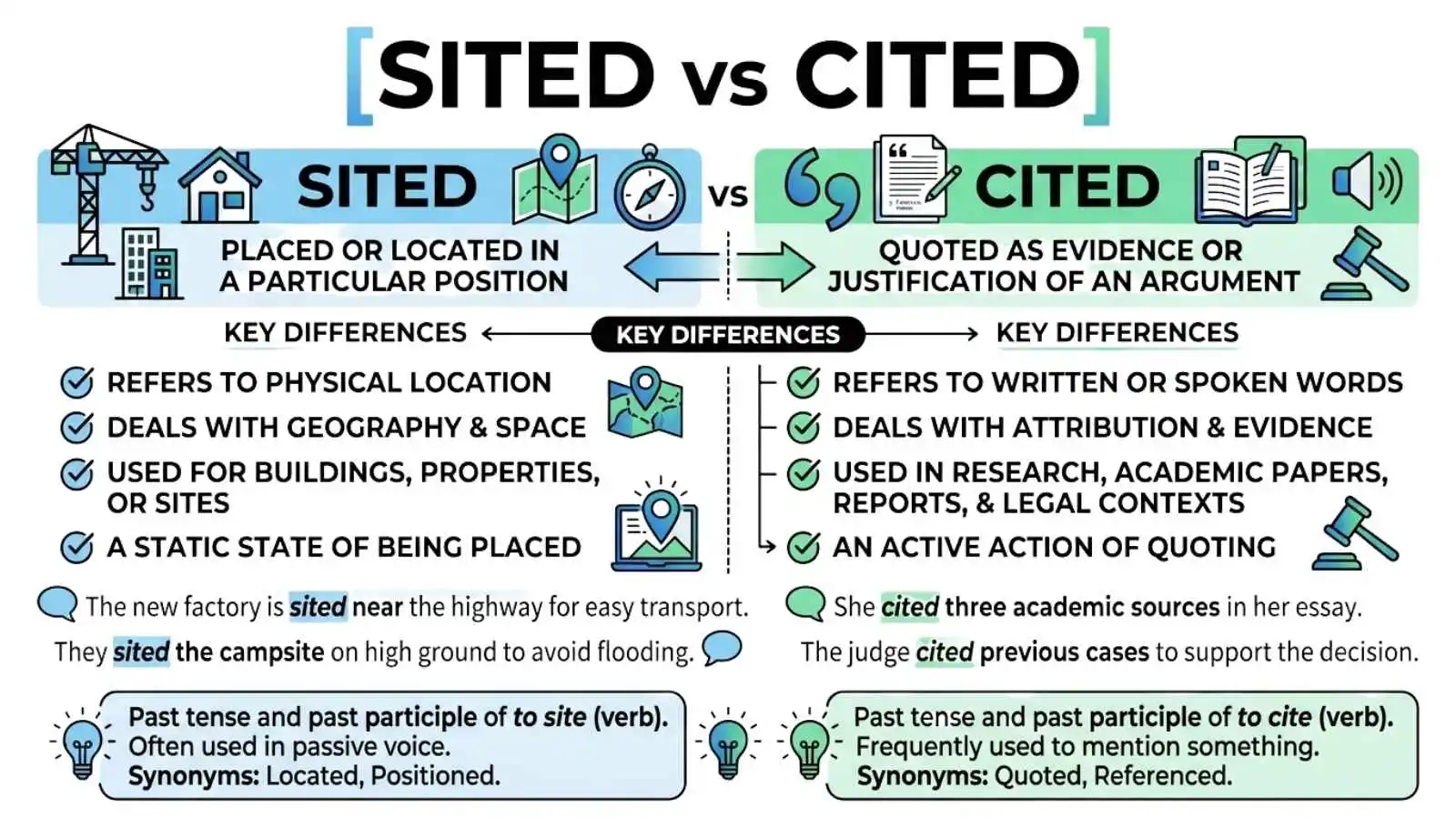
Both words are correct. But they mean different things.
- Cited = gave credit to a source, like a book or study. Example: “She cited three studies in her paper.”
- Sited = placed something in a location. Example: “The new school was sited near the park.”
Quick examples:
- “He cited the report in his speech.” ✅
- “He sited the report in his speech.” ❌
- “The factory was sited by the river.” ✅
- “The factory was cited by the river.” ❌
- “Please cite your sources.” ✅
| Word | Meaning | Word Type |
| Cited | Gave credit to a source | Verb (past tense of “cite”) |
| Sited | Placed in a spot or location | Verb (past tense of “site”) |
The Origin of These Words
Cite comes from the Latin word citare, meaning “to call” or “to summon.” Over time, it grew to mean “to call upon a source” or “to quote something as proof.”
Site comes from the Latin word situs, meaning “a place” or “position.” This is why “site” always relates to a location, like a “construction site” or a “website.”
Since both words end in similar sounds when spoken, people often swap them by mistake, even though they come from very different Latin roots.
Meaning of the Correct Word: Cited
Meaning: To quote or mention a source as proof or support. Part of speech: Verb (past tense of “cite”) Pronunciation: SY-tid Simple definition: Gave credit to a book, study, or person for information used. Synonyms: quoted, referenced, mentioned Opposite: ignored, omitted
Examples:
- “The teacher cited a famous scientist in her lesson.”
- “He cited the law to defend his case.”
British English vs American English Spelling
Good news here. Both “cited” and “sited” are spelled the same in British and American English. There is no UK vs US spelling split for these words, unlike “colour” and “color.”
| Word | British English | American English |
| Cited | cited | cited |
| Sited | sited | sited |
The difference between these two words is about meaning, not region.
Which Spelling Should You Use?
Since spelling does not change by region, your real question is: which word fits your meaning?
- American, British, Canadian, and Australian readers: Use “cited” for giving credit to a source. Use “sited” only when talking about a location.
- Students and teachers: Use “cited” in essays and research papers when quoting sources.
- Business writing: Use “sited” when describing where a building or office is placed.
- Academic writing: “Cited” is very common here, since research papers always credit other sources.
- Social media and casual writing: Both words are rare in casual chat, but if you use them, keep the same rule in mind.
- Global audience: Stick to the meaning-based rule, since spelling stays the same everywhere.
Why Do People Write the Wrong Spelling?
Pronunciation confusion: Both words sound close when spoken quickly.
Typing mistakes: Fingers slip, and “s” replaces “c” or the other way around.
Auto-correct: Some phone keyboards do not catch this mistake, since both are real words.
Similar words: English has many words that look alike but mean different things, like “site,” “sight,” and “cite.” This makes mix-ups common.
Common Mistakes with Sited/Cited
- ❌ “She sited the article in her essay.”
- ✅ “She cited the article in her essay.” (You give credit to an article, so use “cited.”)
- ❌ “The new mall was cited downtown.”
- ✅ “The new mall was sited downtown.” (A mall has a location, so use “sited.”)
- ❌ “He cited his tent near the lake.”
- ✅ “He sited his tent near the lake.” (Placing a tent is about location.)
- ❌ “The report sited five sources.”
- ✅ “The report cited five sources.” (Sources are quoted, not placed.)
- ❌ “The company sited a study in its ad.”
- ✅ “The company cited a study in its ad.”
- ❌ “The house was cited on a hill.”
- ✅ “The house was sited on a hill.”
- ❌ “Please site your references.”
- ✅ “Please cite your references.”
- ❌ “They cited the new offices near the airport.”
- ✅ “They sited the new offices near the airport.”
- ❌ “The judge sited an old law.”
- ✅ “The judge cited an old law.”
Sited and Cited in Everyday Examples
School: “The student cited two books for her project.”
College: “Always cite your sources in your thesis.”
Emails: “Please find the cited sources attached to this email.”
News: “The mayor cited new data on crime rates.”
Books: “The author cited several experts in chapter three.”
Social media: “Great article, but where are the cited sources?”
Text messages: “Did you cite that quote in your report?”
Formal writing: “The committee cited the original study as evidence.”
More examples:
- “She cited a famous quote in her speech.”
- “The camp was sited near a river.”
- “He cited the wrong page number by mistake.”
- “The store was sited close to the mall.”
- “The scientist cited her own past research.”
- “The lawyer cited a similar court case.”
- “The professor cited outdated information.”
Google Trends and Usage Data
Search data shows that “cited” is searched far more often than “sited,” since it appears in schoolwork, research, news, and legal writing all the time. “Sited” is searched less, mostly by people working in construction, planning, or real estate.
People in the US, UK, Canada, and Australia all search both words at similar rates for their true meanings.
Related searches often include “how to cite a source” and “site vs cite,” which shows people also mix up the base words “site” and “cite.”
Comparison Table
| Feature | Cited | Sited |
| Correct spelling | Yes | Yes |
| Meaning | Gave credit to a source | Placed in a location |
| Grammar | Past tense of “cite” | Past tense of “site” |
| Dictionary status | Standard word | Standard word |
| Formal writing | Common in essays, research | Common in real estate, planning |
| Informal writing | Rare | Rare |
| Exams | Used in essay writing | Used in geography, business topics |
| Business writing | Used for legal or research proof | Used for building locations |
Easy Tricks to Remember the Correct Spelling
- Cite = Quote. Both start with a hard “c” sound in your mind.
- Site = Spot. Both start with “s,” just like “spot.”
- Think: “I cite a book.” Books have letters, and “cite” has a “c,” like the word “copy.”
- Think: “A site is a spot.” Both start with “s.”
- Remember: You “cite” someone’s words, but you “site” a building.
- If you can replace it with “quote,” use “cited.”
- If you can replace it with “placed” or “located,” use “sited.”
Common Phrases Using “Cited”
- cited as evidence
- cited a source
- cited in the report
- widely cited
- cited by researchers
- cited a study
- cited a law
- often cited
- cited a case
- cited in court
- cited in the article
- cited for reference
- cited multiple times
- cited the author
- properly cited
Mini Quiz
- She ______ three books in her essay. (cited/sited)
- The new mall was ______ downtown. (cited/sited)
- He ______ an old law in court. (cited/sited)
- The camp was ______ near the river. (cited/sited)
- Please ______ your sources. (cite/site)
- The teacher ______ a famous scientist. (cited/sited)
- The office was ______ close to the airport. (cited/sited)
- The report ______ five studies. (cited/sited)
- The house was ______ on a hill. (cited/sited)
Answers: 1. cited, 2. sited, 3. cited, 4. sited, 5. cite, 6. sited, 7. cited, 8. sited, 9. cited, 10. sited
Fill in the Blanks
- The article was ______ in her research paper.
- The new store was ______ near the highway.
- He ______ a famous quote in his speech.
- The factory was ______ outside the city.
- Please ______ your references at the end.
- The judge ______ an old case.
- The bridge was ______ between two towns.
- She ______ the wrong page number.
- The school was ______ near a park.
- The professor ______ outdated data.
Answers: 1. cited, 2. sited, 3. cited, 4. sited, 5. cite, 6. cited, 7. sited, 8. cited, 9. sited, 10. cited
Frequently Asked Questions
1. Is “sited” a real word? Yes. It means something was placed or located in a spot.
2. Is “cited” a real word? Yes. It means something was quoted or used as a source.
3. Can “cited” and “sited” ever mean the same thing? No. They always have different meanings, even though they sound alike.
5. What is the base verb for “cited”? The base verb is “cite,” meaning to quote or reference something.
6. What is the base verb for “sited”? The base verb is “site,” meaning to place something in a location.
7. How can I remember the difference fast? Think “cite = quote” and “site = spot.” Both match their first letter sound.
Conclusion:
“Cited” and “sited” are both correct words, but they mean very different things. “Cited” means you gave credit to a source, like a book or study. “Sited” means something was placed in a location, like a building or a camp.
There is no British vs American spelling issue here. The real challenge is picking the right word for your meaning. Use “cited” when you quote or reference something. Use “sited” when you talk about where something is placed.
With the simple tricks in this article, like “cite = quote” and “site = spot,” you can remember this rule for good. Careful word choice like this makes your writing clear, correct, and easy to trust.