You’re writing an email. You type “inclusivity.” Then you stop. Wait is that even a word? Should it be “inclusiveness” instead? You’ve seen both. You’re not sure which one is right.
Don’t worry. This happens to a lot of people. Both words show up all the time in job ads, school rules, and news stories. They look almost the same. They mean almost the same thing. So people search for help. They want to know: is one wrong? Is one more formal? Is one British and one American?
This article gives you simple answers. No confusing grammar talk. Just clear, easy explanations, real examples, and plain advice on which word to pick.
Quick Answer
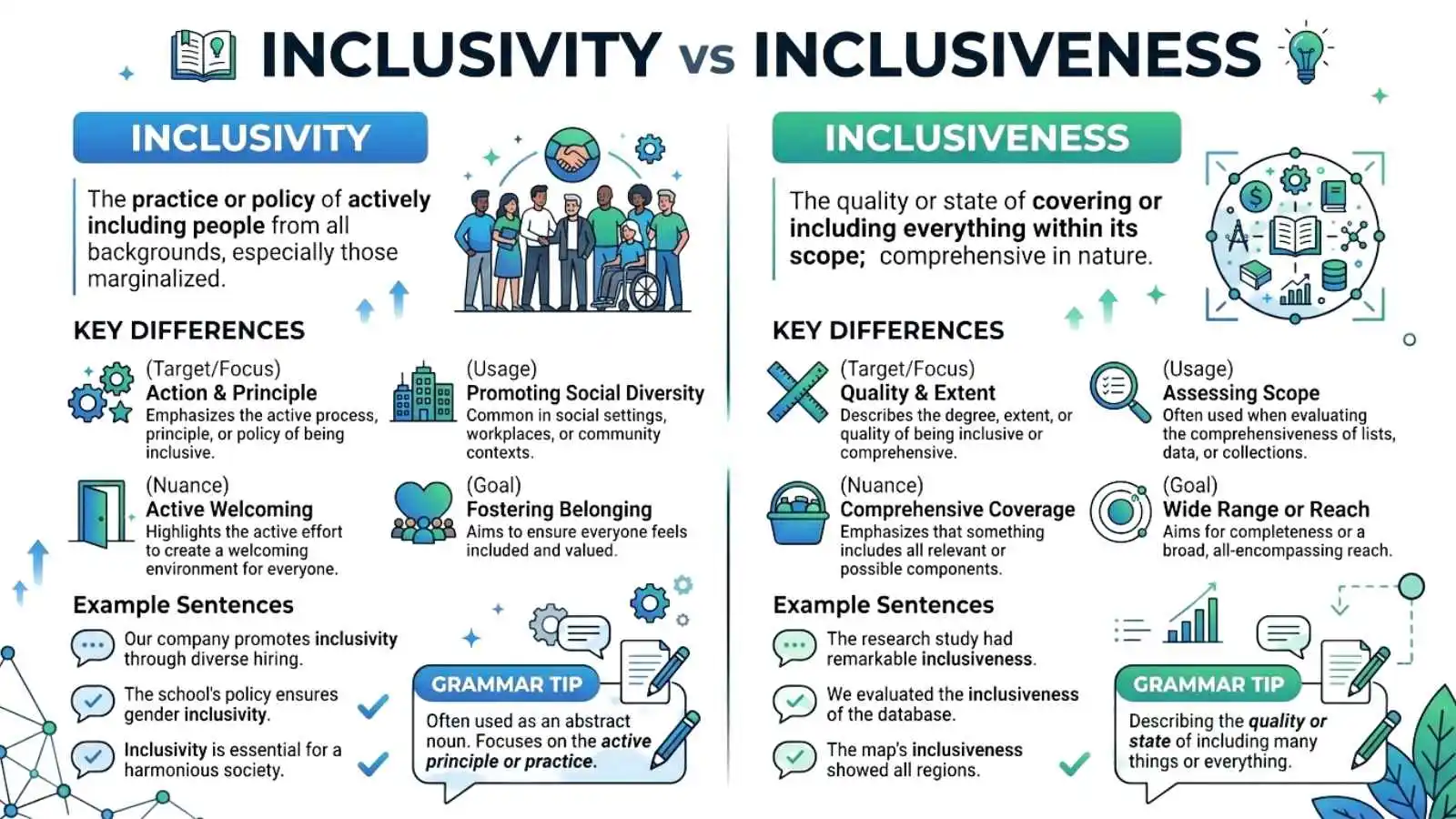
Both words are correct. they come from the word “inclusive.” Both mean the same basic thing: making sure everyone is included, especially people who often get left out.
- Inclusivity = the act of including people. This is the word most people use today.
- Inclusiveness = the quality of being inclusive. This word is a bit older and softer.
Simple examples:
- “The company is working on inclusivity in hiring.”
- “Her inclusiveness made every kid feel welcome.”
You can use either word in almost any sentence. Neither one is a mistake.
Where Do These Words Come From?
Both words started from “inclusive.” That word means “open to everyone.”
English has two common ways to turn a describing word into a naming word:
- Add -ity → makes a word about an action or state (like “active” → “activity”)
- Add -ness → makes a word about a quality (like “kind” → “kindness”)
So:
- Inclusive + ity = Inclusivity (the act of including people)
- Inclusive + ness = Inclusiveness (the trait of being inclusive)
“Inclusiveness” has been around longer. “Inclusivity” is newer. It became popular as more companies and schools started talking about fairness and diversity, especially after the 1990s.
That’s the real reason people mix them up. One word is old and quiet. The other is new and everywhere.
Is It British or American Spelling?
Here’s something important: these are not British vs. American spellings. Unlike “colour” and “color,” both words are spelled the exact same way in every country. Everyone spells them like this: inclusivity, inclusiveness.
What changes by country is not the spelling. It’s how often people use each word.
| What | American English | British English |
| Spelling | inclusivity | inclusivity (same) |
| Spelling | inclusiveness | inclusiveness (same) |
| More popular word | Inclusivity | Inclusivity (a little less popular) |
| Where you see it most | Workplaces, HR | Schools, government |
| Feel of the word | Direct | A bit more formal |
So there’s no real spelling rule to learn here. The choice is about tone, not country.
Which Word Should You Use?
- Writing for American readers or a workplace? Use “inclusivity.” It’s the word most people expect.
- Writing for the UK, or for schools and reports? Either word works. “Inclusiveness” can sound a bit more formal.
- Writing for people all over the world? Use “inclusivity.” It’s more recognized everywhere.
- Writing something personal or reflective? “Inclusiveness” can sound softer and warmer, good for describing a person or a community.
If you’re stuck and not sure, just pick “inclusivity.” It’s the safer, more modern choice.
Common Mistakes People Make
- Thinking one word is a typo of the other. Truth: They are two real, separate words.
- Thinking one is British and one is American. Truth: Both are used everywhere. Only the popularity changes.
- Using “inclusivity” as a describing word, like “an inclusivity policy.” Fix: Use “inclusive” instead “an inclusive policy.”
- Using the same word again and again in one piece of writing. Fix: Mix it up. Try words like “inclusion” or “belonging” too.
- Thinking “inclusiveness” is old and wrong. Truth: It’s still a normal, correct word. It just sounds a bit more formal.
How People Actually Use These Words
In an email: “We care about inclusivity at every step of hiring.”
In a news story: “The school was praised for its inclusiveness toward all students.”
On social media: “So proud my job actually values inclusivity. #DEI”
In a formal report: “The rule’s inclusiveness means every student gets equal access.”
You’ll notice “inclusivity” shows up more in action words doing something. “Inclusiveness” shows up more when describing a feeling or quality something already has.
What the Data Shows
If you check search trends, “inclusivity” wins by a lot. It’s been growing fast since around 2015. That matches the rise of workplace talks about fairness and diversity.
By place:
- United States: People search “inclusivity” much more, especially at work.
- UK and nearby countries: “Inclusivity” still wins, but “inclusiveness” holds steady in schools and government writing.
- Rest of the world: “Inclusivity” is used the most, since it shows up a lot in global business and charity work.
Word Comparison Table
| Word | Type | Where it’s used | How popular |
| Inclusivity | Naming word (state) | Work, HR, social media | Very popular, growing |
| Inclusiveness | Naming word (quality) | Schools, formal writing | Steady, less common |
| Inclusive | Describing word | Rules, spaces, language | Extremely popular |
| Inclusion | Naming word (action) | Programs, rights, community | Extremely popular |
Quick Questions People Ask
1. Is “inclusivity” or “inclusiveness” correct? Both are correct real words.
2. Is one British and one American? No. Both are spelled the same everywhere. There’s no spelling split.
3. Which word do people use more today? “Inclusivity.” It’s more common now, especially at work.
4. Can I swap them in a sentence? Yes, in most cases, they mean close to the same thing.
5. What’s the actual difference? “Inclusivity” is more about doing the act of including people. “Inclusiveness” is more about being a quality someone or something has.
6. Which word is better for a resume or job post? “Inclusivity.” It’s the word most hiring managers expect to see.
Wrapping Up:
Inclusivity and inclusiveness are not a British vs. American spelling thing. They’re just two words built from “inclusive,” using different endings. “Inclusivity” is about the action actually including people. It’s the word most companies and news writers use today. “Inclusiveness” is about the quality describing something as warm and open. It still works well in schools, reports, and softer writing.
For most writing today, especially online, “inclusivity” is the safer bet. But “inclusiveness” isn’t wrong it just fits a different mood. Once you know the small difference, you don’t have to guess anymore. You can just pick the word that fits what you’re trying to say.

Emily Carter is an English grammar writer based in Portland, Oregon, with 7+ years of experience turning tricky grammar rules into simple, easy lessons.