Have you ever written “piqued my interest” and wondered if it should be “peaked my interest”? You are not alone. Piqued or peaked is a common word confusion because both words sound the same when spoken.
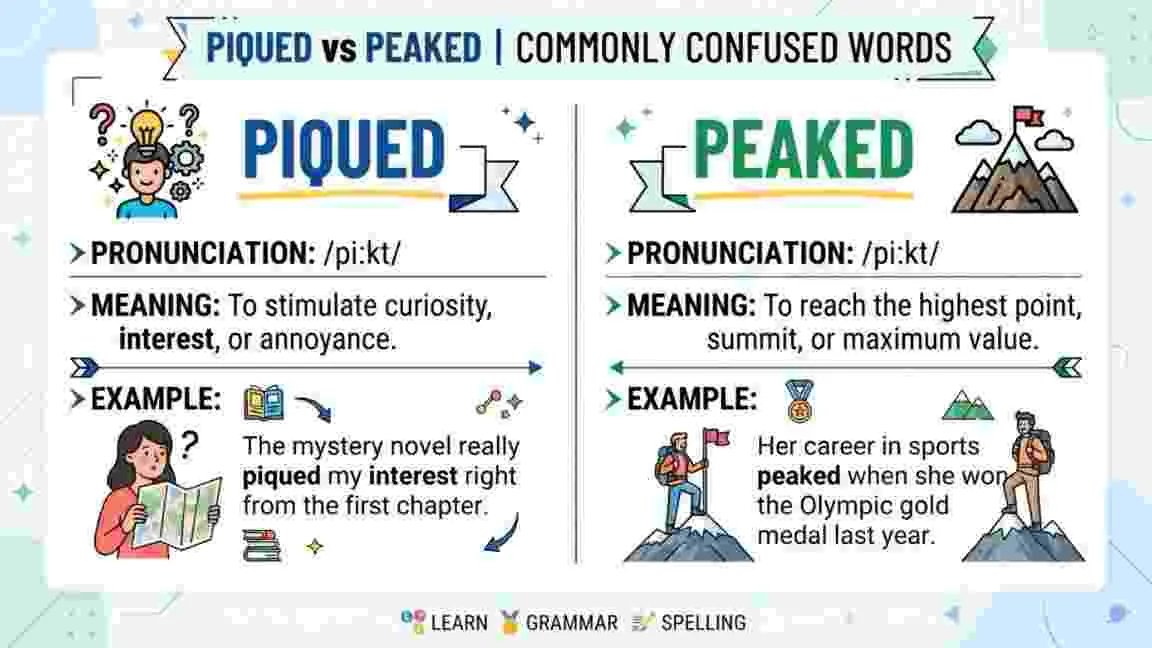
The correct phrase is “piqued my interest.” The word piqued comes from the verb pique, which means to make someone interested or curious. For example, “The book piqued my interest.”
Peaked comes from the word peak. It means to reach the highest point or level. For example, “Sales peaked in July.”
These words have different meanings and uses, even though they sound alike. This guide explains piqued or peaked, their meanings, differences, examples, common mistakes, and how to remember which word to use.
If you want to say that something made you curious or interested, use piqued.
Piqued or Peaked – Quick Answer

Piqued and peaked are both correct words, but they have different meanings.
- Piqued means made someone interested, curious, or sometimes annoyed.
- Peaked means reached the highest point or level.
Examples
Correct: The story piqued my interest.
Meaning: The story made me interested.
Correct: Sales peaked in December.
Meaning: Sales reached their highest level in December.
So, when talking about interest, curiosity, or attention, use piqued.
When talking about a highest point, level, or value, use peaked. Cambridge defines pique as a verb meaning to excite or cause interest, while peak can mean to reach the highest level or value.
What Does Piqued Mean?
Piqued is the past tense and past participle of pique.
When pique means to create interest, it means to make someone interested or curious about something.
Examples
- The movie piqued my interest.
- Her story piqued his curiosity.
- The strange sound piqued their interest.
- The new book piqued my curiosity.
The phrase “piqued my interest” is very common in English. Cambridge describes “pique someone’s curiosity or interest” as making someone interested in something and wanting to know more.
Piqued can also mean annoyed or upset. For example:
She felt piqued by his rude comment.
That meaning is less common in everyday writing than the interest or curiosity meaning. Oxford also lists piqued as meaning annoyed or upset.
What Does Peaked Mean?
Peaked comes from the verb peak.
To peak means to reach the highest point, level, value, or stage.
Examples
- Prices peaked in June.
- Her career peaked in the 1990s.
- The temperature peaked at 40°C.
- The team’s performance peaked during the final game.
Cambridge defines peak as reaching the highest level or value of something.
Peaked can also describe something with a pointed top, such as a peaked roof or peaked cap. Cambridge lists this use as well.
Main Difference Between Piqued and Peaked
The easiest way to understand the difference is to look at what each word talks about.
| Word | Meaning | Common Use | Example |
| Piqued | Made someone interested or curious | Interest and curiosity | The story piqued my interest. |
| Piqued | Made someone annoyed | Feelings | She felt piqued by his comment. |
| Peaked | Reached the highest point | Levels and values | Sales peaked in December. |
| Peaked | Having a pointed top | Shapes and objects | He wore a peaked cap. |
Simple Rule
Interest = piqued
Highest point = peaked
This simple rule can help you choose the right spelling.
Piqued My Interest or Peaked My Interest?
The correct phrase is:
“Piqued my interest.”
Not:
“Peaked my interest.”
For example:
Correct: The new science book piqued my interest.
Incorrect: The new science book peaked my interest.
The reason is simple. The phrase means that something made you interested or curious. That meaning comes from the verb pique, not peak. Cambridge specifically gives examples of pique being used with interest and curiosity.
More Examples
- The teacher’s experiment piqued my interest in chemistry.
- That strange story piqued my curiosity.
- The documentary piqued her interest in history.
- His answer piqued my curiosity.
Piqued My Curiosity or Peaked My Curiosity?
The correct phrase is:
“Piqued my curiosity.”
Use piqued because the phrase means that something made you curious.
Correct
The strange message piqued my curiosity.
Incorrect
The strange message peaked my curiosity.
Think of pique = interest.
Think of peak = highest point.
Origin and History
The word pique came into English from French piquer, meaning “to prick” or “irritate.” Oxford dates the English verb to the middle of the 16th century. Over time, pique developed meanings connected with annoyance and interest.
The word peak has a different history. Oxford dates the verb peak to the 16th century and gives its meaning as reaching the highest point or value.
Although the words have different origins, modern English speakers pronounce pique and peak the same way.
That makes them homophones.
Piqued and Peaked Are Homophones
Piqued and peaked sound the same, but they have different spellings and meanings.
They are examples of words that can cause spelling mistakes because English does not always spell words the way they sound.
Compare:
- pique and peak
- piqued and peaked
- peek and peak
All of these can sound alike in common English pronunciation, but their meanings are different.
Oxford lists peak, peek, and pique as homophones.
British English vs American English
There is no major British vs American spelling difference between piqued and peaked.
Both forms are used in British and American English.
| Word | British English | American English |
| Piqued | Piqued | Piqued |
| Peaked | Peaked | Peaked |
The main difference is not regional spelling. It is meaning and context.
One small difference exists with the adjective peaked. In American English, peaked can describe someone who looks slightly ill or pale. British English commonly uses peaky for this meaning. Oxford and Cambridge both note this difference.
Which One Should You Use?
Use piqued when you mean:
- made someone interested
- made someone curious
- caused interest
- caused curiosity
- made someone feel annoyed
Use peaked when you mean:
- reached the highest point
- reached the highest level
- reached the highest value
- rose to a top level
- had a pointed top
Easy Examples
Interest:
The article piqued my interest.
Curiosity:
The mystery piqued her curiosity.
Highest level:
The price peaked at $100.
Highest point:
His career peaked in 2010.
Common Mistakes
1. Peaked my interest
Incorrect: The book peaked my interest.
Correct: The book piqued my interest.
Why? The book made you interested, so use piqued.
2. Piqued at the highest level
Incorrect: Sales piqued in July.
Correct: Sales peaked in July.
Why? Sales reached their highest level, so use peaked.
3. Peaked my curiosity
Incorrect: The mystery peaked my curiosity.
Correct: The mystery piqued my curiosity.
Why? Something made you curious, so use piqued.
4. Piqued at 100 degrees
Incorrect: The temperature piqued at 40°C.
Correct: The temperature peaked at 40°C.
Why? The temperature reached its highest point.
5. Peaked my interest in science
Incorrect: The experiment peaked my interest in science.
Correct: The experiment piqued my interest in science.
Why? The experiment caused interest.
10 Everyday Examples
- The new book piqued my interest.
- Her question piqued my curiosity.
- The documentary piqued his interest in space.
- The unusual sound piqued their curiosity.
- The article piqued her interest in history.
- Oil prices peaked in July.
- His career peaked during the 1990s.
- The temperature peaked at 42°C.
- Website traffic peaked on Friday.
- The mountain has a peaked top.
Real-Life Usage
In Conversation
You might say:
That story really piqued my interest.
This means the story made you want to know more.
In School
The chemistry experiment piqued my curiosity.
Here, the experiment made the student curious.
At Work
Sales peaked during the holiday season.
Here, peaked means sales reached their highest level.
In an Email
Your proposal piqued my interest.
This is a natural way to say that something made you interested.
In Formal Writing
Demand peaked in the final quarter.
This means demand reached its highest level during that period.
Related Search Questions
Is “piqued my interest” correct?
Yes. “Piqued my interest” is the correct phrase when you mean that something made you interested or curious. Cambridge specifically uses pique for the meaning of causing interest.
Is “peaked my interest” correct?
No, not when you mean “made me interested.” The correct phrase is “piqued my interest.”
Is piqued the same as peaked?
No. They sound the same, but their meanings are different. Piqued can mean made someone interested or annoyed. Peaked usually means reached the highest point or level.
What is the difference between piqued and peaked?
Piqued relates to interest, curiosity, or annoyance. Peaked relates to reaching a highest point or level.
How do you remember piqued vs peaked?
Remember this simple rule:
Piqued = interest
Peaked = highest point
If you can replace the word with “made me interested,” choose piqued.
If you can replace it with “reached the highest point,” choose peaked.
Is piqued my curiosity correct?
Yes. “Piqued my curiosity” is correct. It means that something made you curious and made you want to know more.
Are piqued and peaked pronounced the same?
In their common pronunciations, piqued and peaked are pronounced alike. This is one reason writers often confuse them. Oxford lists peak and pique as homophones.
Usage and Search Trends
There is no need to treat piqued and peaked as spelling variants of the same word. They are separate words with different meanings.
A common search pattern is “piqued my interest or peaked my interest.” This happens because both words sound alike.
The phrase “piqued my interest” is especially important to understand because pique commonly appears with words such as interest and curiosity. Oxford lists these as common objects of the verb pique.
For reliable usage, focus on the meaning rather than the sound:
- Interest or curiosity → piqued
- Highest level or point → peaked
Exact search volume or keyword difficulty is not included here because reliable current SEO data was not provided.
Comparison Table
| Feature | Piqued | Peaked |
| Base word | Pique | Peak |
| Main meaning | Made interested or curious | Reached the highest point |
| Another meaning | Felt annoyed | Having a pointed top |
| Common phrase | Piqued my interest | Sales peaked |
| Common phrase | Piqued my curiosity | Prices peaked |
| Sound | Same | Same |
| British spelling | Piqued | Peaked |
| American spelling | Piqued | Peaked |
FAQs
1. Should I say piqued or peaked my interest?
Say “piqued my interest.” The verb pique means to make someone interested or curious. Peak means to reach a highest point, so “peaked my interest” does not express the intended meaning.
2. Is it piqued my curiosity or peaked my curiosity?
The correct phrase is “piqued my curiosity.” Something piques your curiosity when it makes you curious and makes you want to learn more.
3. What does piqued mean?
Piqued is the past tense of pique. It can mean made someone interested or curious. It can also mean annoyed or upset. The meaning depends on the sentence.
4. What does peaked mean?
Peaked is the past tense of peak. It means reached the highest point, level, or value. For example, “The temperature peaked at 40°C.”
5. Why do people confuse piqued and peaked?
They are commonly pronounced the same, so it is easy to choose the wrong spelling when writing. Their meanings, however, are different.
6. Can peaked describe a person?
Yes. In American English, peaked can describe someone who looks slightly ill or pale. British English often uses peaky for this meaning.
7. Is “piqued my interest” formal?
Yes. “Piqued my interest” is a standard English phrase. You can use it in everyday writing, school work, emails, and formal writing.
Conclusion
Piqued and peaked are both correct words, but they do not mean the same thing.
Use piqued when something makes you interested or curious. For example, “The book piqued my interest.” You can also use piqued when someone feels annoyed or upset.
Use peaked when something reaches its highest point, level, or value. For example, “Sales peaked in December.” It can also describe something with a pointed top, such as a peaked cap.
The easiest way to remember the difference is:
Piqued = interest or curiosity.
Peaked = highest point.
So if you are writing “___ my interest” or “___ my curiosity,” the correct word is piqued.
Do not write “peaked my interest” when you mean that something made you interested. The correct form is “piqued my interest.”