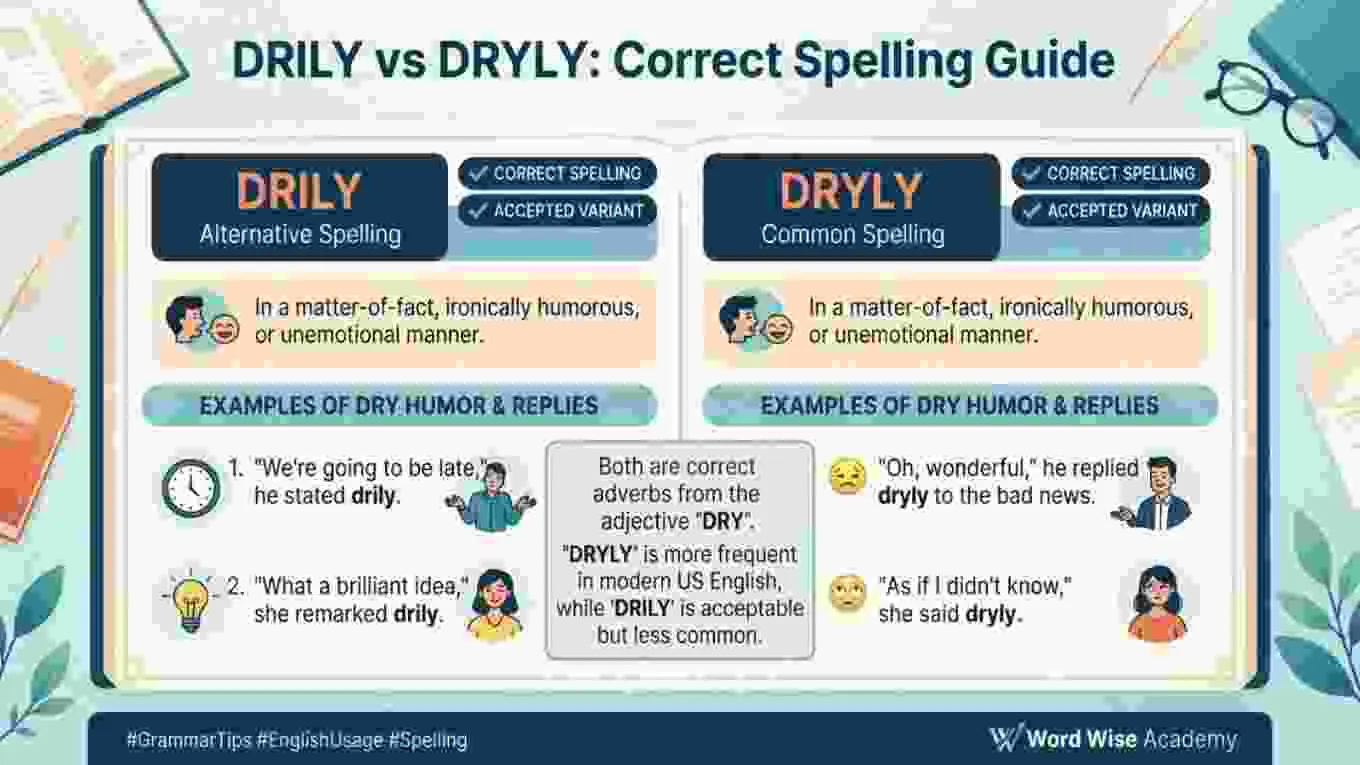
When you want to describe something done in a dry, dull, or matter-of-fact way, you may wonder whether to write drily or dryly. Both spellings are correct, but dryly is the more common and familiar form for many readers.
The confusion comes from the word dry. When we add -ly, the spelling can look unusual. Some writers use drily, while others use dryly. Both forms appear in standard English.
The two words have the same basic meaning. They are adverbs made from dry, and they often describe speech, humor, comments, or actions that lack emotion or show a quiet, ironic tone.
For example, you can write:
“He answered dryly.”
You can also write:
“He answered drily.”
This guide explains the difference between drily and dryly, when to use each form, how British and American English treat them, and how to avoid common spelling mistakes.
Drily or Dryly – Quick Answer

Drily and dryly are both correct spellings.
They usually have the same meaning and work in the same way.
- Dryly is the more common spelling in modern writing.
- Drily is also correct and follows a common spelling pattern in some words ending in -y.
- Both can mean in a dry, unemotional, or matter-of-fact way.
- Both can describe dry humor, speech, comments, or replies.
Example
She replied dryly, “That went well.”
She replied drily, “That went well.”
Both sentences are correct.
If you want the form that is easiest for most readers to recognize, dryly is a simple choice.
What Does Dryly Mean?
Dryly means doing or saying something in a calm, plain, or slightly funny way.
It often describes dry humor. Dry humor sounds serious even when the speaker is making a joke.
For example:
“Great. Another meeting,” she said dryly.
The speaker may not really think the meeting is great. The word dryly shows that the comment has a quiet or ironic tone.
The word can also describe speech that has little emotion.
He dryly explained what had happened.
Here, the person explains the event in a calm and matter-of-fact way.
What Does Drily Mean?
Drily has the same basic meaning as dryly.
It is an adverb formed from the adjective dry.
For example:
“I suppose that was helpful,” he said drily.
The speaker may mean the opposite. The comment can have a dry or ironic tone.
Drily is less familiar to some readers, but it is not a spelling mistake.
Main Differences Between Drily and Dryly
There is no major difference in meaning between the two spellings.
The main difference is spelling and usage preference.
| Term | Meaning | Usage | Example |
| dryly | In a dry, calm, or ironic way | Very common | She smiled dryly. |
| drily | In a dry, calm, or ironic way | Correct but less common | He replied drily. |
Both forms can describe:
- dry humor
- dry comments
- dry replies
- calm speech
- ironic remarks
- matter-of-fact statements
Why Are There Two Spellings?
The difference comes from how English handles the final y when forming adverbs.
The adjective is:
dry
The adverb can be written as:
dryly
or:
drily
Both forms have a long history in English writing.
Many writers keep the y in dryly because it makes the connection with dry very clear.
Others use drily, which removes the y before adding -ly.
So, if you see drily, do not assume it is a typo.
Origin and History of Drily and Dryly
Both forms come from the adjective dry.
The word dry has Old English roots. Old English used the form dryge, which referred to something lacking moisture.
Over time, the word changed in form and pronunciation and became the modern English dry.
English then formed the adverb from the adjective.
This gave English both:
- dryly
- drily
Both forms have been used for a long time.
Modern dictionaries list both spellings, although usage can vary by dictionary, region, and writer.
British English vs American English
There is no simple British-versus-American rule that says one spelling is British and the other is American.
Both drily and dryly can be found in British and American English.
The bigger difference is often style and frequency, not meaning.
In American English
Dryly is a familiar choice.
He said dryly that he had “nothing to worry about.”
In British English
Both forms can appear.
She answered drily.
You may also see:
She answered dryly.
So you should not treat drily as British-only or dryly as American-only.
Which One Should You Use?
For most general writing, dryly is a clear choice.
Use dryly when you want a spelling that most readers will quickly recognize.
Everyday writing
Use:
He laughed dryly.
School writing
Use either form, but dryly may be easier for readers to recognize.
Academic writing
Either spelling can work if it fits the style used by your dictionary or style guide.
Business writing
Use dryly when you need to describe a tone or response.
She dryly noted that the deadline had already passed.
British English
Both forms are acceptable.
American English
Both forms are acceptable, with dryly being a familiar choice.
The most important thing is to choose one spelling and use it consistently.
Common Mistakes With Drily and Dryly
1. Writing “dryley”
Incorrect:
He answered dryley.
Correct:
He answered dryly.
Why?
The correct ending is -ly.
2. Writing “driley”
Incorrect:
She replied driley.
Correct:
She replied drily.
Why?
The accepted form is drily, not driley.
3. Thinking “drily” is always wrong
Incorrect idea:
Drily is not a real English word.
Correct:
Drily is a correct English spelling.
Both drily and dryly are accepted forms.
4. Using “dry” instead of “dryly”
Incorrect:
He answered dry.
Better:
He answered dryly.
Why?
When you describe how someone answers, you normally need an adverb.
5. Confusing dryly with loudly
Incorrect idea:
Dryly means loudly.
Correct:
Dryly usually describes a calm, plain, or ironic way of speaking.
The word does not describe volume.
6. Thinking dryly always means “without water”
The word can have a figurative meaning.
She spoke dryly.
Here, dryly does not mean that her speech lacked water. It describes her tone.
Everyday Examples of Drily and Dryly
Here are some natural examples:
- He dryly said that everything was under control.
- She replied drily to the strange question.
- “What could go wrong?” he asked dryly.
- The teacher smiled dryly at the excuse.
- He drily pointed out the obvious mistake.
- She answered dryly and walked away.
- His dryly spoken joke made everyone laugh.
- “That was a great idea,” she said drily.
- The writer uses dryly funny comments throughout the story.
- He looked at the broken chair and laughed dryly.
- She noted drily that nobody had checked the schedule.
- His reply was short and dryly humorous.
Real-Life Usage
In Conversations
People often use dryly or drily when describing a person’s tone.
“Nice timing,” he said dryly.
This can suggest that the speaker does not really mean the words in a positive way.
In Emails
You might use the word when describing a person’s response:
She replied dryly that the report was already finished.
However, be careful when using dry humor in professional emails. Written words can be hard to read for tone.
At School
Students may use the word when describing a character:
The character dryly tells his friend that the plan will fail.
At Work
It can describe a calm or ironic response:
The manager dryly noted that the team had missed the deadline.
In Social Media
The word may appear when someone describes a joke or comment:
He responded dryly to the post.
Related Search Questions
Is Drily Correct?
Yes. Drily is a correct English word. It is an adverb made from dry and means in a dry, calm, or sometimes ironic way.
Is Dryly Correct?
Yes. Dryly is also correct. It has the same basic meaning as drily.
What Is the Difference Between Drily and Dryly?
There is no major difference in meaning. Both describe something done in a dry, unemotional, or matter-of-fact way. The main difference is spelling and usage preference.
Is Drily British English?
Not only. Drily can be used in both British and American English. It should not be treated as a British-only spelling.
Is Dryly American English?
No. Dryly is not limited to American English. It is also used in British English.
How Do You Use Dryly in a Sentence?
Use dryly to describe how someone speaks, responds, laughs, or makes a comment.
“That sounds fun,” she said dryly.
Is Drily a Spelling Mistake?
No. Drily is a valid spelling. Some writers prefer it, while others prefer dryly.
Usage and Search Trends
Exact search-volume or Google Trends data should come from a current keyword or trends tool. Without such data, it would not be accurate to give a number for searches of drily or dryly.
In normal English use, the two spellings have the same core meaning. Dryly is a very familiar form, while drily is also accepted.
For SEO content, the best approach is to explain both forms naturally. Readers who search for either spelling should find the answer they need.
Drily vs Dryly: Comparison Table
| Feature | Drily | Dryly |
| Correct spelling | Yes | Yes |
| Meaning | In a dry or ironic way | In a dry or ironic way |
| Part of speech | Adverb | Adverb |
| Base word | Dry | Dry |
| Describes tone | Yes | Yes |
| Describes humor | Yes | Yes |
| British English | Used | Used |
| American English | Used | Used |
| Main difference | Spelling preference | Spelling preference |
FAQs About Drily or Dryly
1. Which is more common, drily or dryly?
Dryly is a very familiar spelling and is widely used in modern English. Drily is also correct. If you want a form that many readers will recognize at once, dryly is a simple choice.
2. Can I use drily in formal writing?
Yes. Drily is a valid English adverb and can appear in formal writing. It is not an error. Still, always follow the spelling style used by your school, publisher, or organization if it has a preferred form.
3. Does dryly mean sarcastically?
Not always. Dryly can describe a calm, plain, or unemotional way of speaking. It can also describe dry humor, which may sound ironic or sarcastic. The exact meaning depends on the sentence and the speaker’s tone.
4. Are drily and dryly pronounced the same?
They are generally pronounced the same or very similarly. The main difference between the words is their spelling, not their basic meaning or normal use.
5. Should I write “said dryly”?
Yes. “Said dryly” is a natural phrase. It tells the reader that the person said something in a dry, calm, or ironic tone.
“That was helpful,” he said dryly.
6. Is “dryly” an adverb?
Yes. Dryly is an adverb. It comes from the adjective dry and tells us how someone does something.
She smiled dryly.
Here, dryly describes how she smiled.
7. Can drily and dryly be used in the same sentence?
They can, but there is usually no reason to use both forms in one sentence. Since they have the same basic meaning, choose the spelling that fits your preferred style and use it consistently.
Conclusion
Drily and dryly are both correct. They are adverbs made from the word dry, and both can describe something done in a calm, plain, unemotional, or ironic way.
The main difference is the spelling, not the meaning.
Dryly is a familiar choice for many modern readers. Drily is also accepted and should not be treated as a spelling error. Both forms can appear in British and American English.
For example:
He answered dryly.
and
He answered drily.
Both sentences are correct.
If you are writing for a general audience, dryly can be an easy choice because readers are likely to recognize it quickly. If your dictionary, publisher, school, or style guide prefers drily, that form is perfectly valid too.
The key point is simple: you do not need to choose between a correct and an incorrect spelling. Both drily and dryly are correct.

Emily Carter is an English grammar writer based in Portland, Oregon, with 7+ years of experience turning tricky grammar rules into simple, easy lessons.