A Quick Story First
Anna lived in the US. She had a friend in Canada. Anna said, “Happy Labor Day!” Her friend said, “You mean Labour Day, right?” Anna got confused. She did not know why the spelling was different.
This mix-up happens a lot. Both days honor workers. But the spelling changes. The date can change too.
Why This Word Confuses People
Both words sound the same. You say them the same way. But they are spelled in different ways. This happens with many English words. The spelling can change based on the country.
You will see this word on calendars. They will see it in news stories. You will see it in emails about holidays too.
Using the wrong spelling is not a huge mistake. But it can look odd to readers in a different country.
In this guide, you will get a quick answer first. Then we will look at where this holiday comes from. We will look at common mix-ups too. By the end, you will know the full picture.
Labor Day or Labour Day – The Simple Answer
Here is the easy answer.
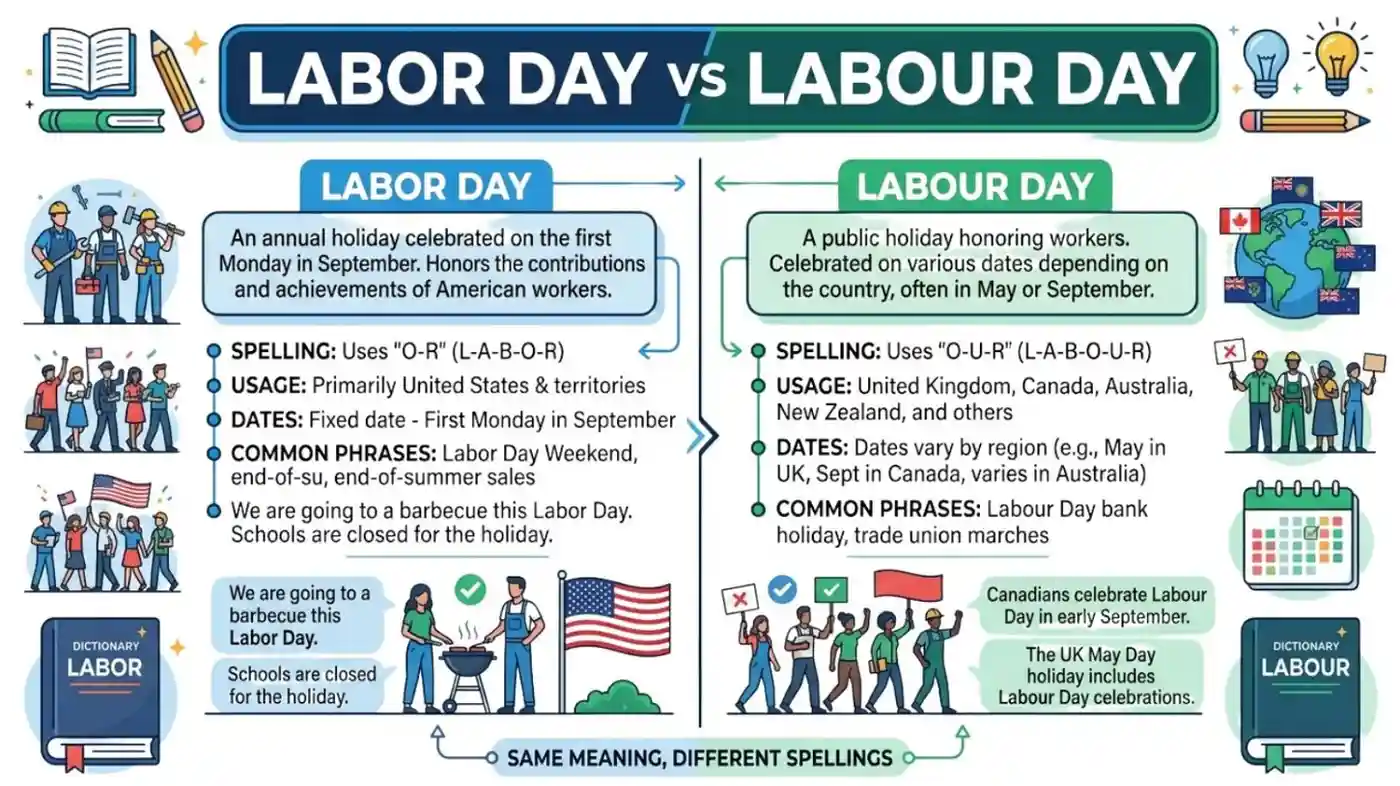
Labor Day is the spelling used in the United States. It falls on the first Monday in September.
Labour Day is the spelling used in Canada, the UK, and many other countries. In Canada, it also falls on the first Monday in September. In other countries, the date can be different.
Example: “We had a big cookout for Labor Day in the US.”
Example: “Labour Day in Canada also falls in early September.”
So the spelling depends on where you live. The date can also depend on the country.
Where This Holiday Comes From
This holiday began in the late 1800s. It started to honor workers. It also started to support fair work hours and fair pay. Workers wanted a day to be seen and thanked for their hard work.
In the United States, the first Labor Day event took place in New York in 1882. It later became an official holiday across the country.
In Canada, a similar holiday grew around the same time. Workers wanted the same kind of day. Canada uses the British-style spelling, “Labour,” since it follows British English rules for many words.
Other countries also honor workers, but many use a different name. This day is often called “International Workers’ Day.” It is held on May 1st in many places around the world.
Good and Bad Points of Each Spelling
Labor Day – The Good Points:
- It matches American English spelling rules.
- It is easy to search for US-based content and events.
Labor Day – The Bad Points:
- It may look wrong to readers in the UK or Canada.
Labour Day – The Good Points:
- It matches British and Canadian English spelling rules.
- It fits well for readers outside the US.
Labour Day – The Bad Points:
- It may look wrong to readers in the United States.
British English vs American English Spelling
This is the main difference between these two words. It comes down to spelling rules, not different holidays.
American English often drops the letter “u” from certain words. British English keeps it. This is why “labor” becomes “labour” in British spelling.
| Word | British English | American English | Countries That Use It |
| Labour Day | Labour Day | — | UK, Canada, and other Commonwealth countries |
| Labor Day | — | Labor Day | United States |
| Color/Colour | Colour | Color | Same pattern applies |
Which Spelling Should You Use?
This depends on your reader, not personal choice.
Use “Labor Day” if: You are writing for readers in the United States.
Use “Labour Day” if: You are writing for readers in Canada, the UK, or other Commonwealth countries.
If you are writing for a global audience: Pick one spelling and stay consistent. You can also mention both spellings once, so all readers understand.
If you are unsure who your reader is: Look at where most of your readers come from. Match the spelling to that group.
A Real Life Example
Sam ran a small online store. He wrote a sale post for “Labor Day Weekend.” Many of his UK customers were confused. Some thought it was spelled wrong. A few asked if it was a US-only sale.
Sam learned that his store had customers in many countries. He decided to write two versions of his post. One used “Labor Day” for US customers. One used “Labour Day” for UK and Canadian customers. His sale did better after that, since more customers understood the post clearly.
Common Mistakes with Labor Day and Labour Day
Here are common mistakes. Here is how to fix them.
Mistake 1: Thinking Labor Day and Labour Day are always on the same date.
Fix: In the US and Canada, they do fall on the same date. But other countries with workers’ day holidays may use a different date, like May 1st.
Mistake 2: Using “Labour Day” in US-based writing.
Fix: Use “Labor Day” instead, since that matches American English spelling.
Mistake 3: Using “Labor Day” in UK or Canadian writing.
Fix: Use “Labour Day” instead, since that matches British and Canadian spelling.
Mistake 4: Mixing both spellings in the same piece of writing.
Fix: Pick one spelling based on your main reader. Stay consistent through the whole piece.
Labor Day and Labour Day in Everyday Life
Let’s look at how these words show up in real life.
In emails: “Our office will be closed for Labor Day on Monday.” “We wish everyone a happy Labour Day this weekend.”
In news stories: “Labor Day marks the unofficial end of summer in the US.” “Labour Day parades are held in many Canadian cities each year.”
On social media: “Enjoying the long Labor Day weekend with family! ” “Happy Labour Day to all the hard workers out there! “
In store ads: “Big Labor Day sale, save up to 50% this weekend!” “Shop our Labour Day deals before they’re gone!”
These examples show that both spellings are common, just in different places.
What People Search Online
People search “labor day vs labour day” a lot in late summer. This is right before the holiday each year. Many people want to know why the spelling changes.
People also search this while writing store ads or emails. They want to use the right spelling for their readers.
Search interest rises every year around the same time. This happens most in the US, Canada, and the UK, since these countries mark the day in some form.
Labor Day vs Labour Day Comparison Table
| Feature | Labor Day | Labour Day |
| Spelling Style | American English | British/Canadian English |
| Main Countries | United States | Canada, UK, and others |
| Date (US and Canada) | First Monday in September | First Monday in September |
| Purpose | Honors workers | Honors workers |
Frequently Asked Questions
1. Is Labor Day the same holiday as Labour Day? Yes, in the US and Canada, it is the same idea. The spelling changes based on the country.
2. Do Labor Day and Labour Day always fall on the same date? In the US and Canada, yes. Both fall on the first Monday in September. Other countries may use a different date.
3. Why does the spelling change between countries? American English often drops the letter “u” from certain words. British English keeps it. This creates the “labor” vs “labour” difference.
4. What is International Workers’ Day? It is another holiday that honors workers. It is held on May 1st in many countries around the world.
5. Should I use “Labor Day” or “Labour Day” for a global audience? Pick one spelling for consistency, or mention both once so all readers understand clearly.
6. Is Labour Day only celebrated in the UK? No. It is also celebrated in Canada and other Commonwealth countries, not just the UK.
7. Does this holiday mean the same thing everywhere? The main idea is the same everywhere: honoring workers. But the exact traditions and dates can be different from country to country.
Wrapping It All Up;
Labor Day and Labour Day both honor hard-working people. The spelling changes based on where you live. The US uses “Labor Day.” Canada, the UK, and other countries use “Labour Day.” In the US and Canada, both holidays fall on the same date, the first Monday in September. This spelling difference follows a common pattern between American and British English.
The easy rule to remember is simple. Match your spelling to your reader’s country. This keeps your writing clear and correct.
Now that you know the difference, you can write with more confidence. Whether you’re sending an email, writing a sale post, or just chatting with a friend, you’ll know exactly which spelling fits. Keep this guide close, and you’ll never mix up Labor Day and Labour Day again.

Emily Carter is an English grammar writer based in Portland, Oregon, with 7+ years of experience turning tricky grammar rules into simple, easy lessons.