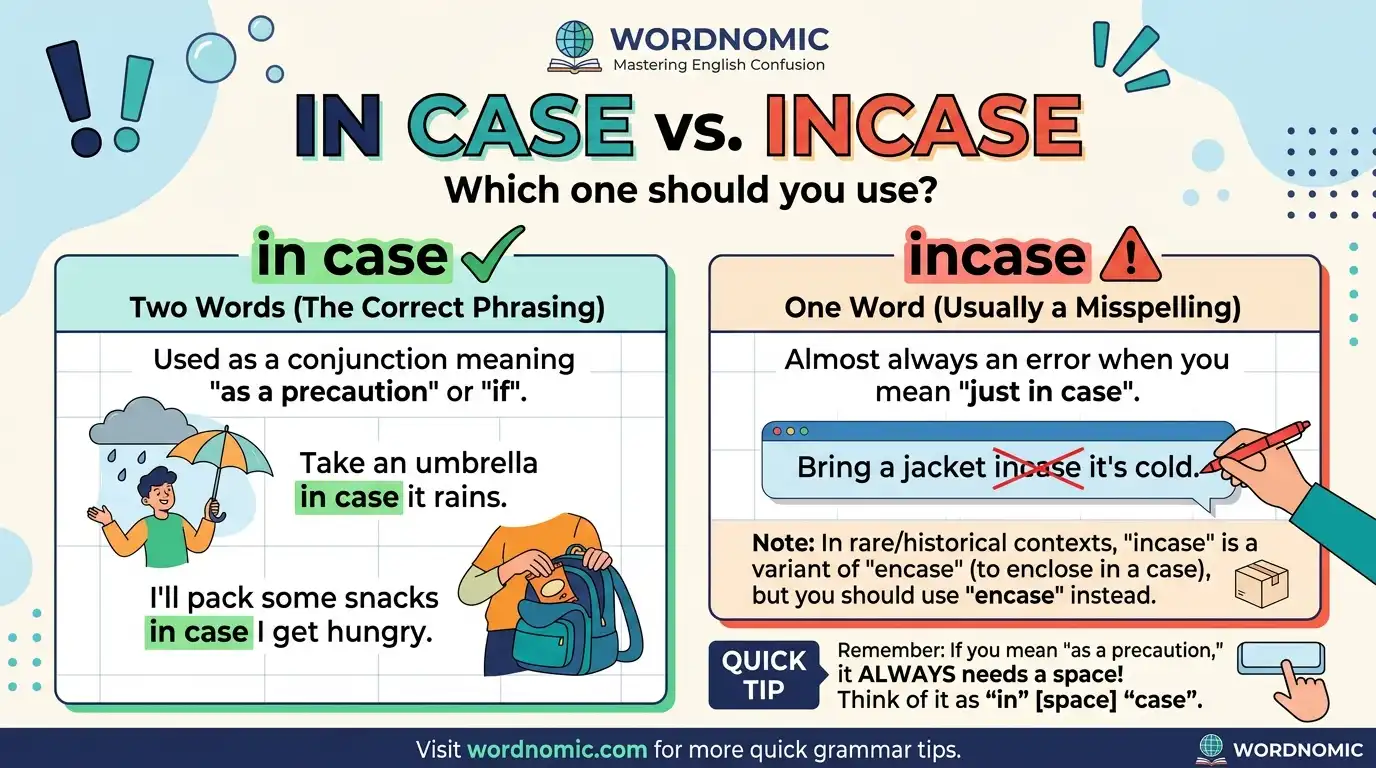
If you are wondering whether “incase” or “in case” is correct, the answer is simple: “in case” is the correct form when you mean “if something happens” or “as a precaution.”
For example:
- Correct: Take an umbrella in case it rains.
- Correct: Call me in case you need help.
- Incorrect for this meaning: Take an umbrella incase it rains.
However, “incase” is not always a spelling mistake. It can be a real English word when it is used as a verb meaning to put something inside a case or covering. This use is rare, though.
So, for normal everyday writing, remember:
Use “in case” when you mean “if” or “as a precaution.”
In Case: Meaning and Correct Use
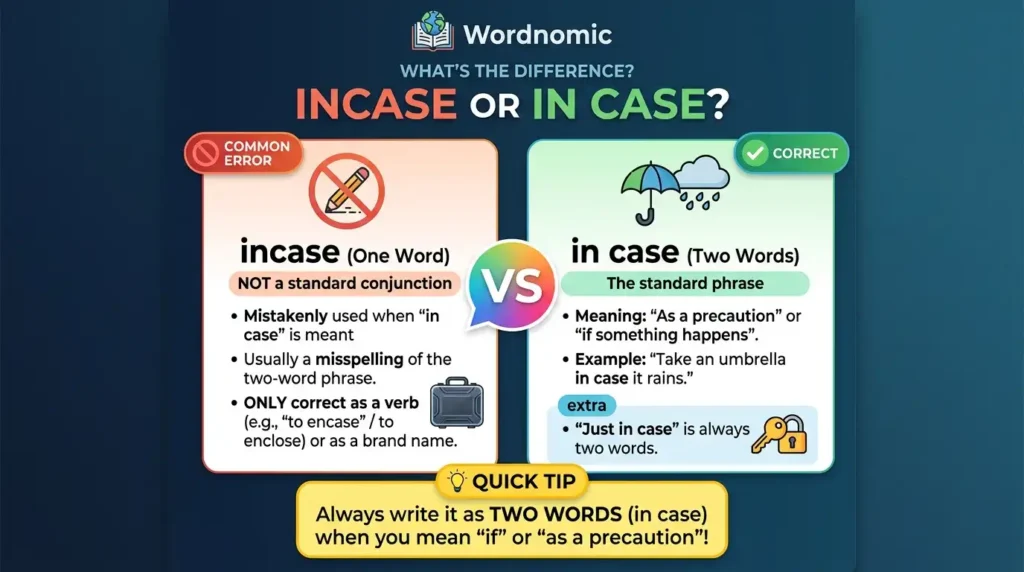
In case is a two-word phrase. It is commonly used when something may happen and you want to be ready for it.
It can often mean “if something happens” or “because something might happen.”
Examples
- Bring some water in case you get thirsty.
- Save the file in case your computer crashes.
- Take your phone in case I need to call you.
- Keep some money with you in case you need it.
- I wrote down the address in case we forget it.
In each sentence, the person is preparing for a possible situation.
In Case vs. If
In case and if can sometimes look similar, but they do not always have the same meaning.
Compare these sentences:
Take an umbrella in case it rains.
This means you should take the umbrella beforehand because rain is possible.
Now compare:
Take an umbrella if it rains.
This suggests that the action depends on whether it actually rains.
The difference is small in some situations, but the basic idea is useful:
- in case = prepare for a possible event
- if = something happens only when a condition is true
More examples
In case:
Take your charger in case your phone battery gets low.
You take the charger now because the battery may become low later.
If:
Take your charger if your phone battery gets low.
The instruction depends on the battery becoming low.
Is “Incase” a Word?
Yes, “incase” can be a word, but it is much less common than “in case.”
As a verb, incase means to put something inside a case, covering, or container.
For example:
The object was incased in a protective covering.
However, this word is rare in modern everyday English. You are much more likely to see encase used for this meaning.
That is why using “incase” when you mean “in case” is usually considered a spelling error.
The important difference
| Form | Meaning | Common? |
| in case | if something happens; as a precaution | Very common |
| incase | to put inside a case or covering | Rare |
For normal emails, school work, websites, messages, and everyday writing, you will almost always want “in case.”
Why Do People Write “Incase”?
The mistake is easy to make because many common English phrases are written as one word.
For example:
- maybe
- already
- inside
- instead
So it may seem natural to write “incase” as one word.
Another reason is pronunciation. In normal speech, “in case” can sound like one connected phrase. When people hear it often, they may assume it is also written as one word.
But spelling and pronunciation do not always work that way.
When you mean “if something happens”, write the phrase as two words:
in case
Common Mistakes With “In Case”
Mistake 1: Writing “incase” instead of “in case”
Incorrect:
Bring a jacket incase it gets cold.
Correct:
Bring a jacket in case it gets cold.
Mistake 2: Using “in case” when “if” is clearer
Sometimes people use in case in places where if would be more natural.
For example:
If you have any questions, ask me.
This is a normal conditional sentence.
You could also say:
Contact me in case you have any questions.
The second sentence focuses more on being ready for the possibility of questions.
Neither phrase should be used just because it sounds formal. Choose the one that matches your meaning.
Mistake 3: Confusing “in case” with “in the case”
These are different expressions.
In case usually refers to a possible situation:
Take an umbrella in case it rains.
In the case of means something more like “when talking about a particular situation.”
In the case of an emergency, leave the building.
The two expressions should not be treated as the same.
“In Case Of” vs. “In Case”
You may also see “in case of” on signs, instructions, and safety information.
It is usually followed by a noun.
Examples:
- In case of fire, use the stairs.
- In case of emergency, call for help.
- In case of damage, contact the company.
- In case of rain, the event may be moved indoors.
By contrast, in case is often followed by a clause containing a subject and verb.
Bring an umbrella in case it rains.
A simple way to remember it is:
in case + subject + verb
in case it rains
in case of + noun
in case of rain
“Just in Case” Meaning
Another very common phrase is “just in case.”
It means you are doing something as a precaution because something might happen.
Examples:
I packed an extra shirt just in case.
Take some cash just in case your card does not work.
I saved the address just in case we need it later.
The word “just” does not change the basic spelling. It is still:
just in case
Not:
just incase
Is “Incase” Ever Correct?
In ordinary writing, you should almost always use “in case” when you mean a possible event or precaution.
The word incase can appear as a verb, but this use is uncommon. For most readers, encase is the more familiar word for putting something inside a case or covering.
For example:
The wires were encased in protective material.
So if you are writing a normal sentence such as:
Bring a coat incase it gets cold.
Do not use incase.
Write:
Bring a coat in case it gets cold.
British vs. American English
There is no major British vs. American spelling difference here.
Both British and American English use:
in case
The phrase does not become incase simply because of the type of English being used.
So whether you are writing for readers in the United States, the United Kingdom, Canada, Australia, or another English-speaking country, in case is the normal form for this meaning.
Easy Way to Remember the Difference
Use this simple rule:
If you mean “if something happens” or “as a precaution,” use “in case.”
Think of these examples:
- Bring a jacket in case it gets cold.
- Save a copy in case you lose the original.
- Call me in case you need help.
- Take an umbrella in case it rains.
If you can replace the phrase with an idea like “because this might happen”, “in case” is usually the form you need.
Quick Comparison
| Form | Correct for normal use? | Example |
| in case | Yes | Take cash in case you need it. |
| incase | Usually no | Incase you need it. ❌ |
| in case of | Yes | In case of fire, leave the building. |
| just in case | Yes | Take your coat just in case. |
Frequently Asked Questions
Is “incase” or “in case” correct?
In case is correct when you mean “if something happens” or “as a precaution.”
Take an umbrella in case it rains.
Is “incase” a real word?
Yes, incase can be used as a verb meaning to put something inside a case or covering, but it is rare. For the common phrase meaning “if something happens,” use in case.
Should “in case” be one word?
No. When you are using it to mean “if something happens” or “as a precaution,” it should be written as two words: in case.
Is “in case” formal or informal?
In case is normal English. It can be used in casual conversation, emails, school writing, and formal writing.
What is the difference between “in case” and “if”?
If normally introduces a condition. In case often shows that you are preparing for a possible event.
Call me if you need help.
Take my number in case you need help.
Is “just incase” correct?
No, not when you mean “as a precaution.” The correct phrase is “just in case.”
I brought an extra pen just in case.
Is “in case of” correct?
Yes. In case of is commonly used before a noun, especially in instructions and safety notices.
In case of emergency, call for help.
Final Answer
For almost all normal uses, the correct choice is “in case.”
Use in case when you mean “if something happens” or “as a precaution.”
Correct:
I took an umbrella in case it rained.
Usually incorrect for this meaning:
I took an umbrella incase it rained.
Although incase can exist as a rare verb, it is not the form you want in everyday sentences. When in doubt, remember the simple rule: “in case” is two words.