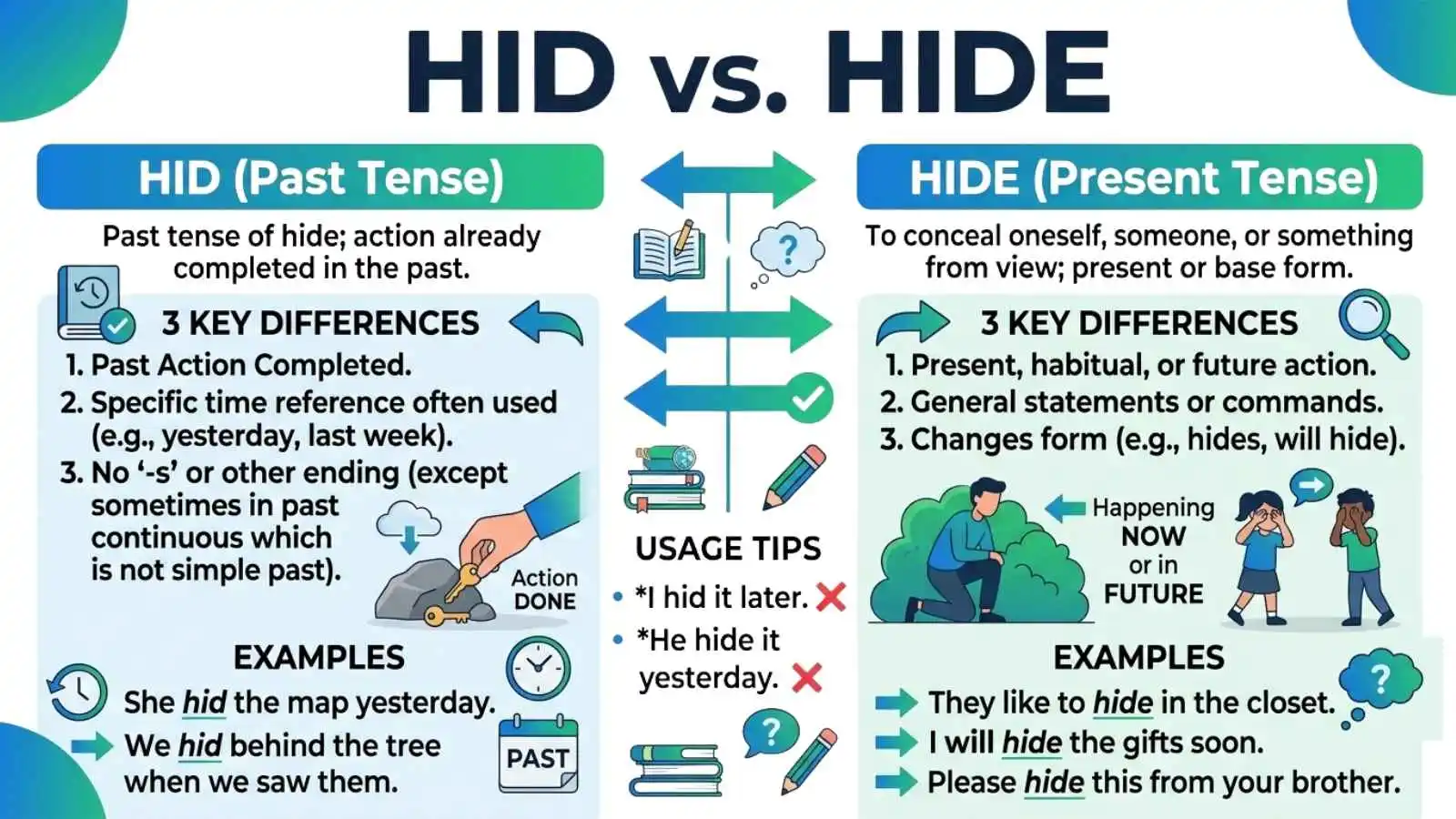
You want to write about something you put away or covered up. You type “I ___ the gift” and stop. Is it hid? Or is it hide? Both feel close, but only one fits your sentence.
This mix-up is common because hide and hid are the same word, just in different tenses. English changes verbs to show when something happened. This can feel tricky, especially with short, simple words like this one.
This guide gives you a clear, easy answer. You’ll learn when to use hide, when to use hid, and a simple trick to remember it. No hard grammar terms. Just plain steps, plus a short exercise at the end.
Hid or Hide – Quick Answer
Both words are correct, but they belong in different sentences.
- Hide is the base form. Use it for things happening now or in the future. Example: “I will hide the keys.”
- Hid is the past tense. Use it for something that already happened. Example: “I hid the keys yesterday.”
If you’re talking about right now or later, use hide. If you’re talking about the past, use hid.
The Origin of Hide and Hid
Both words come from the Old English word hȳdan, which meant to cover or keep something out of sight. Over hundreds of years, this word changed slightly in spelling and sound, but it kept the same basic meaning.
Hide stayed as the base form of the verb. Hid became the past tense form, following an old English pattern where some verbs change their inside vowel sound to show past action. This is called an “irregular verb,” because it doesn’t just add “-ed” like most verbs do.
Hide vs Hid – Verb Forms Table
| Form | Tense | Example |
| Hide | Present / Base form | “I hide my journal every night.” |
| Hid | Past tense | “I hid my journal last night.” |
| Hidden | Past participle | “The journal has been hidden for years.” |
| Hiding | Present participle | “She is hiding behind the door.” |
Notice that hide has more than two forms. This is common for irregular verbs in English.
Which Form Should You Use?
Choosing the right form depends on when the action happened.
- Use hide when the action is happening now, will happen later, or is a general truth. Example: “Cats often hide when scared.”
- Use hid when the action already happened and is fully finished. Example: “The cat hid under the bed yesterday.”
- Use hidden when pairing with helping words like “has,” “have,” or “had.” Example: “She has hidden the letter somewhere safe.”
- Use hiding when describing an action still in progress. Example: “He is hiding in the closet right now.”
Memory Trick to Get It Right
Here’s a simple way to remember the difference.
Trick: Match it with “ride” and “rode.” “Hide” changes to “hid” the same way “ride” changes to “rode” — the middle sound changes to show the past. If you remember “I ride today, I rode yesterday,” you can also remember “I hide today, I hid yesterday.”
Common Mistakes with Hid and Hide
Here are wrong examples, followed by the correct way to write them.
- ❌ “I hide the money yesterday.”
- ✅ “I hid the money yesterday.”
- ❌ “She will hid the surprise tomorrow.”
- ✅ “She will hide the surprise tomorrow.”
- ❌ “He has hid the truth for years.”
- ✅ “He has hidden the truth for years.”
- ❌ “The dog is hid behind the couch right now.”
- ✅ “The dog is hiding behind the couch right now.”
Hid or Hide in Everyday Examples
emails: “I will hide the surprise gift in the office until Friday.”
text messages: “lol I hid your charger, check the drawer “
formal writing: “The report states that the error was hidden from the public for months.”
storytelling: “She hid behind the old oak tree, waiting for her friends to find her.”
Is “Hid” Ever Used the Same Way as “Hide”?
No. Hid only works for finished, past actions. It cannot be used for something happening now or in the future. If you’re describing a current or future action, always use hide, hiding, or in some cases, hidden with a helping word.
Other Irregular Verbs Like Hide
Learning a few other irregular verbs can help the pattern feel more natural. These verbs also change their middle sound instead of adding “-ed.”
- Ride → Rode → Ridden. “I ride my bike today. I rode it yesterday. I have ridden it many times.”
- Write → Wrote → Written. “I write letters now. I wrote one yesterday. I have written many letters.”
- Drive → Drove → Driven. “I drive to work daily. I drove there yesterday. I have driven this road before.”
- Bite → Bit → Bitten. “The dog bites sometimes. It bit me once. It has bitten other people too.”
Notice how each of these verbs follows a similar pattern to hide, hid, and hidden. Once you learn one, the others become easier to remember too.
How “Hide” Is Used in Stories and Games
The word hide shows up often in games, stories, and everyday play. This makes it a word that both kids and adults use all the time.
games: “Let’s play hide and seek before dinner.”
storytelling: “The little rabbit hid behind the bushes, hoping the fox wouldn’t see her.”
movies and shows: “The character hides important clues throughout the film.”
sports commentary: “The runner hides behind his blockers to avoid being tackled.”
Because this word appears in so many fun, everyday situations, learning its correct forms can help with schoolwork, storytelling, and even casual conversations with friends and family.
A Quick Recap Before You Go
Let’s go over the main points one more time, in short and simple steps:
- Hide is the base form. Use it for now or future actions.
- Hid is the past tense. Use it for actions already finished.
- Hidden pairs with helping words like “has,” “have,” or “had.”
- Hiding describes an action still happening right now.
- This verb is irregular, meaning it doesn’t follow the normal “-ed” rule.
Keep this list nearby. It will help you choose the right word quickly, every time.
Frequently Asked Questions
1. Is “hid” the same as “hidden”? No. “Hid” is the simple past tense, used alone. “Hidden” is the past participle, usually paired with helping words like “has” or “have.”
2. What is the base form of this verb? The base form is “hide.” All other forms, like “hid,” “hidden,” and “hiding,” come from this root word.
3. Why does “hide” change to “hid” instead of adding “-ed”? “Hide” is an irregular verb. Instead of following the normal “-ed” rule, its middle vowel sound changes to show past tense.
4. Can “hide” be used as a noun? Yes. “Hide” can also mean animal skin, as in “the hide of a cow.” This is a different meaning from the verb form.
5. How do you remember when to use “hid” instead of “hide”? Think about whether the action already fully happened. If yes, use “hid.” If it’s happening now or later, use “hide.”
6. Is “hided” ever correct? No. “Hided” is not a correct English word. The correct past tense is always “hid.”
7. Can “hiding” be used as a noun too? Yes, in casual speech, “hiding” can describe a punishment, like “he got a hiding,” though this usage is more common in British English.
8. Is “hide” only used for physical actions? No. “Hide” can also mean keeping information or feelings secret. Example: “She hid her sadness behind a smile.”
9. Does “hide” change in different English dialects? The core verb forms stay the same worldwide, though phrases using “hide” or “hiding” may sound more common in certain regions, like British or Australian English.
Conclusion:
So, hid or hide — which one is correct? Both are correct, but they belong in different situations. Use hide for actions happening now or in the future. Use hid for actions that are already finished in the past. When pairing with helping words like “has” or “have,” use instead.
Remember the simple trick: “hide” changes to “hid” just like “ride” changes to “rode.” Once this pattern feels familiar, you’ll never pause over these words again.
Getting small verb changes right, like this one, helps your writing sound clear and correct, whether you’re texting a friend or writing something formal.
Quick Exercise: Test Your Understanding
Fill in the blank with the correct word: hide, hid, hidden, or hiding.
- Yesterday, she ______ the letter in her desk drawer.
- Right now, the cat is ______ under the bed.
- Tomorrow, I will ______ the surprise gift in the closet.
- He has ______ his true feelings for years.
- Every winter, bears ______ in caves to sleep.
Answers:
- hid
- hiding
- hide
- hidden
- hide

Emily Carter is an English grammar writer based in Portland, Oregon, with 7+ years of experience turning tricky grammar rules into simple, easy lessons.