Quick Answer
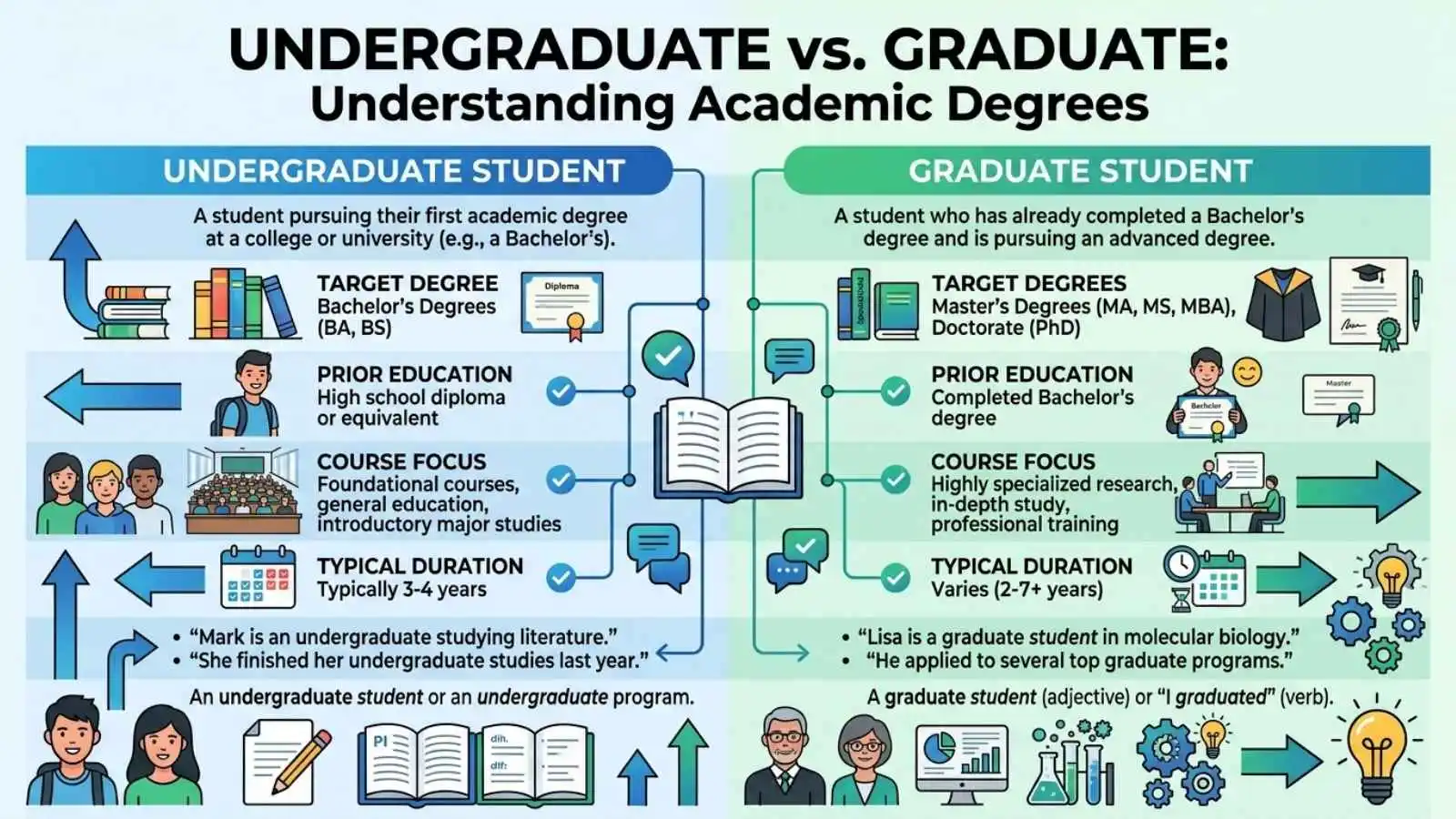
Undergraduate means a student working on their first college degree, like a bachelor’s degree.
Graduate has two meanings. It can mean a student who finished a degree. It can also mean a student working on a higher degree, like a master’s or PhD, after finishing their first degree.
Example: “She is an undergraduate at State University.” This means she is still working on her first degree.
Example: “He is a graduate student now.” This means he already has a first degree and is studying for a higher one.
Introduction
You hear the word “graduate.” You hear the word “undergraduate.” They sound close. Are they the same thing? Many students, parents, and even teachers mix these words up.
This confusion happens because both words relate to school and degrees. But they don’t mean the same stage of school. One word can also have two different meanings, which makes it even trickier.
This guide will clear it all up. You’ll learn what each word means, how they are different, and how to use them the right way. Easy words. Clear examples. No confusing school jargon. At the end, there’s a short activity to help the words stick in your memory.
Where These Words Come From
Both words come from Latin roots. “Graduate” comes from the Latin word gradus, which means “step.” This makes sense, since finishing a degree is like completing a big step in your education.
“Undergraduate” adds the prefix “under” to “graduate.” It means someone who is “under,” or below, the level of a graduate. In other words, they haven’t finished their first degree yet.
Over time, English speakers began using “graduate” in two ways: as a verb (to graduate) and as a noun (a graduate). This is part of why the word can feel confusing in different sentences.
Graduate vs Undergraduate – Key Differences
Let’s break this down in a clear, simple way.
Undergraduate:
- A student working on their first college degree
- Usually working toward a bachelor’s degree
- Classes are often called “undergrad classes”
- Example: “I’m an undergraduate studying biology.”
Graduate (as a student):
- A student who already has a first degree
- Now working on a higher degree, like a master’s or PhD
- Classes are called “graduate school” or “grad school”
- Example: “I’m a graduate student studying law.”
Graduate (as a finished student):
- Someone who has completed any degree or program
- Used as a verb too: “I will graduate next spring.”
- Example: “She is a graduate of State University.”
So, the same word “graduate” can mean three different things, depending on how it’s used in a sentence.
Which Term Should You Use?
Here’s some simple advice based on the situation.
If someone is working on their first degree: Use undergraduate. Example: “He’s an undergraduate at a state college.”
If someone finished their first degree and is now studying for a higher one: Use graduate (or “grad student”). Example: “She’s a graduate student in psychology.”
If someone finished any degree program: Use graduate as well. Example: “He graduated last year.” or “She is a college graduate.”
In everyday talk: Many people just say “grad” as a short, casual way to say “graduate.” Example: “I’m a grad student” or “I just graduated.”
Common Mistakes with Graduate and Undergraduate
Here are wrong examples, followed by the correct way to say them.
- ❌ “I am a graduate studying for my first degree.”
- ✅ “I am an undergraduate studying for my first degree.”
- ❌ “She is doing her undergraduate after finishing her bachelor’s degree.”
- ✅ “She is doing her graduate studies after finishing her bachelor’s degree.”
- ❌ “He graduated undergraduate school.” (confusing double use)
- ✅ “He finished his undergraduate degree.”
- ❌ Using “graduate” only to mean finishing school.
- ✅ Remember “graduate” can also mean a student in a higher degree program, not just someone who finished school.
Graduate and Undergraduate in Everyday Examples
In an email: “I am currently an undergraduate student applying for a summer internship.”
In the news: “The university welcomed over 2,000 new graduate and undergraduate students this fall.”
On social media: “Just started grad school! So excited for this next step. 🎓”
In formal writing: “Applicants must hold an undergraduate degree before applying to the graduate program.”
Graduate vs Undergraduate Comparison Table
| Term | Stage of School | Degree Level | Example |
| Undergraduate | Working on first degree | Bachelor’s degree | “She is an undergraduate at NYU.” |
| Graduate (student) | After first degree | Master’s or PhD | “He is a graduate student in math.” |
| Graduate (finished) | Completed any degree | Any level | “She is a proud graduate of the class of 2024.” |
How Common Is Each Word?
“Undergraduate” is mostly used in school and college settings. You’ll see it on college websites, applications, and school forms.
“Graduate” is used more often overall, since it applies to many situations — finishing school, applying to grad school, or simply saying someone “graduated.” It also appears often in news stories, job listings, and everyday conversation.
Both words are common worldwide, in the United States, the United Kingdom, Canada, Australia, and beyond. The meaning stays mostly the same across English-speaking countries, though grad school systems can look a little different from country to country.
Other School Words That Sound Similar
There are a few other school words that can feel just as confusing. Knowing them can help you avoid more mix-ups.
- Freshman, Sophomore, Junior, Senior – These are the four years of undergraduate school in the U.S.
- Alumnus / Alumna / Alumni – These words describe a graduate after they leave school, especially when talking about past students as a group.
- Postgraduate – Used more in the UK, this word means the same as “graduate student” in the U.S.
- Doctoral student – A student working on the highest graduate degree, called a PhD or doctorate.
Learning these extra words can help you understand school and job talk even better, especially when reading resumes, school websites, or news stories about education.
Undergraduate vs Graduate: Time, Cost, and Structure
Beyond terminology, the two stages of school also differ in practical ways that matter for planning:
- Length of study: An undergraduate (bachelor’s) degree usually takes 3 to 4 years, depending on the country. A graduate degree can range widely a master’s typically takes 1 to 2 years, while a PhD can take 4 to 7 years or more.
- Class structure: Undergraduate classes tend to be larger, with broader general education requirements alongside a chosen major. Graduate classes are usually smaller, more specialized, and focused heavily on one subject area.
- Type of work: Undergraduates mostly attend lectures, complete assignments, and take exams. Graduate students often take on research, write a thesis or dissertation, and may teach or assist professors.
- Cost: Tuition costs vary a lot by school and country, but graduate programs especially professional degrees like an MBA, JD, or MD often cost more per year than undergraduate programs, though funding, assistantships, or scholarships can offset this at the graduate level.
- Admission requirements: Undergraduate admission usually depends on high school records and entrance exams. Graduate admission usually requires a completed bachelor’s degree, letters of recommendation, a statement of purpose, and sometimes standardized tests specific to the field (like the GRE, GMAT, or LSAT).
Why This Matters for Resumes and Job Applications
Getting these words right isn’t just about grammar. It can matter for real-life situations too, like writing a resume or filling out a job application.
If a job posting says “Undergraduate degree required,” it means you need at least a bachelor’s degree. If it says “Graduate degree required,” it usually means you need a master’s degree or higher.
Using the wrong word on a resume or cover letter could confuse a hiring manager. For example, saying “I am a graduate” when you mean “I am still an undergraduate” could send the wrong message about your education level. Taking a moment to use the correct word shows that you understand your own academic background clearly.
Frequently Asked Questions
1. Is an undergraduate the same as a college student? Yes, in most cases. An undergraduate is a college student working on their first degree, usually a bachelor’s degree.
2. Can someone be both a graduate and an undergraduate? Not at the same time in the same program. But someone can be an undergraduate now and become a graduate student later, after finishing their first degree.
3. What is the difference between a graduate degree and an undergraduate degree? An undergraduate degree is your first college degree, like a bachelor’s. A graduate degree comes after, like a master’s or doctorate.
4. Why does “graduate” have more than one meaning? It can be used as a noun (a graduate), a verb (to graduate), and part of a phrase (graduate school), which is why the meaning changes based on the sentence.
5. Is “undergrad” the same as “undergraduate”? Yes. “Undergrad” is just a shorter, more casual way to say “undergraduate.”
6. Do all countries use these terms the same way? Mostly, yes. Most English-speaking countries use “undergraduate” and “graduate” in a similar way, though exact degree names can vary.
7. Is graduate school required after undergraduate school? No. Many people finish their undergraduate degree and go straight into a job. Graduate school is optional and depends on your career goals.
Can you apply to graduate school before finishing your undergraduate degree?
Usually not fully most graduate programs require proof of a completed bachelor’s degree before enrollment starts, though some students apply during their final undergraduate year with plans to finish just before starting grad school.
9. Does a graduate degree always mean a higher salary?
Not always, but in many fields a graduate degree can open doors to higher-paying or more specialized roles. It depends heavily on the industry, the specific degree, and job market demand.
A Quick Recap Before You Go
Let’s go over the main points one more time, in short and simple steps:
- Undergraduate means working on your first college degree.
- Graduate can mean a student in a higher degree program, or anyone who finished a degree.
- Both words come from the Latin word for “step.”
- Use “undergrad” as a shorter, casual version of “undergraduate.”
- The meaning of “graduate” changes depending on how it’s used in a sentence.
Keep this list handy. It will help you use both words the right way, every time.
Conclusion:
So, graduate or undergraduate — what’s the real answer? It depends on where someone is in their school journey. An undergraduate is working on their first degree. A graduate has either finished a degree or is working on a higher one, like a master’s or PhD.
Knowing this small difference can help you sound clear and correct, whether you’re writing a resume, an email, or a simple conversation about school. Remember the easy rule: “under” means before, so “undergraduate” comes first. “Graduate” comes after, once that first big step is done.
Quick Exercise: Test Your Understanding
Fill in the blank with the correct word: graduate or undergraduate.
- She is working on her first degree, so she is an ______.
- He finished his bachelor’s degree and is now a ______ student.
- After four years, she will finally ______ from college.
- The word “______” comes from the Latin word for “step.”
- Most students start as an ______ before becoming a ______ student.
Answers:
- undergraduate
- graduate
- graduate
- graduate
- undergraduate, graduate

Emily Carter is an English grammar writer based in Portland, Oregon, with 7+ years of experience turning tricky grammar rules into simple, easy lessons.










