
Have you ever stopped while writing and wondered, “Is it enflamed or inflamed?” These two spellings look almost the same, and both can be found in English dictionaries. That can make the choice confusing.
The good news is simple. Inflamed is the usual and preferred spelling in modern English. Enflamed is also a real word, but it is a less common variant of inflamed. Major dictionaries such as Merriam-Webster and Dictionary.com list enflame as a variant of inflame.
The word inflamed can describe a body part that is red, sore, or swollen. It can also describe strong feelings, anger, or a tense situation.
In this guide, you will learn the difference between enflamed and inflamed, which spelling to use, where the words came from, and how to use them in real sentences.
Enflamed or Inflamed – Quick Answer
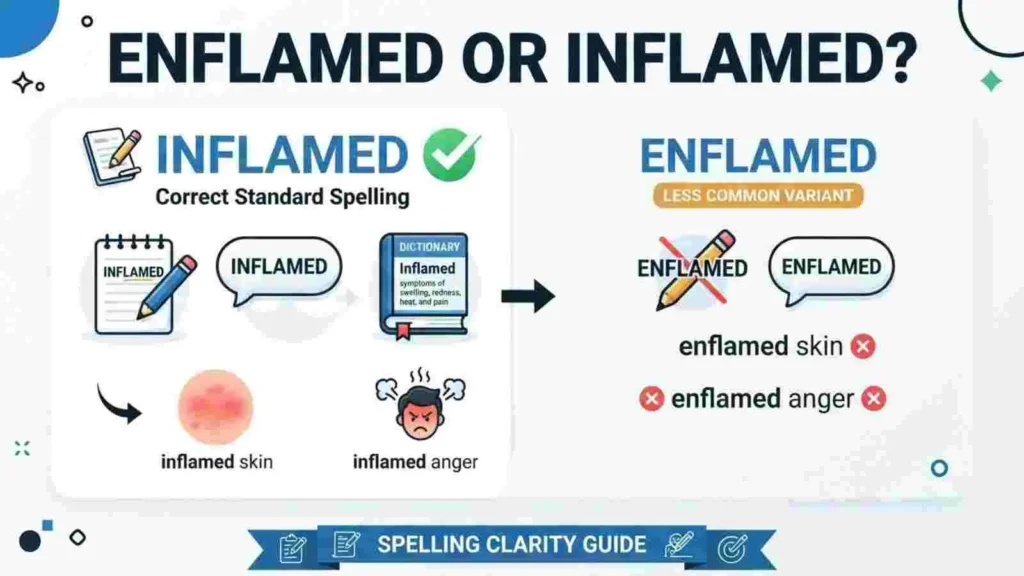
Inflamed is the standard and more common spelling in modern English.
Enflamed is a real variant spelling, but it is much less common. Merriam-Webster lists enflame as a less common variant of inflame. Dictionary.com also lists enflame as a variant.
For most writing, choose inflamed.
- Correct and common: The skin is inflamed.
- Correct but less common: The skin is enflamed.
- Best choice for modern writing: inflamed
So, if you are writing an email, school paper, medical text, report, or normal online content, inflamed is the safer choice.
What Does Inflamed Mean?
Inflamed is the past tense and past participle of the verb inflame.
It has more than one meaning.
1. Red, swollen, or painful
When a body part becomes red, swollen, hot, or painful, we can describe it as inflamed.
For example:
My knee is inflamed after the injury.
Cambridge defines inflame as making part of the body red, painful, and swollen. Collins also defines inflamed as red or swollen, often because of illness, injury, or infection.
2. To make feelings stronger
Inflame can also mean to make strong feelings, such as anger, stronger.
For example:
His comments inflamed the argument.
Here, inflamed does not mean that something became physically swollen. It means that the argument became more heated or angry.
3. To set something on fire
The word can also have a fire-related meaning.
For example:
The dry wood was inflamed by the fire.
This meaning connects to the old idea of setting something on fire or making something burn.
What Does Enflamed Mean?
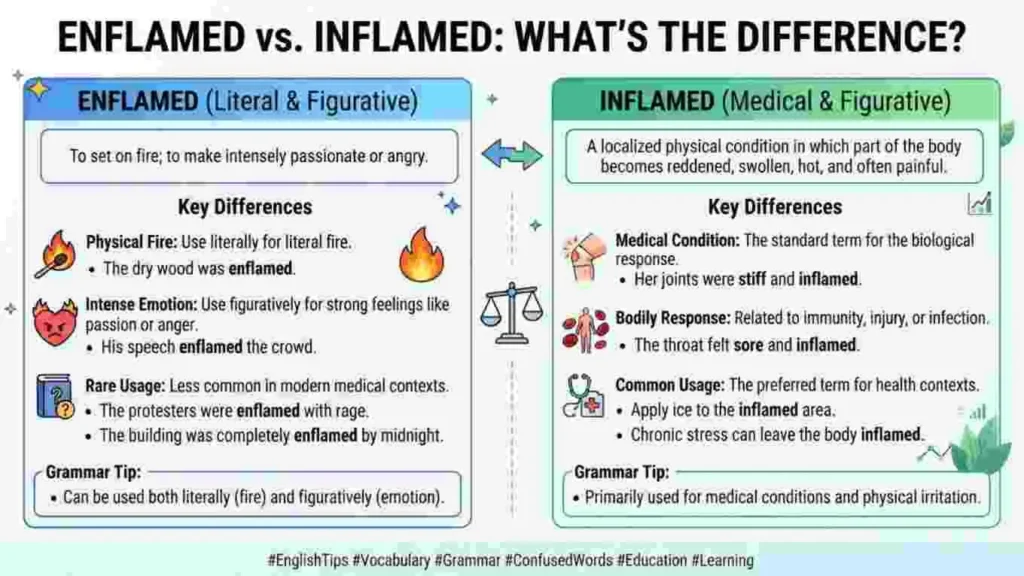
Enflamed is a variant of inflamed.
It comes from the verb enflame, which means the same basic thing as inflame. Dictionary.com lists enflame as a variant of inflame, while Collins gives enflame as another form of the verb.
For example:
His anger enflamed the argument.
This sentence can be understood, but inflamed is more natural in modern writing:
His anger inflamed the argument.
The important point is that enflamed is not simply a spelling mistake. It is a real, less common form.
Enflamed vs Inflamed: Main Difference
The main difference is modern usage and frequency, not meaning.
| Term | Meaning | Usage | Example |
| Inflamed | Red, swollen, angry, or made stronger | Standard and common | Her ankle is inflamed. |
| Enflamed | Same basic meaning as inflamed | Less common variant | His words enflamed the debate. |
Both forms come from the same word family.
However, inflamed is the better choice for most modern writing.
Why Do People Confuse Enflamed and Inflamed?
The confusion comes from the history of the words.
Both forms have been used in English for hundreds of years. Older English sources used forms related to enflame, while inflame later became the more common spelling.
This makes the two forms look like normal spelling alternatives, much like some British and American spelling pairs.
But there is an important difference.
Enflamed vs inflamed is not mainly a British vs American spelling difference.
It is mostly a difference in common usage and word history.
Origin and History of Inflame and Enflame
The history of these words goes back a long way.
The English verb inflame came through Middle English forms such as enflamen and inflammen. These forms came from Old French enflamer, which came from Latin inflammare, meaning to set on fire or kindle.
The original idea was linked to fire and burning.
Over time, the word developed wider meanings. It could describe physical heat or inflammation. It could also describe strong feelings such as anger or passion.
The spelling changed over time too.
Etymonline notes that enflame was used in English from around the mid-14th century. It also says that the spelling with in- became more common from about the 16th century. This helps explain why both spellings still exist.
A simple history
- Old French had enflamer.
- Latin had inflammare.
- English used forms such as enflame and inflame.
- Inflame became the more common modern form.
- Enflame remained as a less common variant.
British English vs American English
There is no major British vs American spelling difference here.
British and American English both use inflame and inflamed.
The main modern choice is still inflamed.
Enflame can also appear, but it is less common and is not simply the special British spelling or special American spelling.
For example:
British English
The doctor said that his knee was inflamed.
American English
The doctor said that his knee was inflamed.
The spelling stays the same.
Collins gives the same pronunciation for inflamed in British and American English.
Which One Should You Use?
For almost all modern writing, use inflamed.
Everyday writing
Use:
My eye looks inflamed.
School writing
Use:
The injured area became inflamed.
Academic writing
Use:
The study examined signs of inflamed tissue.
Medical writing
Inflamed is the clear choice.
For example:
The patient had inflamed gums.
Business writing
Use:
The comments inflamed the dispute.
Online writing
Use:
My skin is red and inflamed.
When can you use enflamed?
You may see enflamed in older texts, literary writing, or less common modern uses. Dictionaries recognize it as a variant. (Dictionary.com)
But if your goal is clear, modern English, inflamed is usually the better choice.
Common Mistakes With Enflamed and Inflamed
Mistake 1: Thinking enflamed is always wrong
Incorrect idea: Enflamed is never a word.
Better understanding: Enflamed is a real variant of inflamed.
Example:
Enflamed is listed as a variant of inflamed.
Dictionaries support this usage.
Mistake 2: Using enflamed in medical writing
You may see it, but inflamed is clearer and more familiar.
Better:
Her gums were inflamed.
Mistake 3: Thinking they have different meanings
The two forms can have the same basic meanings.
The main difference is how common they are.
Mistake 4: Thinking enflamed is American English
It is not simply an American spelling.
The difference is not like color and colour.
Mistake 5: Writing inflammed
The correct spelling is:
inflamed
Not:
inflammed
The verb is inflame, so the past form is inflamed.
Mistake 6: Writing inflamated
Do not write:
inflamated
Use:
inflamed
Mistake 7: Confusing inflamed with inflammation
These words are related but have different jobs.
- Inflamed is usually an adjective or verb form.
- Inflammation is a noun.
Example:
The knee is inflamed.
The doctor found inflammation in the knee.
10 Everyday Examples
Here are simple examples of inflamed and enflamed.
- My ankle is inflamed after the fall.
- Her eyes looked red and inflamed.
- The doctor found inflamed tissue.
- His gums were badly inflamed.
- The injury left his knee inflamed.
- The angry speech inflamed the crowd.
- His comments inflamed the dispute.
- The report inflamed public anger.
- The old story describes an enflamed heart.
- The writer used the word enflamed in a literary sense.
The first eight examples use the modern and more common form, inflamed.
Real-Life Usage
In conversations
People normally use inflamed when talking about health.
“Why is your finger so red?”
“I think it is inflamed.”
In emails
A work email may use the word in a figurative sense:
The comment only inflamed the disagreement.
At school
A student might write:
The injured area became inflamed.
This is clear and natural.
At work
A report may say:
The manager’s statement inflamed the dispute.
Here, inflamed means made the dispute more intense.
On social media
You may see:
That post just inflamed the argument.
Again, the meaning is to make strong feelings stronger.
In formal writing
Inflamed is the safer choice because it is familiar and widely used.
Enflamed can sound old or unusual in some contexts.
Related Search Questions
Is enflamed a correct word?
Yes. Enflamed is a real word and a variant of inflamed. Major dictionaries recognize enflame as a variant or less common form. However, inflamed is the more common choice in modern English.
Is inflamed the correct spelling?
Yes. Inflamed is the standard modern spelling. It is the past form and past participle of inflame.
What is the difference between enflamed and inflamed?
There is little difference in meaning. Both forms come from the same word family. Inflamed is much more common in modern English, while enflamed is a less common variant.
Is enflamed British or American?
Neither. Enflamed is not simply a British or American spelling. It is a variant form that can appear in English writing. Both British and American English commonly use inflamed.
What does inflamed mean medically?
In medical use, inflamed describes tissue or a body part that has become red, swollen, painful, or hot. The exact signs depend on the cause and body part.
What is the past tense of inflame?
The past tense is inflamed.
Example:
The infection inflamed the skin.
The past participle is also inflamed:
The skin was inflamed.
Can I use enflamed in formal writing?
You can, because it is a recognized variant. However, inflamed is usually the clearer choice for modern formal, academic, medical, and business writing.
Usage and Search Trends
Exact search volume or Google Trends data should not be claimed without current, verified data.
The word inflamed has a strong place in modern English because it is used in health, medicine, everyday speech, news, and discussions about conflict or strong feelings. Cambridge and Collins both document these modern meanings.
Enflamed is also a real form, but dictionary evidence shows that it is a variant of inflame. Merriam-Webster describes enflame as a less common variant, while Dictionary.com lists it directly as a variant.
This means a search for enflamed or inflamed can come from two different needs:
- checking the correct spelling
- checking whether enflamed is a real word
The simple answer is that both exist, but inflamed is the normal modern choice.
Enflamed vs Inflamed Comparison Table
| Feature | Inflamed | Enflamed |
| Word type | Adjective / verb form | Adjective / verb form |
| Basic meaning | Red, swollen, excited, or made stronger | Same basic meaning |
| Modern use | Common | Less common |
| Dictionary status | Standard form | Variant form |
| Medical writing | Preferred | Uncommon |
| Academic writing | Preferred | Less common |
| Business writing | Preferred | Less common |
| British English | Used | Possible but uncommon |
| American English | Used | Possible but uncommon |
| Best choice today | Yes | Usually no |
7 FAQs About Enflamed or Inflamed
1. Which is more common, enflamed or inflamed?
Inflamed is more common in modern English. It appears in normal medical, academic, business, and everyday writing. Enflamed is a recognized variant, but it is much less common. Merriam-Webster lists enflame as a less common variant of inflame.
2. Is enflamed a spelling mistake?
No. Enflamed is not simply a spelling mistake. Dictionaries recognize enflame as a variant of inflame. Still, most writers should choose inflamed because it is the more familiar modern form.
3. Should I write inflamed skin or enflamed skin?
Write inflamed skin in normal modern English. For example:
The cream may help soothe inflamed skin.
This form is clear and natural.
4. Is inflamed only used for body parts?
No. Inflamed has several meanings. It can describe a physical condition, but it can also describe anger, feelings, or a tense situation.
For example:
His comments inflamed the debate.
Here, it means the comments made the debate more intense.
5. Is inflammation related to inflamed?
Yes. The words belong to the same word family. Inflamed describes something affected by inflammation, while inflammation is the condition or process itself. Cambridge defines inflammation as a red, painful, and often swollen area in or on part of the body.
6. Does British English use enflamed?
British English can use enflamed, but it is not the normal spelling choice. Inflamed is the standard form used in modern British English. The same form is also normal in American English.
7. What is the easiest way to remember the correct spelling?
Remember this simple rule:
Use INFLAMED for modern English.
If you see enflamed, do not assume it is meaningless. It is a real variant. But for most school, work, medical, and online writing, inflamed is the better choice.
Conclusion
The answer to enflamed or inflamed is simple once you know the history.
Inflamed is the standard and more common form in modern English. Use it when you write about red or swollen body parts, strong feelings, anger, conflict, or something made more intense.
Enflamed is also a real word. It is a variant of inflamed, and major dictionaries recognize it. However, it is much less common today.
This is not mainly a British vs American spelling issue. Both forms can be found in English, but inflamed is the safer choice for modern writing.
For school work, business emails, academic writing, medical writing, and everyday English, choose inflamed.
For example:
The skin around the cut was inflamed.
You can also use inflamed in a non-medical sense:
His words inflamed the argument.
So, when you are unsure, remember one simple choice:
Inflamed is the modern form to use.

Emily Carter is an English grammar writer based in Portland, Oregon, with 7+ years of experience turning tricky grammar rules into simple, easy lessons.










