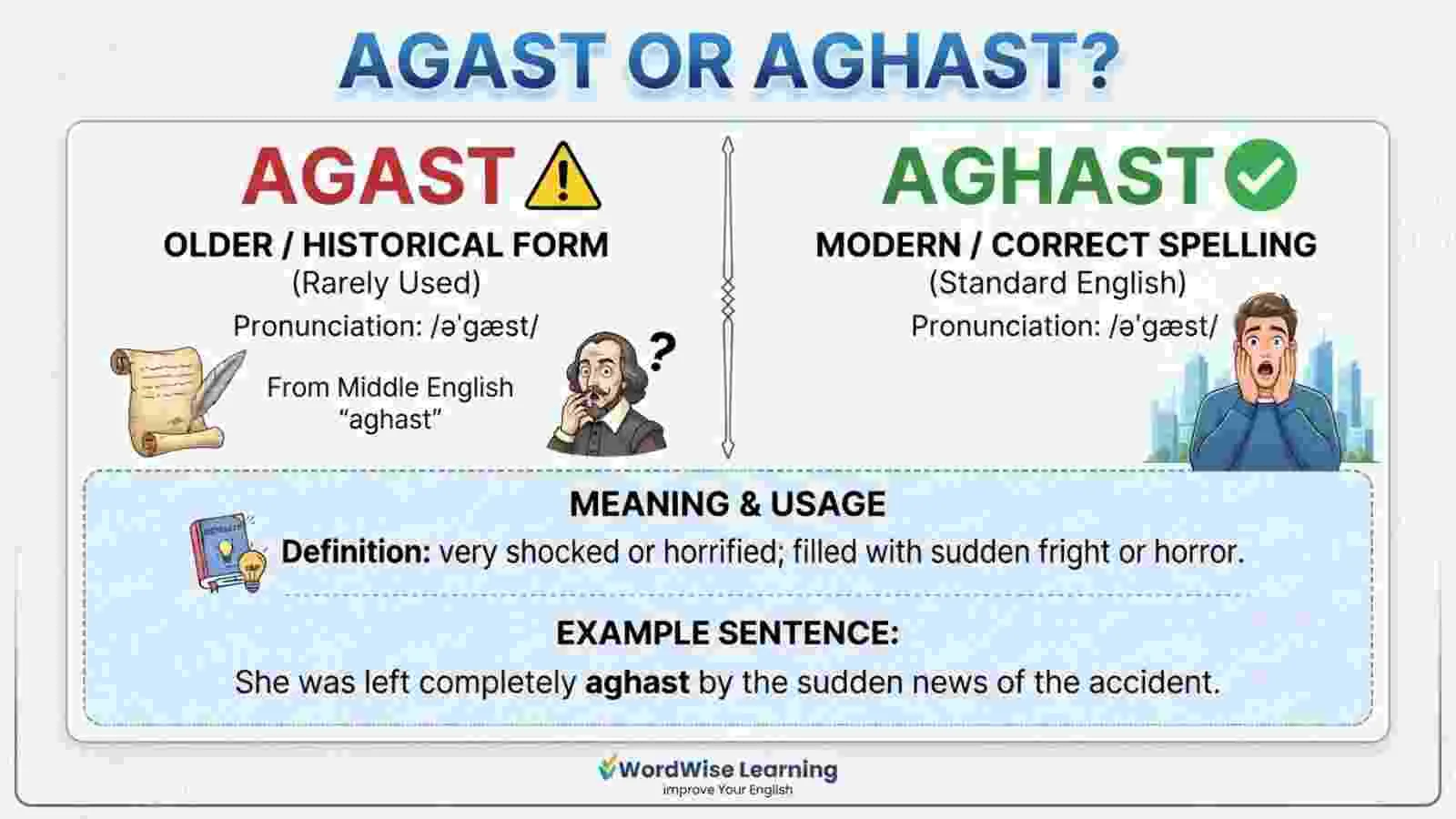
Have you ever seen agast or aghast and wondered which spelling is correct? This is a common English spelling question because both forms have appeared in older texts.
The correct word for modern English is aghast. It means very shocked, frightened, or upset by something you see or hear. For example, you can say, “She was aghast at the news.”
Agast is not simply a common modern spelling mistake. It is an older form of the word. Historical dictionaries record agast as an earlier form, but modern English uses aghast as the standard spelling.
People often search for agast or aghast because the extra h can seem strange. The word is also pronounced differently from how some readers may expect. This guide explains the meaning, spelling, history, pronunciation, British and American usage, common mistakes, and easy examples.
The simple rule is easy to remember:
Modern English: aghast
Older form: agast
Agast or Aghast – Quick Answer
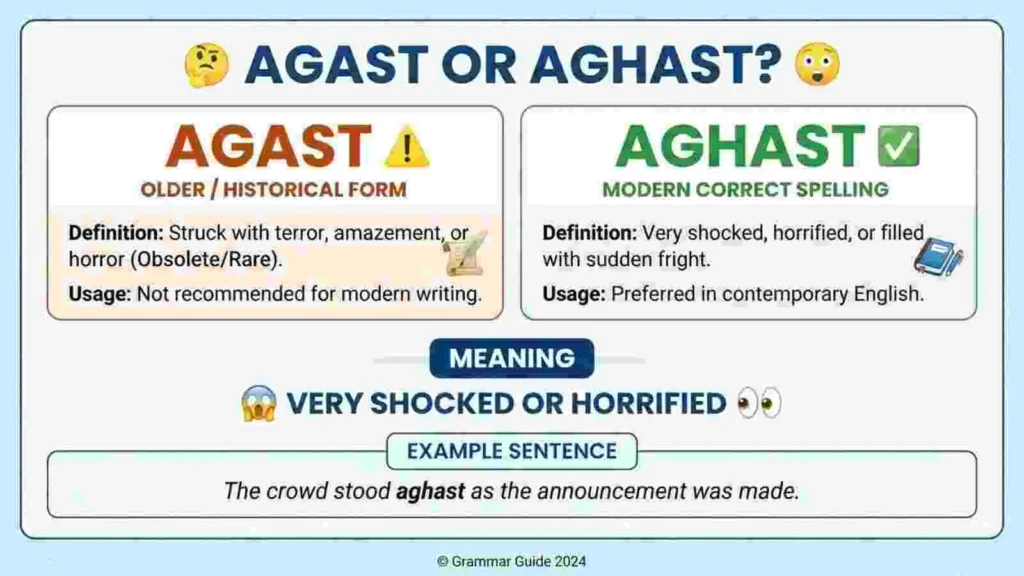
Aghast is the correct and standard spelling in modern English.
Agast is an older form that appears in historical English. It is not the normal spelling to use in modern writing.
What does aghast mean?
Aghast means very shocked, frightened, or filled with horror and surprise.
Examples:
- She looked aghast at the news.
- He was aghast at what he saw.
- They stood aghast after hearing the story.
Quick rule
Use: aghast ✅
Avoid: agast ❌ in normal modern writing.
The word is usually followed by at when you say what caused the shock:
She was aghast at the sudden change.
Cambridge defines aghast as being suddenly filled with strong feelings of shock and worry.
What Is the Difference Between Agast and Aghast?
The main difference is modern versus historical usage.
| Term | Modern Standard English? | Meaning | Example |
| aghast | ✅ Yes | Very shocked, frightened, or horrified | She was aghast at the news. |
| agast | ❌ Usually no | Older form of aghast | Found mainly in older or historical texts. |
The two forms are closely related. Agast was an older form of the word. Over time, aghast became the standard modern spelling.
So, if you are writing an email, essay, article, message, or school assignment, choose aghast.
A simple way to understand it
Think of the words this way:
agast → older form
aghast → modern form
This makes the choice much easier.
What Does Aghast Mean?
Aghast is an adjective.
It describes a person who feels strong shock, fear, horror, or surprise.
Simple meaning
Aghast = very shocked or horrified
For example:
The parents were aghast at the damage.
This means the parents were very shocked by the damage.
Another example:
She looked aghast when she heard the news.
This means she looked very shocked or upset.
Aghast synonyms
Common words with a similar meaning include:
- shocked
- horrified
- stunned
- amazed
- frightened
- appalled
The exact meaning depends on the sentence. Aghast often combines strong shock with fear, horror, or amazement.
Main Differences Between Agast and Aghast
There are four useful points to remember.
1. Spelling
Modern English uses aghast.
aghast ✅
Agast is an old form.
agast ❌ for normal modern writing
2. Meaning
Both forms are connected to the same older word and describe fear or shock. The modern word aghast carries this meaning today.
3. Usage
Use aghast in modern writing.
You may find agast in old books, historical texts, or discussions about word history.
4. Pronunciation
The spelling is the same in British and American English, but the pronunciation can differ by accent.
Cambridge gives British pronunciation as approximately uh-GAAST and American pronunciation as approximately uh-GAST.
The Origin and History of Agast and Aghast
The history of aghast explains why agast looks like a possible spelling.
The word goes back to Middle English agast, which came from the verb agasten, meaning “to frighten.” That verb is linked to Old English gǣstan, also meaning “to frighten,” and to an Old English word connected with ghost.
The older spelling agast was used in English centuries ago.
Later, the spelling with gh became common. Historical sources connect the modern spelling with forms influenced by words such as ghost and ghastly. Oxford notes that the spelling with gh became general by about 1700.
A simple timeline is:
Old English → Middle English agast → Modern English aghast
The exact spelling history is more complex than this short timeline, but the main point is clear: agast is historically real, while aghast is the standard modern form.
British English vs American English
There is no modern spelling difference between British and American English.
Both use:
aghast
The main difference is pronunciation.
| Feature | British English | American English |
| Standard spelling | aghast | aghast |
| Meaning | Shocked, frightened, or horrified | Shocked, frightened, or horrified |
| Pronunciation | /əˈɡɑːst/ | /əˈɡæst/ |
| Agast as normal modern spelling | No | No |
Cambridge lists the same spelling for both varieties and gives different pronunciation guides.
Is “agast” the British spelling?
No.
Agast is not a special British spelling. It is an older form. Modern British English uses aghast.
Is “agast” the American spelling?
No.
American English also uses aghast.
So the easy rule is:
UK: aghast
US: aghast
Which One Should You Use?
For almost every modern English situation, use aghast.
Everyday writing
Use:
I was aghast at the news.
School writing
Use:
The students were aghast at the sudden announcement.
Academic writing
Use aghast when the word fits the meaning and tone.
Business writing
Use:
The team was aghast at the unexpected result.
However, in very formal business writing, a simpler word such as shocked may sometimes be clearer.
Online writing
Use aghast in posts, comments, blogs, and messages when you want to describe strong shock or horror.
Historical writing
You may see agast when reading older English. In that case, keep the original spelling when quoting or studying the historical text.
For normal modern writing, choose aghast.
Common Mistakes With Agast or Aghast
1. Writing “agast” in modern English
Incorrect for normal modern use:
She was agast at the news.
Correct:
She was aghast at the news.
The modern standard spelling includes gh.
2. Treating “agast” as a British spelling
Incorrect idea:
Agast is British English.
Correct:
British English uses aghast.
The spelling does not change between British and American English.
3. Treating “aghast” as a verb
Incorrect:
The news aghasted her.
Correct:
She was aghast at the news.
Aghast is an adjective in modern English.
4. Using “aghast” when you only mean surprised
Less exact:
I was aghast when my friend arrived early.
Better:
I was surprised when my friend arrived early.
Aghast usually suggests a much stronger feeling than simple surprise.
5. Forgetting “at”
A common pattern is:
aghast at something
Example:
She was aghast at the high cost.
This is a useful structure to remember.
6. Adding the wrong ending
Incorrect:
He looked aghasting.
Better:
He looked aghast.
Use aghast as the adjective. Do not treat it like a normal verb.
Agast or Aghast: 10 Everyday Examples
- She was aghast at the sudden news.
- He looked aghast when he saw the damage.
- The children stood aghast after the loud crash.
- I was aghast at the amount of money they spent.
- The teacher looked aghast at the messy room.
- They were aghast when the plan failed.
- She stared at the screen aghast.
- The family was aghast at what had happened.
- He looked aghast after hearing the shocking story.
- We were aghast at the sudden change.
More simple examples
She looked aghast.
He stood aghast.
They were aghast at the news.
These examples show how the word works naturally in a sentence.
Aghast in Real-Life Usage
In conversation
“I was aghast when I saw the bill!”
Here, aghast shows strong shock.
In an email
I was aghast at the sudden change in the schedule.
This works when the writer wants to show strong surprise or shock.
At school
The students were aghast when they heard the news.
At work
The staff were aghast at the unexpected announcement.
On social media
I was absolutely aghast when I saw this!
This is an informal use.
In formal writing
The public was aghast at the scale of the damage.
Aghast is often described as a formal word, so it can fit serious writing well.
Related Search Questions
Is “agast” correct?
Agast is a historical form of the word, but aghast is the standard spelling in modern English. If you are writing modern English, use aghast.
Is “aghast” the correct spelling?
Yes. Aghast is the standard modern spelling. It means very shocked, frightened, or horrified.
Is “agast” an old word?
Yes. Historical dictionaries record agast as an older form of aghast. It can appear in old texts and historical language studies.
How do you use “aghast” in a sentence?
A common pattern is:
Someone was aghast at something.
Example:
She was aghast at the news.
You can also use it after a linking verb:
He looked aghast.
Is “aghast” British or American?
It is used in both British and American English. The spelling is the same. The main difference is pronunciation.
What is another word for aghast?
Depending on the sentence, you can use shocked, horrified, stunned, appalled, or frightened.
Usage and Search Trends
Searches for agast or aghast mainly reflect a spelling and meaning question. People may see the shorter form agast in older material and wonder whether it is still correct.
There is also a pronunciation reason for the confusion. The gh in aghast does not represent a separate “h” sound in modern pronunciation. This can make agast look like a logical spelling to some learners.
Current dictionaries consistently give aghast as the modern headword. Cambridge, Oxford, Collins, and American Heritage all document the modern word and its meaning.
Exact Google search volume or Google Trends numbers should not be stated without current verified data. The useful search-intent takeaway is simple:
People looking for the modern spelling should use “aghast.”
Agast vs Aghast: Comparison Table
| Word | Modern Use | Meaning | Example |
| aghast | ✅ Standard | Very shocked or horrified | She was aghast at the news. |
| agast | ⚠️ Historical/obsolete | Older form of aghast | The old text used agast. |
Quick comparison
Aghast = modern English
Agast = older English form
FAQs About Agast or Aghast
1. Is it “agast” or “aghast”?
The correct modern spelling is aghast. It means very shocked, frightened, or horrified. Agast is an older form that can be found in historical English, but it is not the normal spelling to use today.
2. What does “aghast” mean?
Aghast means suddenly very shocked, frightened, or horrified by something. It can describe a strong reaction to bad news, a frightening sight, or a surprising event. For example, “She looked aghast at the damage” means she looked very shocked or horrified.
3. Is “agast” a misspelling?
In modern everyday English, agast should usually be treated as an incorrect spelling. However, it was a real historical form of the word. So it is not simply a made-up spelling. It belongs mainly to older English and historical texts.
4. Is “aghast” used in British English?
Yes. Aghast is the standard spelling in British English. British pronunciation is commonly given as /əˈɡɑːst/. American English also uses the same spelling, although its common pronunciation differs.
5. Is “aghast” used in American English?
Yes. American English uses aghast. American pronunciation can be /əˈɡæst/ or /əˈɡɑst/, depending on the speaker and variety. The spelling remains aghast.
6. What is the difference between agast and aghast?
The main difference is historical usage. Agast is an older form, while aghast is the established modern spelling. Both are linked to older words meaning to frighten, but modern readers should use aghast in normal writing.
7. What is an easy way to remember aghast?
Think of aghast as the modern spelling with gh. You can also connect it with ghastly, which has a similar spelling and a related feeling of horror. The key rule is simple: modern English = aghast.
Conclusion
If you are choosing between agast or aghast, use aghast in modern English. It is the standard spelling used in both British and American English.
Aghast means very shocked, frightened, or horrified. You can use it for a strong reaction to bad news, a frightening event, or something that causes great surprise. A common sentence pattern is “aghast at”, as in “She was aghast at the news.”
The spelling agast has a real history. It was used in older forms of English and can still appear in historical texts. It is therefore useful to know, but it is not the normal modern spelling.
There is no British versus American spelling difference here. Both varieties use aghast. The main difference is pronunciation.
So, when writing an email, essay, article, school assignment, or social media post, choose aghast. If you see agast in an old text, it may be a historical form rather than a simple spelling error.
The easiest rule to remember is:
Aghast is correct for modern English.