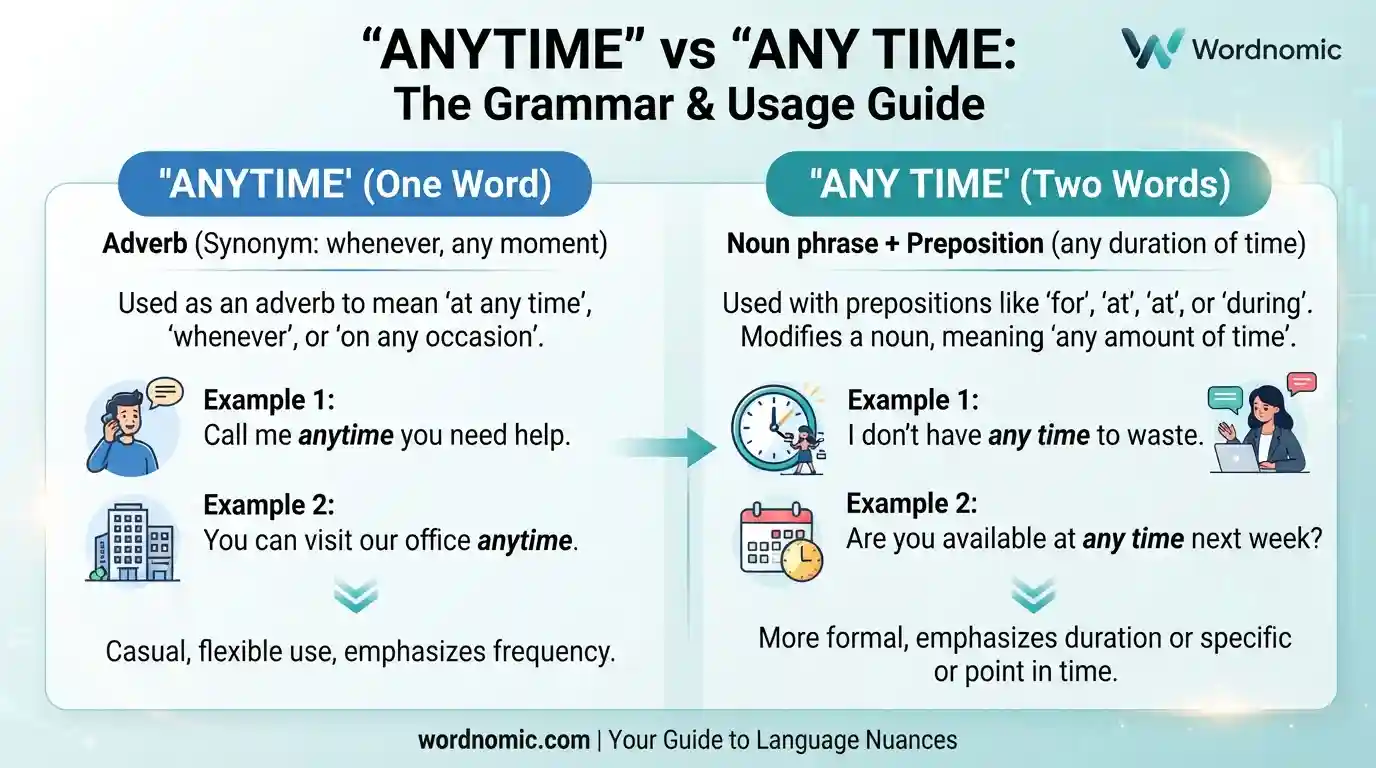
Anytime or any time can confuse even strong English writers. The two forms look almost the same, but they do not always work in the same way. So, which one should you use?
The answer is simple: both “anytime” and “any time” are correct, but they are used in different ways.
Any time is the older and more flexible form. It can mean “at any time” and can be used in many sentence structures. Anytime is usually an adverb that means “whenever” or “at any time.” It is common in modern, informal English.
For example:
You can call me any time.
You can call me anytime.
Both can be correct in this type of sentence.
However, there is an important rule. Anytime cannot always replace any time. For example, after the word at, use any time, not “at anytime.”
This guide explains the difference between anytime and any time, their history, British and American usage, common mistakes, and many simple examples.
Anytime or Any Time – Quick Answer
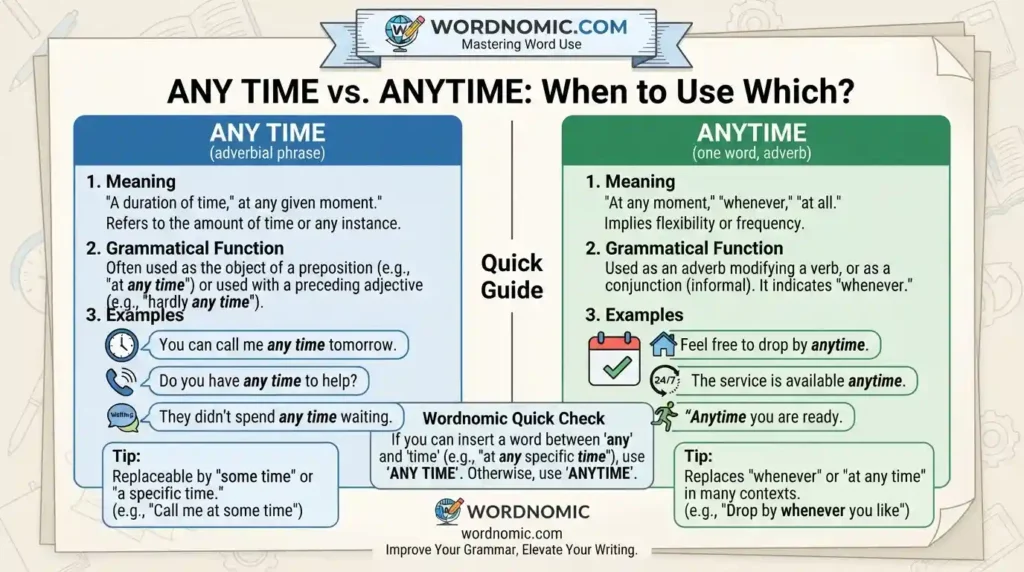
“Anytime” and “any time” can both be correct, but they are not always interchangeable.
Use anytime mainly as an adverb meaning whenever or at any time.
Use any time when the phrase works as a noun phrase or follows a preposition such as at.
Examples
Anytime:
Call me anytime.
Any time:
You can call me at any time.
Easy rule
- Anytime = usually an adverb
- Any time = usually a noun phrase
- After at, use any time
Correct:
Call me anytime.
Correct:
Call me at any time.
Incorrect in standard edited English:
Call me at anytime.
The Meaning of Anytime
Anytime means “whenever” or “at any time.”
It tells us that something can happen at any moment.
Examples:
- You can visit me anytime.
- Call me anytime.
- We can start anytime.
- Come over anytime you want.
In these sentences, “anytime” works as an adverb.
A useful test is to replace anytime with whenever.
Call me anytime.
Call me whenever you want.
Both have a similar meaning.
The Meaning of Any Time
Any time is made of two separate words.
Here, time is a noun.
Examples:
Do you have any time today?
I do not have any time to waste.
You can come at any time.
In these sentences, “time” refers to a period or amount of time.
This is why you should not always write “anytime.”
Compare these examples
Call me anytime.
Here, the word means whenever.
But:
Do you have any time for a meeting?
Here, “time” is a noun. You are asking whether someone has enough free time.
The Origin of Anytime and Any Time
The phrase any time comes from the combination of any and time.
“Any” has long been used in English to refer to one or more possible things without choosing a specific one.
“Time” is an old English word that refers to a period, moment, or occasion.
The single-word form anytime developed later as English usage changed. It became common as an adverb meaning “at any time” or “whenever.”
The two-word form remains important because any time can still function as a normal noun phrase.
This explains why modern English has both forms.
The spelling depends on how the phrase works in the sentence.
British English vs American English Spelling
Both anytime and any time are used in British and American English.
There is no major US-versus-UK spelling difference like color/colour or center/centre.
The main issue is grammar and sentence structure, not nationality.
| Usage | American English | British English |
| Call me anytime. | Correct | Correct |
| Call me at any time. | Correct | Correct |
| Do you have any time? | Correct | Correct |
| At anytime | Usually avoided in edited writing | Usually avoided in edited writing |
| Anytime as “whenever” | Common | Common |
Is “anytime” more American?
It is common in American English, but British English also uses it.
So, it is not correct to say that “anytime” is only American.
Is “any time” more formal?
Often, any time can sound more formal or careful, especially in phrases such as:
You may contact us at any time.
But this does not mean that “anytime” is informal in every situation.
Which Spelling Should You Use?
The best form depends on how you use it.
For everyday writing
Use anytime when you mean “whenever.”
You can call me anytime.
This sounds natural and friendly.
For formal writing
Use any time when it follows at.
Please contact our office at any time.
This is clear and standard.
For American English
Both forms are used.
Call me anytime.
You may contact me at any time.
For British English
Both forms are also used.
The same grammar rule applies.
For global English
Focus on the sentence structure rather than choosing a form based on country.
If you mean whenever, “anytime” often works well.
If you use at, write any time.
Common Mistakes with Anytime or Any Time
Mistake 1: Writing “at anytime”
Incorrect:
You can contact me at anytime.
Correct:
You can contact me at any time.
After the preposition at, use the two-word form.
Mistake 2: Using “anytime” when “any time” is a noun
Incorrect:
Do you have anytime for me?
Correct:
Do you have any time for me?
Here, “time” means free time, so it stays separate.
Mistake 3: Thinking “anytime” is always wrong
Incorrect idea:
Anytime is not a real word.
Correct:
Anytime is a correct English word.
Example:
You can visit anytime.
Mistake 4: Thinking “any time” is always better
“Any time” is not always the only correct form.
Example:
Call me anytime.
This is correct and natural.
Mistake 5: Using “anytime” after every preposition
Be careful with phrases that contain a preposition.
Correct:
You can come anytime.
Correct:
You can come at any time.
Not standard:
You can come at anytime.
Mistake 6: Confusing “any time” with “free time”
“Any time” can refer to any possible period.
Example:
Do you have any time tomorrow?
This asks about availability.
Anytime or Any Time in Everyday Examples
Emails
Please call me anytime if you have questions.
You may contact our office at any time.
News writing
The storm could return at any time.
Here, at any time is the natural form.
Social media
Message me anytime!
This sounds friendly and natural.
Formal writing
Customers may cancel their order at any time.
The two-word form works well after “at.”
School writing
Students can ask questions anytime.
Or:
Students can ask questions at any time.
Both can work, depending on the sentence.
Work conversations
Let me know anytime you need help.
This sounds natural in everyday work communication.
Anytime or Any Time: More Examples
- You can call me anytime.
- Please visit us anytime.
- Do you have any time tomorrow?
- You may leave at any time.
- Call me anytime you need help.
- I do not have any time today.
- The meeting can start anytime.
- The price may change at any time.
- Can we find any time for a meeting?
- Feel free to email me anytime.
- You can ask questions at any time.
- I can meet you anytime after lunch.
These examples show why the two forms cannot always replace each other.
A Simple Test: Can You Replace It With “Whenever”?
One easy way to decide whether to use anytime is to try the word whenever.
If “whenever” works, anytime often works too.
Call me anytime.
Call me whenever you want.
Another example:
You can visit anytime.
You can visit whenever you want.
But this test does not work when time is being used as a noun.
Do you have any time today?
You cannot naturally replace “any time” with “whenever.”
So the meaning and grammar of the sentence matter.
Related Search Questions
Is anytime one word or two words?
Both forms exist. Anytime is one word when it works as an adverb meaning “whenever.” Any time is two words when “time” acts as a noun or when it follows a preposition such as “at.”
Is “at anytime” correct?
In standard edited English, write at any time. The word “at” is a preposition, and the standard phrase is “at any time,” with “any” and “time” written separately.
Can I say “call me anytime”?
Yes. Call me anytime is correct and very common. Here, “anytime” means “whenever you want” or “at any time.”
Is “anytime” formal English?
Anytime is standard English, but it often has a more casual or modern feel. In formal writing, you can use it when the grammar calls for it. The phrase “at any time” is often a good formal choice.
Is “any time” always two words?
No. English also has the one-word adverb anytime. The correct form depends on how the word works in the sentence.
Do British people use “anytime”?
Yes. British English uses both anytime and any time. The same basic grammar rules apply.
Which is better, anytime or any time?
Neither form is always better. Use anytime when it works as an adverb. Use any time when “time” is a noun or when it follows “at,” such as at any time.
Anytime or Any Time – Google Trends and Usage Data
Exact search-volume numbers or Google Trends figures should not be invented without reliable current data.
The general usage pattern is easier to explain.
People often search for anytime or any time because the two forms look very similar. The main question is whether the word should be joined or separated.
Modern English commonly uses anytime as an adverb:
You can call me anytime.
The two-word form remains very common in structures such as:
at any time
and:
Do you have any time?
The important factor is sentence structure, not simply whether the writer uses American or British English.
Anytime vs Any Time Comparison Table
| Form | Main Use | Example |
| anytime | Adverb meaning “whenever” | Call me anytime. |
| any time | Noun phrase | Do you have any time? |
| at any time | Prepositional phrase | You can leave at any time. |
| anytime you want | Adverbial expression | Come anytime you want. |
| any time today | Refers to an available period | Do you have any time today? |
Quick rule to remember
Anytime = whenever
Call me anytime.
Any time = a possible period or amount of time
Do you have any time?
At any time = always write two words
You may leave at any time.
FAQs
1. What is the difference between anytime and any time?
Anytime is usually an adverb that means “whenever” or “at any time.” Any time uses “time” as a noun. For example, “Call me anytime” uses the one-word form, while “Do you have any time?” uses the two-word form.
2. Should I write “at any time” or “at anytime”?
Write at any time. This is the standard form in edited English. The word “at” is followed by the two-word phrase “any time.” For example, “You can contact us at any time.”
3. Is “anytime” grammatically correct?
Yes. Anytime is a correct English word when it functions as an adverb. For example, “You can visit anytime” is correct. It means that you can visit whenever you want.
4. Can “anytime” and “any time” mean the same thing?
Sometimes they can express nearly the same idea. For example, “Call me anytime” and “Call me at any time” have almost the same meaning. However, “Do you have any time?” cannot normally be changed to “Do you have anytime?”
5. Is anytime one word in American English?
Yes. American English commonly uses anytime as an adverb. However, American English also uses the two-word form “any time” in phrases such as “at any time” and “do you have any time?”
6. Is anytime one word in British English?
Yes. British English also uses anytime as an adverb. British writers also use “any time” when the grammar requires the two-word form.
7. How can I remember the difference?
Use this simple trick: if you can replace the word with whenever, “anytime” often works. If “time” means an amount or period, use any time. After at, always use at any time.
Conclusion
The choice between anytime or any time depends on how the phrase works in your sentence. Both forms are correct, but they do not always have the same grammar.
Use anytime as an adverb when you mean “whenever.”
Call me anytime.
Use any time when “time” works as a noun.
Do you have any time today?
When the phrase follows at, use two words:
You can call me at any time.
This rule works in both American and British English. You do not need to choose a spelling based only on your country.
The easiest way to remember the difference is to look at the role of time. If the whole word acts like an adverb, anytime often works. If “time” is a noun or follows “at,” use any time.
When you are unsure, check the sentence rather than simply choosing the form that looks more familiar.

Emily Carter is an English grammar writer based in Portland, Oregon, with 7+ years of experience turning tricky grammar rules into simple, easy lessons.