Among or amongst is a common English word choice that can confuse writers. Both words look almost the same, and both can have the same meaning. So, which one is correct?
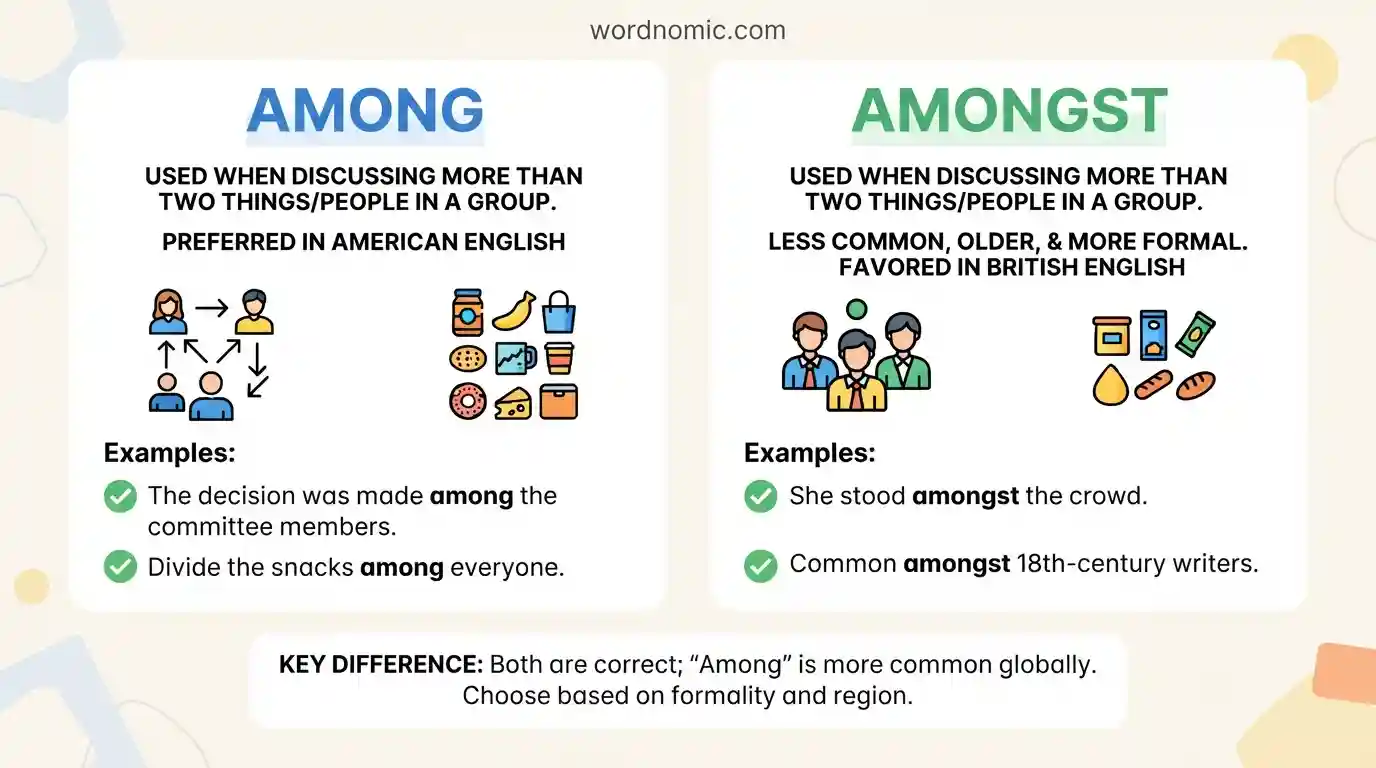
The simple answer is that both “among” and “amongst” are correct. They can both mean being in a group, surrounded by people or things, or included with others. The main difference is style and usage.
Among is much more common in modern English. People use it in everyday speech, school writing, emails, business writing, and most other situations. Amongst is less common. It can sound more formal, old-fashioned, or literary, especially in American English.
For most readers, among is the safe and natural choice.
This guide explains the difference between among and amongst, their meanings, history, British and American usage, common mistakes, and real examples. You will also learn when to use each word and why one may sound more natural than the other.
Among or Amongst – Quick Answer
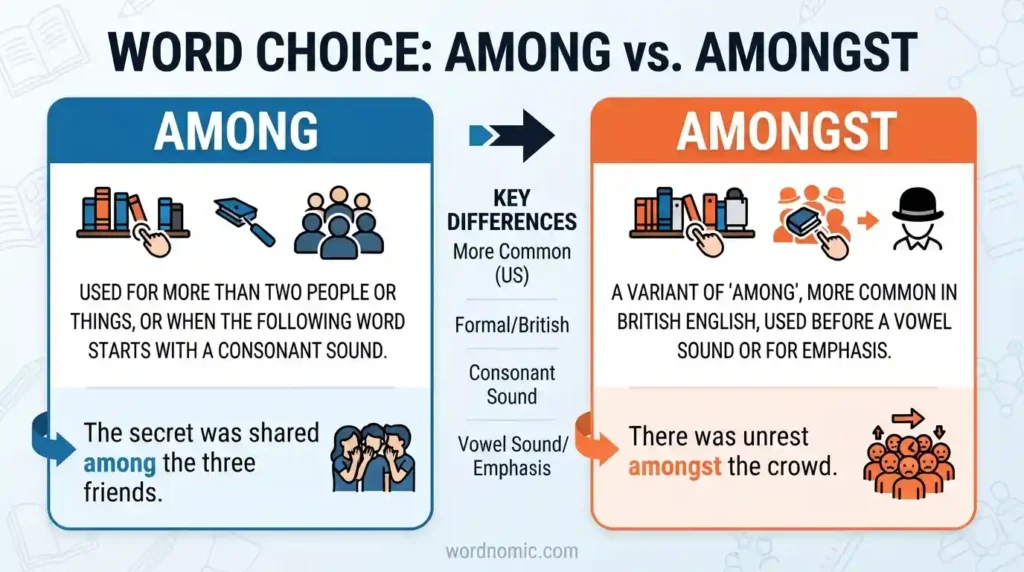
Among and amongst are both correct words. They have the same basic meaning.
Use among in most situations because it is more common and natural in modern English.
Use amongst when you want a more formal, literary, or traditional style.
Examples:
- She was sitting among her friends.
- She was sitting amongst her friends.
Both sentences are correct. The first one is more common.
Simple rule
Among = common and natural
Amongst = less common and more formal or literary
There is no major difference in meaning between the two words.
What Does Among Mean?
Among means being in or surrounded by a group of people or things.
It often shows that someone or something is part of a group.
Examples:
- He stood among the students.
- The house is hidden among the trees.
- She felt happy among her friends.
- There was a lot of excitement among the crowd.
Among can also mean that something is shared or happens within a group.
For example:
The teacher divided the books among the students.
Here, the books are shared within the group of students.
What Does Amongst Mean?
Amongst has the same basic meaning as among.
It can also describe someone or something that is surrounded by or included in a group.
Examples:
- He walked amongst the trees.
- She felt safe amongst her family.
- The news spread quickly amongst the workers.
The main difference is not meaning. It is style and frequency.
“Amongst” often sounds more formal, traditional, or literary. It is also more common in British English than in American English, although “among” remains very common in Britain too.
Among vs Amongst: Main Differences
The two words have almost the same meaning, but their use can feel different.
1. Frequency
Among is much more common in modern English.
Amongst is less common.
If you are unsure, among is usually the better choice.
2. Style
Among sounds simple and natural.
Amongst can sound more formal or old-fashioned.
Compare:
She walked among the trees.
She walked amongst the trees.
Both are correct. The second sentence has a more literary feel.
3. American English
American English strongly favors among.
You may still see “amongst,” but it is less common.
4. British English
British English uses both forms.
“Among” is still very common, while “amongst” can appear more often in formal or literary writing.
5. Meaning
There is usually no important difference in meaning.
Both words can mean:
- in a group
- surrounded by others
- included with others
- within a group
Origin and History of Among and Amongst
The words among and amongst are old English forms.
Among developed from older forms of English that expressed the idea of being in a group or surrounded by others.
Amongst developed as a longer form of among. The ending “-st” appears in several older English words.
English once used several forms that are now rare or have changed over time. Among and amongst survived into modern English.
Today, both remain correct, but among has become the more common form in everyday English.
The same pattern can be seen in words such as:
- amid and amidst
- while and whilst
The shorter form is often more common in modern writing.
British English vs American English
There is a small usage difference between British and American English.
| English Type | Common Form | Notes |
| American English | among | Much more common |
| British English | among | Very common |
| British English | amongst | Also used, often with a formal or literary feel |
| Formal writing | among | Usually the safer choice |
| Literary writing | among / amongst | Both can work |
The key point is that amongst is not wrong in American English, and among is not only a British form.
Both forms are understood in both varieties of English.
Which One Should You Use?
For most writing, choose among.
It works well in:
- Everyday conversation
- School writing
- Academic writing
- Business emails
- Reports
- News writing
- Online writing
- General English
Use “among” when you want simple, modern English
Example:
The decision caused concern among employees.
This sounds clear and natural.
Use “amongst” when the style calls for it
Amongst may fit a more formal, traditional, or literary sentence.
Example:
The old castle stood amongst the hills.
This is correct, but “among the hills” is also natural.
What if you are writing for a global audience?
Choose among.
It is easy to understand and widely used.
Common Mistakes With Among and Amongst
Mistake 1: Thinking “amongst” is wrong
Incorrect idea: Amongst is always incorrect.
Correct: Amongst is a correct English word.
Example:
She walked amongst the flowers.
This sentence is grammatically correct.
Mistake 2: Thinking “among” is only American
Incorrect idea: Among is only used in American English.
Correct: Among is common in both American and British English.
Example:
He was popular among his classmates.
Mistake 3: Using “amongst” in every sentence
Amongst is correct, but it can sound too formal in simple writing.
Less natural for everyday writing:
I found my keys amongst my books.
More natural:
I found my keys among my books.
Mistake 4: Using the wrong meaning
Among normally refers to a group or several things.
Example:
She sat among her friends.
Do not use it when you need a simple two-person relationship. In many such cases, between works better.
Example:
The agreement was between John and Mark.
Mistake 5: Thinking the words have different meanings
Among and amongst usually have the same meaning.
Example:
The bird flew among the trees.
The bird flew amongst the trees.
Both sentences say that the bird flew within or around the group of trees.
Mistake 6: Avoiding “among” because it seems too simple
Some writers choose “amongst” because they think it sounds more professional.
That is not always true.
Clear writing is often better than writing that sounds overly formal.
Everyday Examples of Among and Amongst
Here are some simple examples:
- She sat among her friends.
- The house is hidden among the trees.
- He was standing among the crowd.
- The teacher shared the books among the students.
- There was a lot of excitement among the fans.
- The little house stood amongst the green hills.
- She felt happy amongst her family.
- The bird disappeared amongst the leaves.
- The news spread quickly among the workers.
- He found an old photo among his papers.
- The child ran among the trees.
- She felt comfortable amongst her friends.
Among or Amongst in Real-Life Usage
In conversation
Most people will naturally use among.
“I saw Sarah among the people at the party.”
Among sounds simple and normal in everyday speech.
In school writing
Among is usually a good choice.
The story became popular among young readers.
It is clear and easy to understand.
In business writing
Among also works well in professional writing.
The new policy was discussed among team members.
There is usually no need to replace it with “amongst.”
In formal writing
Both forms can be correct.
However, among is still a strong choice because it is clear and widely used.
In literary writing
Amongst may sometimes fit better.
The old road disappeared amongst the trees.
The longer form can give the sentence a traditional or literary tone.
On social media
Among is usually more natural.
I love being among good friends.
It is short and easy to read.
Related Search Questions
Is “amongst” grammatically correct?
Yes. Amongst is grammatically correct. It has the same basic meaning as among. It is less common in modern English and may sound more formal, traditional, or literary.
Is “among” more common than “amongst”?
Yes. Among is more common, especially in everyday modern English and American English. British English also uses among very often.
What is the difference between among and amongst?
The main difference is style and frequency, not meaning. Both can mean being within or surrounded by a group. Among is more common, while amongst can sound more formal or literary.
Is “amongst” British English?
Amongst is often associated with British English because it appears more often there than in American English. However, it is not limited to British English. American speakers and writers can use it too.
Can I use “among” in formal writing?
Yes. Among works well in formal writing, academic writing, business writing, and reports. You do not need to use “amongst” to make your writing sound formal.
Should I use among or amongst in an essay?
Among is usually the safest choice for an essay. It is clear, common, and accepted in both British and American English. Use amongst only if it fits the style of your writing.
Can among and amongst be used in the same way?
In most cases, yes. They can often replace each other without changing the basic meaning of a sentence.
Usage and Search Trends
Exact search-volume or Google Trends numbers should not be used here unless reliable, current data is available.
The general usage pattern is clear: among is the more common form in modern English, while amongst appears less often.
People may search for this pair because they want to know:
- Is among or amongst correct?
- Among vs amongst
- Difference between among and amongst
- Is amongst British English?
- How do you use among?
- How do you use amongst?
- Among or amongst in a sentence
The main reason for the confusion is simple. Both forms are correct, and both can work in many of the same sentences.
Among vs Amongst Comparison Table
| Term | Meaning | Usage | Example |
| Among | In or within a group | Very common | She sat among her friends. |
| Amongst | In or within a group | Less common, often more formal or literary | She sat amongst her friends. |
Quick comparison
| Feature | Among | Amongst |
| Correct English | Yes | Yes |
| Basic meaning | Same | Same |
| Common today | Yes | Less common |
| American English | Very common | Less common |
| British English | Very common | Also common |
| Formal writing | Good choice | Can be used |
| Literary style | Good choice | Can fit well |
| Everyday speech | Very common | Less common |
FAQs
1. Which is correct, among or amongst?
Both are correct. They usually have the same meaning. Among is more common in modern English and works well in almost every type of writing. Amongst is less common and may sound more formal, traditional, or literary.
2. Is amongst more formal than among?
Often, yes, but this is mainly a matter of style. Amongst can sound more formal or old-fashioned to some readers. Among is more neutral. The meaning does not normally change when you replace one with the other.
3. Do Americans use amongst?
Yes, Americans can use amongst, but it is much less common than among in American English. If you are writing for an American audience, among will usually sound more natural.
4. Do British people say amongst?
Yes. British English uses both among and amongst. Among is still very common. Amongst may appear more often in formal, traditional, or literary styles.
5. Can I use amongst in academic writing?
Yes, but you do not need to. Among is clear and fully suitable for academic writing. Choose amongst only when it fits the style and tone of the sentence.
6. Does amongst have a different meaning from among?
No major difference exists in normal modern use. Both words can describe someone or something that is in, surrounded by, or included within a group.
7. Which word should I use most of the time?
Use among most of the time. It is common, clear, and accepted in both British and American English. Use amongst when you want or need its more traditional or literary tone.
Conclusion
Among and amongst are both correct English words. They usually have the same meaning, so the choice is mainly about style and common usage.
Among is the better everyday choice for most writers. It is common in American English and British English. You can use it in conversations, school work, business emails, academic writing, reports, and online content.
Amongst is also correct. It is less common and can give a sentence a more formal, traditional, or literary feel. It is often seen in British English, but it is not only a British word.
You do not need to worry about changing the meaning when you choose between these two forms. In many sentences, either word will work.
If you are unsure which one to use, choose among. It is simple, natural, and widely accepted.
For example:
She was sitting among her friends.
That sentence is clear and natural. You could also write:
She was sitting amongst her friends.
The meaning stays almost the same.