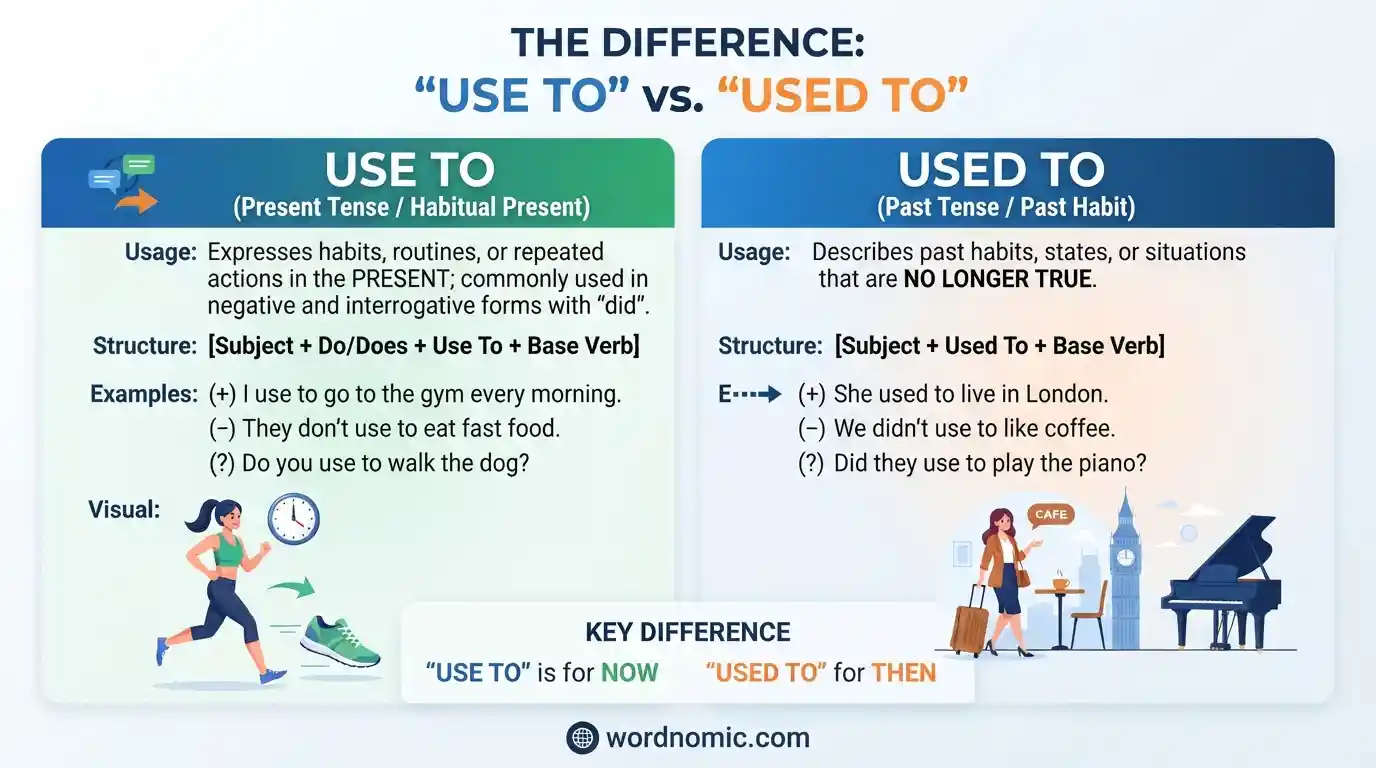
Have you ever stopped while writing a sentence and wondered whether to write use to or used to? This is a very common English grammar problem. The two forms look almost the same, but they are used in different sentence patterns.
The confusion often comes from questions and negative sentences. For example, we say, “I used to play football,” but we write, “Did you use to play football?” The change can look strange at first.
The good news is that the rule is simple. Used to is normally used to talk about a past habit or past state. Use to is normally used after did or did not, because the word “did” already shows the past.
This guide explains the difference in simple English. You will learn when to use each form, see clear examples, learn common mistakes, and understand how the forms work in everyday writing.
Use to or Used to – Quick Answer
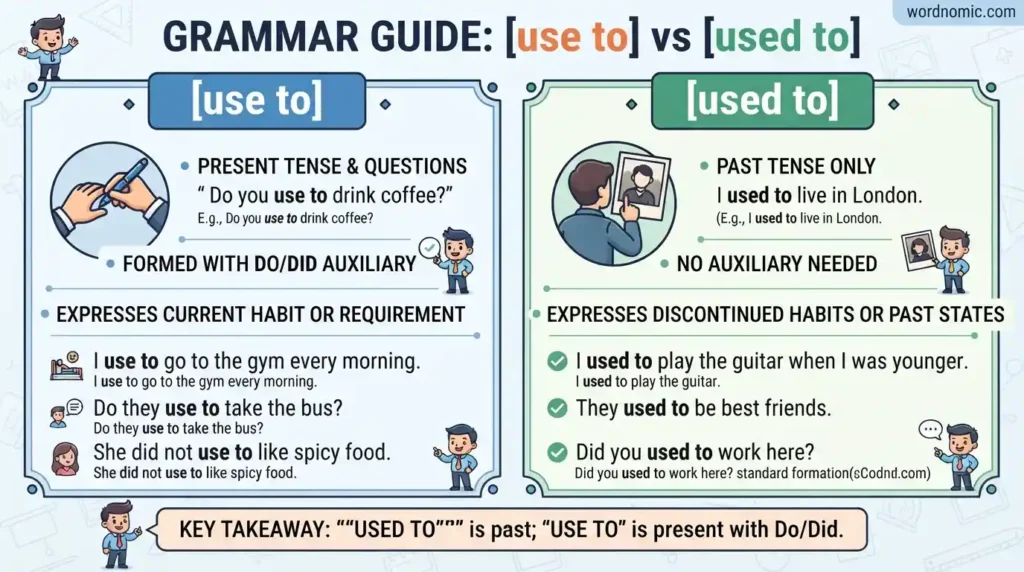
The correct choice depends on the sentence.
Use used to when talking about a past habit or past situation.
Example:
- I used to live in London.
- She used to play tennis.
- We used to visit our grandparents every Sunday.
Use use to after did or did not.
Examples:
- Did you use to live here?
- I did not use to like coffee.
- Did she use to work here?
Easy Rule
Positive sentence: used to
Question with did: use to
Negative with did not: use to
This is the main rule that helps you choose the right form.
What Does Used to Mean?
Used to describes something that happened regularly in the past or was true in the past but is not true now.
For example:
I used to play cricket every weekend.
This means I played cricket regularly in the past. It also suggests that I do not do it now.
Another example:
She used to live in Canada.
This means she lived there in the past, but she lives somewhere else now.
The phrase can describe both actions and states.
Past Habit
We used to walk to school.
Past State
He used to be very shy.
What Does Use to Mean?
Use to normally appears after did or did not when talking about a past habit or state.
For example:
Did you use to watch cartoons?
Here, “did” already shows that the question is about the past. Because of this, the main verb stays in its base form: use, not used.
The same rule applies to negative sentences:
I did not use to eat vegetables.
Not:
I did not used to eat vegetables.
This is one of the most common grammar mistakes with this phrase.
The Origin of Use to or Used to
The word use comes from Old French and Latin roots linked to the idea of using or making use of something.
Over time, English developed the expression used to to describe repeated actions and past states.
The grammar pattern became common because English often uses a past form to show that something happened before now.
When did is used, however, English normally keeps the main verb in its basic form.
For example:
She played tennis.
But:
Did she play tennis?
We do not normally say:
Did she played tennis?
The same idea explains:
She used to play tennis.
But:
Did she use to play tennis?
The word “did” carries the past meaning, so use stays in its base form.
British English vs American English Spelling
There is no major British and American spelling difference between these forms.
Both British and American English use:
- used to
- use to
The difference comes from grammar and sentence structure, not from regional spelling.
| Sentence Type | British English | American English |
| Positive | I used to play. | I used to play. |
| Question | Did you use to play? | Did you use to play? |
| Negative | I did not use to play. | I did not use to play. |
| Past habit | She used to swim. | She used to swim. |
Both varieties follow the same basic rule.
Which Spelling Should You Use?
You do not need to choose a British or American spelling here.
Instead, look at the grammar of the sentence.
Use used to in a normal positive sentence:
I used to live there.
Use use to after did:
Did you use to live there?
Use use to after did not:
I did not use to live there.
This rule works for American English, British English, and most standard forms of English.
If you are writing for a global audience, these same grammar rules are safe to follow.
Common Mistakes with Use to or Used to
1. Writing “Did you used to?”
This is a very common mistake.
Incorrect:
Did you used to play football?
Correct:
Did you use to play football?
The word did already shows the past.
2. Writing “I did not used to”
Incorrect:
I did not used to drink coffee.
Correct:
I did not use to drink coffee.
Again, “did” takes the past meaning.
3. Using “use to” in a positive sentence
Incorrect:
I use to play tennis.
Correct:
I used to play tennis.
Without “did,” the past form is normally used to.
4. Confusing “used to” with “be used to”
These forms have different meanings.
I used to wake up early.
This means it was a past habit.
I am used to waking up early.
This means waking up early is normal or familiar to me now.
5. Confusing “used to” with “use”
The word “use” can also mean using an object.
I use my phone every day.
This is different from:
I used to use my phone less often.
The first sentence describes a current habit. The second describes a past habit.
Use to or Used to in Everyday Examples
In Emails
I used to work with your team.
This can be used when telling someone about a past job or role.
In a Question
Did you use to work here?
This asks about a past situation.
In a Negative Sentence
I did not use to enjoy reading.
This means reading was not a past habit.
In Social Media
I used to travel a lot when I was younger.
This can describe an old habit.
In Formal Writing
The company used to operate in three countries.
This describes a past situation.
In Conversation
Did you use to play football at school?
Yes, I used to play every week.
This shows both forms working together.
10 Simple Examples
- I used to play basketball.
- She used to live in Paris.
- We used to visit them every summer.
- He used to drink tea every morning.
- Did you use to watch that show?
- Did they use to work together?
- I did not use to like spicy food.
- She did not use to drive.
- Did he use to study here?
- They used to be close friends.
These examples show the basic pattern clearly.
Use to or Used to: Comparison Table
| Form | Where It Is Used | Example |
| Used to | Positive past statement | I used to swim. |
| Use to | Question with did | Did you use to swim? |
| Use to | Negative with did not | I did not use to swim. |
| Used to | Past habit | She used to walk. |
| Used to | Past state | He used to be shy. |
| Be used to | Something familiar now | I am used to the noise. |
| Get used to | Becoming familiar | I am getting used to the noise. |
The last two forms have different meanings and should not be mixed with the past-habit form.
Used to vs Be Used to
This is another important difference.
Used to
It describes a past habit or state.
I used to wake up at 6 a.m.
This suggests that I did this in the past.
Be Used to
It means something is familiar or normal.
I am used to waking up at 6 a.m.
This means waking up at 6 a.m. feels normal to me now.
Compare:
I used to drive to work.
I am used to driving to work.
The first talks about a past habit. The second talks about something familiar.
Use to or Used to – Google Trends & Usage Data
Search interest in grammar questions can change over time and across countries. People may search this phrase when they are unsure about questions, negative sentences, or past habits.
Searches may include:
- use to or used to
- used to or use to
- did you use to
- did you used to
- did not use to
- used to meaning
- how to use used to
The search intent is mainly informational. People usually want a quick grammar rule and examples that show why one form is correct.
Exact popularity by country should be checked with a current keyword or search trends tool. It is not useful to claim fixed search numbers without reliable current data.
When Should You Use Each Form?
Use this simple pattern:
Positive
I used to play football.
Question
Did you use to play football?
Negative
I did not use to play football.
This three-line rule solves most cases.
If you see did, use use.
If there is no did and you are describing a past habit or state, use used to.
FAQs
1. Is it use to or used to?
Both can be correct. Use used to in positive statements about past habits or states. Use use to after “did” or “did not.” For example, “I used to play tennis” is correct, while “Did you use to play tennis?” is also correct.
2. Is it “Did you use to” or “Did you used to”?
The standard form is Did you use to. The word “did” already shows the past, so the main verb stays in its base form. Therefore, “Did you used to play?” is not the standard form.
3. Is “I used to” correct?
Yes. I used to is correct when you are talking about a past habit or state. For example, “I used to live in Lahore” means that you lived there in the past.
4. Is “I use to” correct?
Usually, not when you mean a past habit in a positive sentence. You normally need I used to. However, use to is correct after “did” or “did not,” such as “Did you use to live here?”
5. Is it “did not use to” or “did not used to”?
The standard form is did not use to. The word “did” carries the past tense. The main verb therefore stays in its base form.
6. What is the difference between “used to” and “be used to”?
Used to describes a past habit or state. Be used to means something is familiar or normal. For example, “I used to wake up early” talks about a past habit, while “I am used to waking up early” talks about something that feels normal now.
7. Is this rule the same in British and American English?
Yes. British and American English use the same basic grammar pattern. Both use used to in positive statements and use to after “did” or “did not.”
Conclusion
Choosing between use to or used to becomes easy when you look at the sentence structure. The main rule is simple.
Use used to when you make a positive statement about a past habit or past state.
I used to play football.
Use use to when the phrase comes after did or did not.
Did you use to play football?
I did not use to play football.
The reason is that “did” already carries the past tense. The main verb then stays in its basic form.
There is no British versus American spelling difference to worry about here. Both forms follow the same grammar rules.
Also remember that used to, be used to, and get used to have different meanings. Learning this difference can prevent many common mistakes.
When in doubt, check for the word did. If “did” or “did not” comes before the phrase, use use to. In a normal positive past statement, use used to.