A Quick Story First
Fatima worked for a company. It had offices in Pakistan and the US. She wrote a warning message. She typed, “This is an unauthorized login.” Her manager in Lahore read it. She asked, “Shouldn’t that be unauthorised?” Fatima paused. She had never thought about this before.
This mix-up happens a lot. Both spellings look right at first look. But they come from two different styles of English.
Why This Word Confuses People
Both words sound the same. You say them the same way. But they are spelled in two ways. This happens because English has two main styles. One comes from Britain. One comes from the US.
You will see this word in work emails. They will see it in the news too. You will see it in warning messages as well.
Using the wrong one is not a big problem. But it can look a bit odd, especially in work writing.
In this guide, you will get a quick answer first. Then you will learn where this word comes from. You will see common mix-ups too. By the end, you will always know which one to use.
Unauthorised or Unauthorized – The Simple Answer
Here is the easy answer.
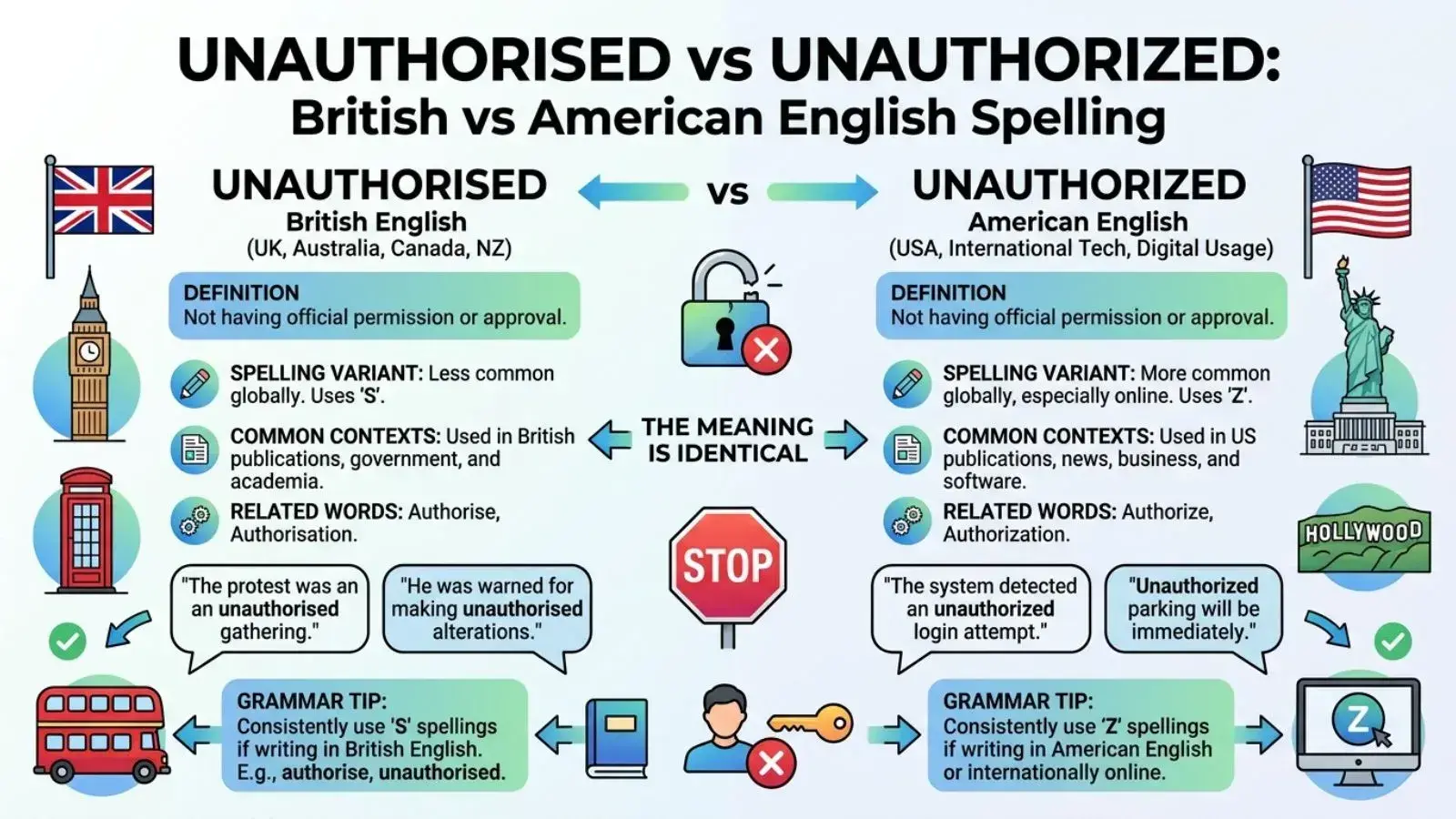
Unauthorised is used in British English. This includes the UK, Pakistan, India, and Australia.
Unauthorized is used in American English. This includes the US and Canada.
Example: “He accessed an unauthorised account.” (British English)
Example: “He accessed an unauthorized account.” (American English)
Both words mean the same thing. They mean something was not officially allowed. Neither one is wrong. It just depends on where your reader lives.
Where This Word Comes From
This word starts with “authorise” or “authorize.” That word means to give someone official permission. Add “un-” to the front. Now it means “not.” Add “-ed” to the end. Now it shows something that already happened.
Put it all together. The word means “not given official permission.”
The spelling split happened a long time ago. British English kept an older style. It uses the letter “s.” American English later moved to a simpler style. It uses the letter “z” instead. You will see this same pattern in other words too, like “organise” and “organize.”
Good and Bad Points of Each Spelling
Unauthorised (British Spelling) – The Good Points:
- It matches the style used in the UK and nearby countries.
- It feels normal to readers in places like Pakistan, India, and Australia.
Unauthorised (British Spelling) – The Bad Points:
- It can look a bit odd to readers in the US.
Unauthorized (American Spelling) – The Good Points:
- It matches the style used in the US and Canada.
- It is the spelling used a lot in global tech and business content.
Unauthorized (American Spelling) – The Bad Points:
- It can look a bit odd to readers in the UK.
British English vs American English Spelling
This word follows a well-known pattern between the two styles.
| Word | British English | American English |
| Unauthorised/Unauthorized | Unauthorised | Unauthorized |
| Organised/Organized | Organised | Organized |
| Realised/Realized | Realised | Realized |
| Recognised/Recognized | Recognised | Recognized |
| Specialised/Specialized | Specialised | Specialized |
Once you learn this rule, it gets much easier to spell many other words too.
Which Spelling Should You Use?
This choice depends on your reader.
Use “unauthorised” if: You are writing for readers in the UK, Pakistan, India, or Australia.
Use “unauthorized” if: You are writing for readers in the US or Canada.
If you write for readers all over the world: Pick one spelling. Use it the whole way through your writing.
If you already used other American or British spellings in the same piece: Match this word to that same style.
A Real Life Example
Ahmed ran a small software company in Karachi. Most of his clients were local. He always used “unauthorised” in his warning messages. His company later got a big client in the US. That client asked why the spelling looked different from what they were used to.
Ahmed made two versions of his messages. One used “unauthorised” for UK and nearby readers. One used “unauthorized” for US readers. This small change made his work feel more normal to every user, no matter where they lived.
Common Mistakes with Unauthorised and Unauthorized
Here are common mistakes. Here is how to fix them.
Mistake 1: Spelling it “unautorised” or “unathorized,” missing a letter by mistake.
Fix: Always check the full word. “Authorise” or “authorize” sits at the middle of it.
Mistake 2: Mixing both spellings in the same piece of writing.
Fix: Pick one style. Use it the whole way through.
Mistake 3: Forgetting that other words, like “authorisation” and “authorization,” follow the same rule. Fix: Remember that the noun form changes the same way too.
Mistake 4: Thinking one spelling is more correct than the other.
Fix: Both spellings are correct. They just belong to two different English styles.
Unauthorised and Unauthorized in Everyday Life
Let’s look at how this word shows up in real life.
In work emails: “Your request was marked as unauthorised access.” (UK) “Your request was marked as unauthorized access.” (US)
In news stories: “Police arrested suspects for unauthorised entry into the building.” (UK) “Police arrested suspects for unauthorized entry into the building.” (US)
On social media: “Warning: This account shows unauthorised activity.” (UK) “Warning: This account shows unauthorized activity.” (US)
In work writing: “Any unauthorised use of company data is not allowed.” (UK) “Any unauthorized use of company data is not allowed.” (US)
These examples show how each spelling fits, based on the writer’s readers.
What People Search Online
People search “unauthorised or unauthorized” a lot while writing work reports, emails, or warning messages. Many people want a clear answer, since getting this word wrong can look careless.
Search interest often comes from people working in tech and business, since this word shows up a lot in warning messages.
Both spellings are searched a lot around the world. “Unauthorized” gets more searches overall, mostly because the US has such a large number of readers. “Unauthorised” stays strong in the UK and nearby countries.
Unauthorised vs Unauthorized Comparison Table
| Feature | Unauthorised | Unauthorized |
| Spelling Style | British English | American English |
| Common Countries | UK, Pakistan, India, Australia | United States, Canada |
| Verb Form | Authorise | Authorize |
| Noun Form | Authorisation | Authorization |
Frequently Asked Questions
1. Is “unauthorised” correct English? Yes. It is correct in British English and many nearby countries.
2. Is “unauthorized” wrong? No. It is correct in American English.
3. Why are there two spellings for this word? British and American English grew apart over time. This led to different rules, especially for words ending in “-ise” or “-ize.”
4. Which spelling should I use for global business writing? Many global tech writers use “unauthorized,” since the US has a large number of readers. But both spellings work well, based on your readers.
5. Can I use both spellings in the same article? It’s best not to. Stick with one spelling style through your whole piece.
6. What does “unauthorized” mean? It means something was not given official permission.
7. Which countries use “unauthorised” the most? The UK, Pakistan, India, and Australia use this spelling the most.
Wrapping It All Up
Unauthorised and unauthorized mean the same thing. Both point to something not officially allowed. The only real difference is spelling style. Unauthorised follows British rules, common in the UK, Pakistan, India, and Australia. Unauthorized follows American rules, common in the US and Canada. This split comes from old changes in spelling. The same pattern shows up in other word pairs too, like organise and organize.
The easy rule to remember is simple. Match your spelling to your reader’s country. Keep it the same through your whole piece of writing.
Now you know the difference. You can write work emails, warnings, and reports with more confidence. Whether you write for local readers or readers around the world, you’ll know which spelling fits. Keep this guide close. You’ll never feel unsure between unauthorised and unauthorized again.
Welcome to the official author page of Clara Wordsmith, grammar writer at Wordnomic. Clara specializes in explaining confusing English words, grammar rules, spelling differences, and vocabulary topics with clear examples and beginner-friendly explanations.










