Have you ever wondered whether you should write temporarily or temporary? You are not alone. These two words look very similar, but they do different jobs in a sentence. Using the wrong one can make your sentence sound unclear or incorrect.
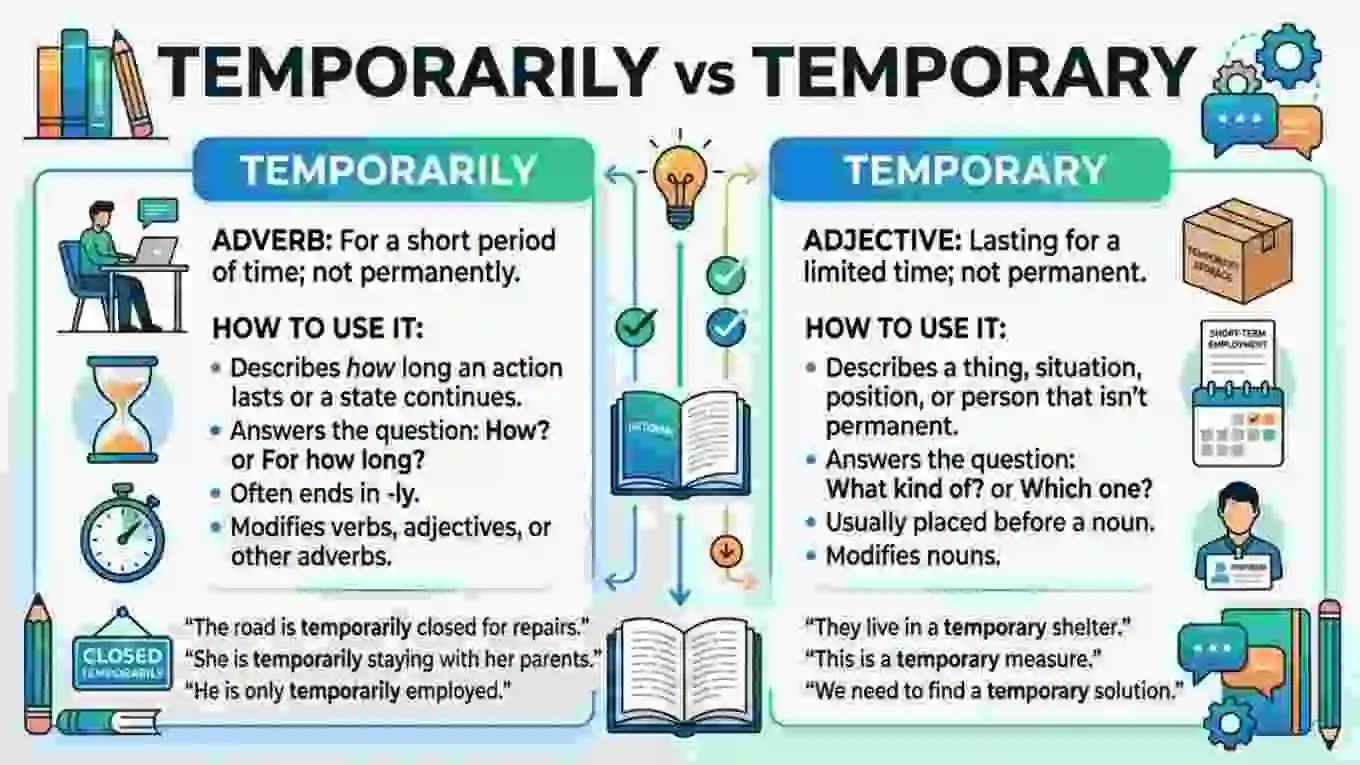
The main difference is simple. Temporary is an adjective. It describes a person, thing, place, job, or situation that will not last forever. Temporarily is an adverb. It tells us that an action happens for a short time.
For example, you can say, “This is a temporary problem.” You can also say, “The store is temporarily closed.”
People often search for “temporarily or temporary” because both words relate to something that lasts for a short time. The ending -ly can make the difference easy to miss.
In this guide, we will explain the meaning, grammar, spelling, history, and correct use of both words. You will also see simple examples, common mistakes, and a quick comparison table. By the end, you will know exactly when to use temporary and when to use temporarily.
Temporarily or Temporary – Quick Answer
Temporary and temporarily are both correct words, but they have different grammar roles.
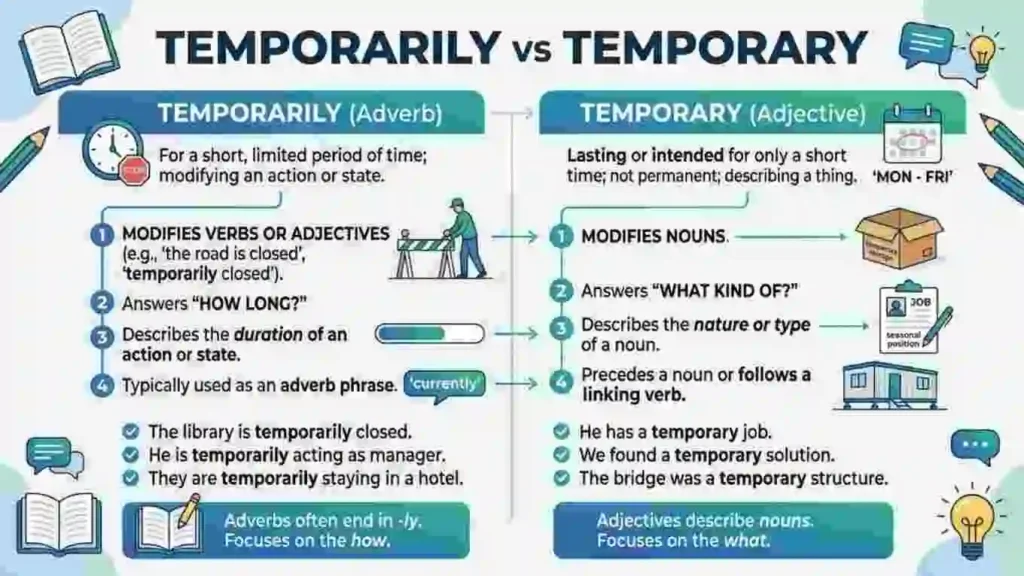
- Temporary is an adjective.
- Temporarily is an adverb.
Use “temporary” to describe a noun
Examples:
- We need a temporary worker.
- This is a temporary office.
- She found a temporary solution.
- He has a temporary job.
Here, temporary describes a noun.
Use “temporarily” to describe an action
Examples:
- The office is temporarily closed.
- The road is temporarily blocked.
- The website is temporarily unavailable.
- She is temporarily living with her parents.
Here, temporarily tells us how or for how long something happens.
Easy rule to remember
Think of it this way:
Temporary = describes a thing.
Temporarily = describes an action or state.
For example:
We have a temporary office.
We are temporarily working from home.
Both sentences are correct.
The Origin of Temporary and Temporarily
The word temporary comes from the Latin word temporarius, which means “of time” or “lasting for a time.”
It is linked to the Latin word tempus, meaning “time.”
The word later entered English through French. English speakers have used temporary for many years to describe something that does not last forever.
The word temporarily comes from temporary plus the adverb ending -ly.
This is a common pattern in English.
For example:
- quick → quickly
- slow → slowly
- normal → normally
- final → finally
- temporary → temporarily
The ending -ly often changes an adjective into an adverb.
That is why temporary and temporarily have almost the same spelling and meaning. Their main difference is their grammar role.
Why do the two words look so similar?
They come from the same word family.
Temporary describes something short-term.
Temporarily tells us that an action or condition happens for a short time.
The meaning stays closely connected, but the grammar changes.
British English vs American English Spelling
There is no major spelling difference between British English and American English for temporary or temporarily.
Both forms are spelled the same:
| Word | British English | American English |
| Temporary | Temporary | Temporary |
| Temporarily | Temporarily | Temporarily |
This means you can safely use the same spelling in both forms of English.
The difference you need to focus on is not British versus American spelling. It is grammar.
British English examples
- The station is temporarily closed.
- He has a temporary job.
- The road is temporarily closed.
American English examples
- The store is temporarily closed.
- She found a temporary solution.
- The office is temporarily unavailable.
The spelling stays the same.
Which Spelling Should You Use?
You do not need to choose between British and American spelling here because temporary and temporarily are standard in both.
Instead, choose the word based on its role in your sentence.
Use “temporary” before a noun
Examples:
- temporary job
- temporary home
- temporary worker
- temporary fix
- temporary change
- temporary problem
In these examples, temporary describes the noun.
Use “temporarily” with an action or condition
Examples:
- temporarily closed
- temporarily stopped
- temporarily unavailable
- temporarily moved
- temporarily disabled
In these examples, temporarily describes what is happening.
For US readers
Use either word based on grammar.
The shop has a temporary closure.
The shop is temporarily closed.
For UK and Commonwealth readers
The same rule applies.
We need a temporary worker.
The worker is temporarily away.
For global writing
Keep the rule simple:
Temporary = adjective.
Temporarily = adverb.
This works for readers around the world.
Common Mistakes with Temporarily or Temporary
Many mistakes happen because the two words have almost the same meaning.
Mistake 1: Using “temporary” after an action
Incorrect:
The store is temporary closed.
Correct:
The store is temporarily closed.
Why?
“Closed” describes a condition. Temporarily tells us that the store is closed for a short time.
Mistake 2: Using “temporarily” before a noun
Incorrect:
She got a temporarily job.
Correct:
She got a temporary job.
Why?
“Job” is a noun, and temporary describes it.
Mistake 3: Writing “temporaryly”
Incorrect:
The website is temporaryly unavailable.
Correct:
The website is temporarily unavailable.
“Temporaryly” is not the standard spelling.
Mistake 4: Thinking the words mean different time periods
Both words relate to something that does not last forever.
The main difference is grammar.
Compare:
This is a temporary change.
The rules have temporarily changed.
The first word describes “change.”
The second word describes the action “changed.”
Mistake 5: Using “temporary” when you need an adverb
Incorrect:
The service has been temporary stopped.
Correct:
The service has been temporarily stopped.
The word temporarily tells the reader that the stopping will not last forever.
Temporarily or Temporary in Everyday Examples
These words appear often in daily English. You can see them in emails, news reports, social media posts, websites, and formal documents.
In emails
You might write:
Our office will be temporarily closed on Monday.
Or:
We are using a temporary office while repairs are completed.
Both are correct.
In news
News reports often use temporarily when describing short-term events.
Example:
The road was temporarily closed after heavy rain.
They may also use temporary to describe a short-term situation.
Example:
The city opened a temporary shelter.
On social media
People often write:
My account is temporarily unavailable.
Or:
I am taking a temporary break from social media.
In formal writing
Both words are common in business and formal writing.
Examples:
The company introduced a temporary policy.
The service was temporarily suspended.
At work
Examples:
- temporary employee
- temporary position
- temporary office
- temporary solution
- temporarily closed
- temporarily unavailable
On websites
You may see messages such as:
This page is temporarily unavailable.
Or:
We are using a temporary page while the site is updated.
Temporarily or Temporary – Comparison Table
| Feature | Temporary | Temporarily |
| Part of speech | Adjective | Adverb |
| Main use | Describes a noun | Describes an action or condition |
| Meaning | Lasting for a short time | For a short time |
| Common position | Before a noun | Often before an adjective, verb, or past participle |
| Example | temporary job | temporarily closed |
| British spelling | Temporary | Temporarily |
| American spelling | Temporary | Temporarily |
More examples
| Temporary | Temporarily |
| temporary job | temporarily closed |
| temporary home | temporarily unavailable |
| temporary worker | temporarily stopped |
| temporary fix | temporarily moved |
| temporary office | temporarily disabled |
| temporary change | temporarily suspended |
How to Remember the Difference
Here is a simple trick.
Ask yourself:
Am I describing a thing?
If yes, use temporary.
a temporary job
Temporary home
a temporary solution
If you are describing an action or condition, use temporarily.
temporarily closed
temporarily stopped
A simple formula
Temporary + noun
Temporarily + action or condition
For example:
temporary problem
temporarily closed
This small rule can help you choose the right word quickly.
Practice Exercise
Choose temporary or temporarily to complete each sentence.
- The shop is ______ closed.
- He found a ______ job.
- The website is ______ unavailable.
- They moved to a ______ home.
- The machine was ______ stopped.
- We need a ______ solution.
Answers
- temporarily
- temporary
- temporarily
- temporary
- temporarily
- temporary
The pattern is clear. Use temporary to describe a noun. Use temporarily to describe an action or condition.
Temporarily or Temporary – Google Trends & Usage Data
Both temporary and temporarily are common English words.
Their search and use patterns are different because people often use them in different situations.
Temporary is common in phrases related to:
- temporary jobs
- temporary housing
- temporary workers
- temporary solutions
- temporary offices
- temporary changes
Temporarily is common in phrases related to:
- temporarily closed
- temporarily unavailable
- temporarily suspended
- temporarily disabled
- temporarily blocked
- temporarily out of stock
Search interest can also change based on the topic.
For example, people may search for temporarily closed when a store, road, website, or service is not available for a short time.
People may search for temporary job when they are looking for short-term work.
There is no British or American spelling difference to worry about. Both countries use temporary and temporarily in the same way.
For SEO content, the best approach is to answer the exact question behind the search. Someone searching “temporarily or temporary” usually wants to know which word fits a sentence.
So, give the direct answer first, then explain the grammar with short examples.
FAQs;
1. Is “temporary” a correct word?
Yes. Temporary is a correct and common English adjective. It describes something that does not last forever.
Example:
She has a temporary job.
2. Is “temporarily” a correct word?
Yes. Temporarily is a correct adverb. It means “for a short time.”
Example:
The store is temporarily closed.
3. What is the main difference between temporary and temporarily?
Temporary is an adjective. Temporarily is an adverb.
Example:
This is a temporary problem.
The problem has been temporarily fixed.
4. Is “temporaryly” correct?
No. Temporaryly is not the standard spelling. The correct word is temporarily.
5. Should I say “temporary closed” or “temporarily closed”?
Say temporarily closed.
Example:
The restaurant is temporarily closed.
6. Should I say “temporary job” or “temporarily job”?
Say temporary job.
Example:
She has a temporary job.
7. Are temporary and temporarily spelled differently in British English?
No. The spelling is the same in British and American English.
British English uses temporary and temporarily.
American English also uses temporary and temporarily.
Conclusion;
The difference between temporarily or temporary is simple once you understand their grammar roles. Both words describe something that lasts for a short time, but they do different jobs in a sentence.
Use temporary as an adjective. It describes a person, thing, place, job, problem, or situation.
For example:
He has a temporary job.
Use temporarily as an adverb. It describes an action or condition that happens for a short time.
For example:
The office is temporarily closed.
You do not need to worry about British versus American spelling. Both English forms use the same spelling for these words.
The easiest rule is to remember temporary + noun and temporarily + action or condition. This rule works in emails, school work, business writing, news, social media, and everyday English.
If you remember this small difference, you can use both words with confidence and avoid common errors such as “temporary closed” or “temporaryly.”