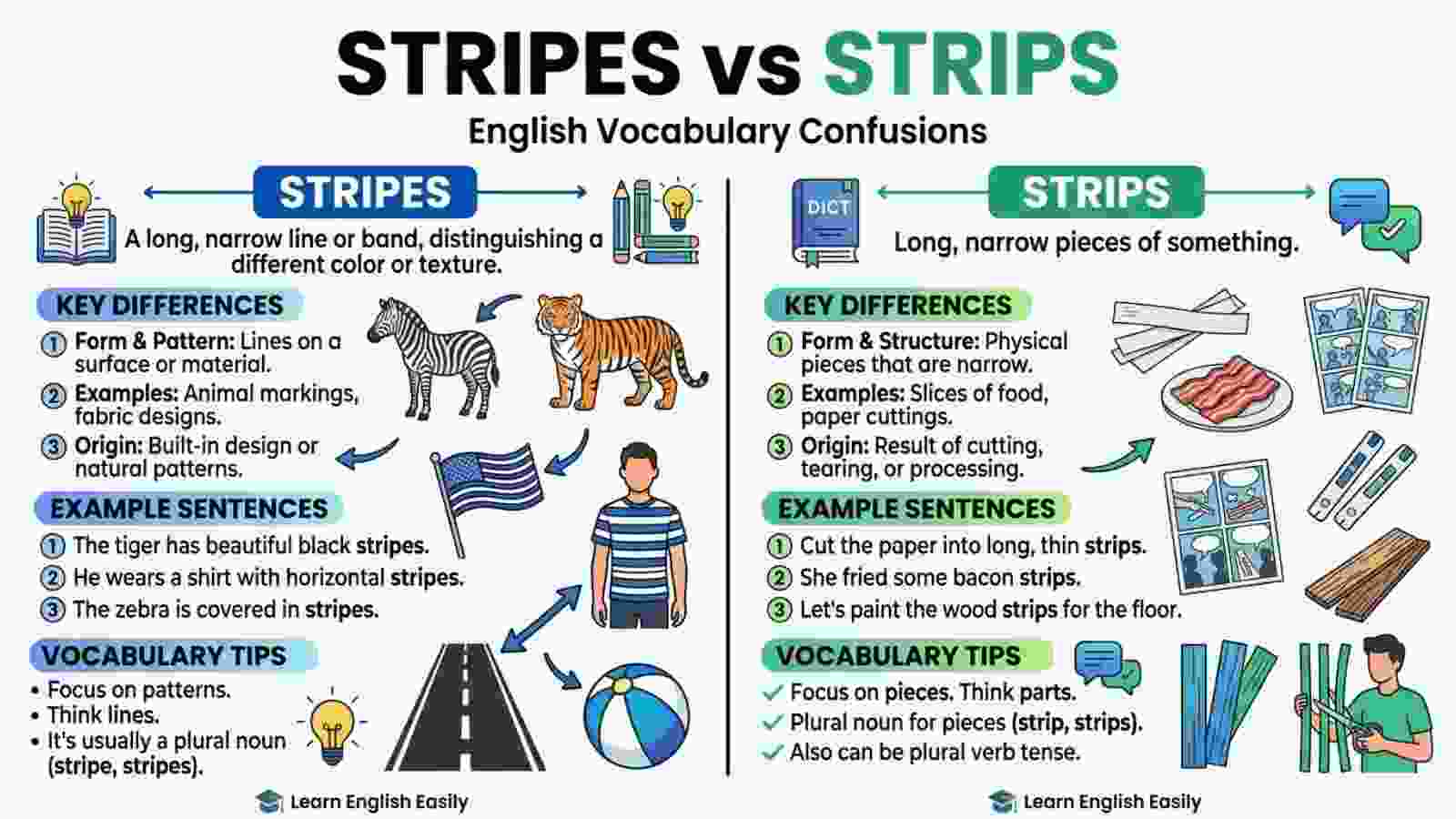
Have you ever wondered whether to use stripes or strips? These two words look and sound similar, but they do not always mean the same thing. This can make them easy to mix up, especially when talking about clothes, patterns, food, paper, or other objects.
The good news is that the difference is simple once you know what each word means.
Stripes usually describe long, narrow lines or bands that form a pattern. For example, a shirt can have blue and white stripes. A flag can also have stripes.
Strips usually describe narrow pieces that have been cut, removed, or separated from something. For example, you can cut paper into strips or cut a piece of meat into strips.
People search for stripes vs strips because both words can describe something long and narrow. However, the reason they are long and narrow is different.
In this guide, you will learn the meaning of stripes and strips, how they differ, where they came from, and how to use them correctly. You will also see simple examples, common mistakes, and an easy comparison table.
Stripes vs Strips – Quick Answer
Stripes and strips are both correct words, but they have different meanings.
Examples:
- The shirt has blue and white stripes.
- The flag has three red stripes.
- The zebra has black and white stripes.
- The road has yellow stripes.
Strips
Strips are long, narrow pieces of something. They are often made by cutting or separating a larger piece.
Examples:
- Cut the paper into thin strips.
- Add chicken strips to the salad.
- She cut the cloth into strips.
- The machine cuts metal into strips.
The easiest way to remember
Think of stripes as lines in a pattern.
Think of strips as pieces of something.
For example:
I bought a shirt with red stripes.
I cut the paper into red strips.
The Origin of Stripes vs Strips
The words stripe and strip have different histories, even though they look very similar.
The origin of “stripe”
The word stripe has been used in English for many centuries. Its early history is linked to words used for marks, lines, or bands.
Today, stripe often means a long, narrow line or band that appears on a surface.
For example:
- a striped shirt
- a striped flag
- a striped animal
- a striped road
The plural form is stripes.
The origin of “strip”
The word strip also has a long history in English. It has been used to describe taking something away or removing part of something.
Over time, strip also came to mean a long, narrow piece of material.
For example:
- a strip of paper
- a strip of cloth
- a strip of land
- a strip of metal
The plural form is strips.
Why are they easy to confuse?
Both words can describe something long and narrow.
However, their main ideas are different:
Stripe = a line or band, often part of a pattern.
Strip = a narrow piece of something.
This small difference helps you choose the right word.
British English vs American English Spelling
There is no major spelling difference between stripes and strips in British and American English.
Both forms use the same spelling.
| English Type | Correct Word | Example |
| British English | stripes | The shirt has blue stripes. |
| American English | stripes | The shirt has blue stripes. |
| British English | strips | Cut the paper into strips. |
| American English | strips | Cut the paper into strips. |
The meaning also stays the same in both forms of English.
Singular and plural forms
| Singular | Plural | Meaning |
| stripe | stripes | Lines or bands |
| strip | strips | Narrow pieces |
Examples:
The flag has one stripe.
The flag has several stripes.
And:
I cut one strip of paper.
I cut several strips of paper.
Related words
The same difference appears in other forms.
Stripe:
- stripe
- stripes
- striped
Strip:
- strip
- strips
- stripped
- stripping
Examples:
She wore a striped shirt.
He stripped the old paint from the wall.
Which Spelling Should You Use?
You do not need to choose between British and American spelling here. Both English varieties use stripes and strips.
The important thing is to choose the word that matches your meaning.
Use “stripes” for patterns
Use stripes when you mean lines or bands on a surface.
Examples:
The cat has dark stripes.
I like shirts with stripes.
The flag has red and white stripes.
Use “strips” for pieces
Use strips when you mean narrow pieces of something.
Examples:
Cut the vegetables into strips.
She used strips of paper for the project.
The worker cut the wood into strips.
For global English
If you write for people around the world, both words are safe. Just make sure the context makes your meaning clear.
Common Mistakes with Stripes vs Strips
1. Calling a striped shirt a “stripped shirt”
This is a common mistake.
Incorrect:
She is wearing a stripped shirt.
Correct:
She is wearing a striped shirt.
Striped means a shirt has stripes.
Stripped means something was removed.
These words have very different meanings.
2. Using “stripes” for pieces of food
If you cut chicken into long, narrow pieces, call them chicken strips.
Correct:
We ordered chicken strips.
Not:
We ordered chicken stripes.
3. Using “strips” for a pattern
If a shirt has lines, use stripes.
Correct:
He bought a shirt with black stripes.
Not:
He bought a shirt with black strips.
4. Confusing stripe and strip
A stripe is usually a mark or band.
A strip is usually a piece.
Compare:
The flag has a blue stripe.
I need a strip of blue paper.
5. Confusing “striped” and “stripped”
These words are especially easy to mix up.
Striped = having stripes.
The dog has a striped coat.
Stripped = having something removed.
The old wall was stripped of paint.
Remember:
striped = pattern
stripped = removed
Stripes vs Strips in Everyday Examples
Both words appear often in everyday English.
In emails
Please print the form on paper with no colored stripes.
Please cut the labels into small strips.
In news writing
The team wore shirts with blue and white stripes.
Workers cut the material into thin strips.
On social media
I love these black-and-white stripes!
Cut the paper into small strips for the craft.
In formal writing
The sample showed several dark stripes across the surface.
The material was cut into narrow strips for testing.
Cooking
Strips are very common when talking about food.
Examples:
Cut the peppers into thin strips.
Add chicken strips to the pan.
Slice the beef into small strips.
You would not normally use stripes for these pieces.
In clothing
Stripes are common when talking about patterns.
Examples:
She wore a shirt with green stripes.
The dress has thin black stripes.
The socks have colorful stripes.
Stripes vs Strips – Google Trends & Usage Data
Searches for stripes vs strips usually come from people who see both words used in similar contexts and want to know which one is correct.
The words have different search uses.
Stripes often appears in searches about:
- Clothes
- Fashion
- Flags
- Animals
- Road markings
- Patterns
- Sports uniforms
Strips often appears in searches about:
- Food
- Cooking
- Paper
- Cloth
- Metal
- Wood
- Land
- Cleaning or removal
Both words are common in English-speaking countries, including the United States, United Kingdom, Canada, and Australia.
The search intent can change based on the topic. Someone searching about clothes may want to know whether a shirt is striped. Someone searching about food may want to know whether to say strips.
There is no special British or American spelling issue with these words. The main issue is meaning.
Stripes vs Strips: Comparison Table
| Feature | Stripes | Strips |
| Singular | stripe | strip |
| Plural | stripes | strips |
| Main meaning | Lines or bands | Narrow pieces |
| Common use | Patterns | Cut pieces |
| Clothing | Yes | Sometimes |
| Food | Rare | Very common |
| Paper | Sometimes | Very common |
| Flags | Very common | Not usually |
| Animals | Very common | Not usually |
| Example | Blue stripes | Paper strips |
Side-by-side examples
| Stripes | Strips |
| Red stripes | Red paper strips |
| Zebra stripes | Chicken strips |
| Blue stripes on a shirt | Strips of cloth |
| Road stripes | Strips of metal |
| Stripes on a flag | Strips of land |
Stripes, Strips, Striped, and Stripped
These four forms can cause confusion.
Stripe
A single line or band.
The shirt has one blue stripe.
Stripes
More than one line or band.
The shirt has blue and white stripes.
Striped
Having stripes.
She wore a striped shirt.
Strip
A narrow piece or a single narrow part.
I need a strip of paper.
Strips
More than one narrow piece.
I cut the paper into strips.
Stripped
Having something removed.
The wall was stripped of old paint.
This is an important group to remember.
Practice Exercise
Choose the correct word: stripes or strips.
- The zebra has black and white ________.
- Cut the paper into thin ________.
- She bought a shirt with blue ________.
- Add chicken ________ to the salad.
- The flag has three red ________.
Answers
- stripes
- strips
- stripes
- strips
- stripes
Bonus Exercise
Choose striped or stripped.
- He wore a ________ shirt.
- The worker ________ the old paint from the door.
- She bought a black-and-white ________ dress.
Answers
- striped
- stripped
- striped
FAQs;
1. What is the difference between stripes and strips?
Stripes are usually lines or bands that form a pattern. Strips are narrow pieces of something.
2. Is it a striped shirt or a stripped shirt?
It is a striped shirt if the shirt has lines or bands.
She wore a striped shirt.
3. Is it chicken stripes or chicken strips?
The normal term is chicken strips. These are narrow pieces of chicken.
4. Are stripes and strips the same?
No. They can both describe something long and narrow, but they have different meanings.
5. What is the plural of stripe?
The plural is stripes.
The shirt has many stripes.
6. What is the plural of strip?
The plural is strips.
Cut the paper into strips.
7. Do British and American English use different spellings?
No. Both British and American English use stripes and strips.
Conclusion;
The difference between stripes vs strips is easy once you focus on meaning. Stripes usually mean long lines or bands that appear as a pattern. You can see stripes on shirts, flags, roads, and animals.
Strips usually mean long, narrow pieces of something. You can cut paper, cloth, vegetables, chicken, wood, or metal into strips.
The words are spelled the same way in British and American English, so there is no regional spelling rule to learn. The main thing is to choose the word that fits the situation.
Remember this simple rule:
Stripes = lines or bands.
Strips = narrow pieces.
Also watch out for striped and stripped. A striped shirt has a pattern. Something that has been stripped has had something removed.
Once you remember these simple meanings, you can use stripes, strips, striped, and stripped with confidence in everyday, school, work, and formal writing.