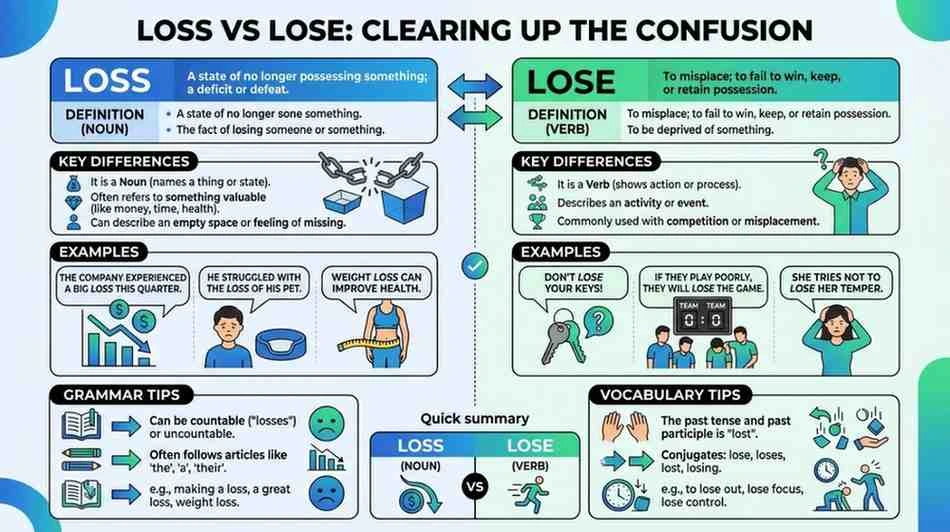
Many people feel confused about loss and lose. These two words look very close. They sound almost the same too. Because of this, many writers use the wrong word by mistake.
The good news is simple. The words have different jobs in English. One word is a noun. The other word is a verb. When you know this small rule, the confusion becomes easy to fix.
People search for “loss vs lose” because they want better grammar. They may need help with school work, emails, blogs, or business writing. Using the wrong word can make a sentence look wrong and unprofessional.
This guide will help you understand the difference in a very easy way. You will learn the meaning of each word, where the words came from, common mistakes, and how to use them in daily writing. You will also see tables, examples, and quick tips.
By the end, you will know when to use loss and when to use lose with confidence. You will also learn simple grammar rules that can help your writing look clean, clear, and correct.
Loss vs Lose – Quick Answer
Loss and lose are both correct, but they have different meanings.
- Loss is a noun.
- Lose is a verb.
Easy Meaning
| Word | Meaning |
| Loss | something that is lost |
| Lose | to stop having something |
Examples
- The team had a big loss.
- I do not want to lose my keys.
- The business showed a loss.
- You may lose your phone.
The first and third sentences use nouns.
The second and fourth sentences use verbs.
Simple Rule
Use:
- lose for actions
- loss for things or results
The Origin of Loss vs Lose
The words loss and lose come from old English words. They are part of the same word family.
The word lose came first. People used it many years ago to talk about missing something or no longer having it.
Later, English made the word loss. This word became a noun. It talked about the result after something was lost.
Easy Examples
- You lose money.
- The missing money is a loss.
The spelling changed over time, but the meaning stayed connected.
Word History Table
| Word | Word Type | Meaning |
| Lose | Verb | to stop having something |
| Loss | Noun | the result of losing |
These words are now very common in English writing and speech.
British English vs American English Spelling
There is almost no spelling difference between British English and American English for these words.
Both countries use:
- loss
- lose
Examples
| British English | American English |
| lose | lose |
| loss | loss |
The spelling stays the same in both English styles.
Example Sentences
British English
- Many shops lose money each year.
- The company had a loss.
American English
- Many shops lose money each year.
- The company had a loss.
The words work the same way in both countries.
Which Spelling Should You Use?
The choice is not about British or American English. The choice depends on grammar.
Use “Lose”
Use lose when talking about:
- actions
- movement
- missing something
Examples
- Do not lose your bag.
- They may lose the game.
- I lose my pen all the time.
Use “Loss”
Use loss when talking about:
- results
- problems
- something missing
Examples
- The loss was huge.
- Her loss made people sad.
- The storm caused a loss.
Easy Tip
Think like this:
| Word | Easy Trick |
| Lose | action word |
| Loss | naming word |
Common Mistakes with Loss vs Lose
Many people confuse these words because they sound alike.
Some people also mix lose and loose, which creates even more mistakes.
Common Errors
| Wrong | Correct |
| I did not loss my keys | I did not lose my keys |
| The team will loss | The team will lose |
| We had a lose yesterday | We had a loss yesterday |
| Please do not loose it | Please do not lose it |
Why These Mistakes Happen
People often:
- type too fast
- forget grammar rules
- mix similar sounds
Easy Writing Tips
- Use lose for actions.
- Use loss for results.
- Read your sentence again.
- Use spell check tools.
Quick Test
Ask yourself:
“Is this an action?”
If yes, use lose.
If no, and it names something, use loss.
Loss vs Lose in Everyday Examples
These words appear in daily life all the time.
In Emails
- Please do not lose this file.
- The business had a small loss this month.
- We may lose customer data.
- The company reported a heavy loss.
In News Writing
- The team may lose the final match.
- The flood caused great loss.
- Many stores lose money during slow seasons.
- The loss hurt the local economy.
On Social Media
- I always lose my charger!
- That loss made fans very sad.
- Do not lose hope.
- The movie studio faced a huge loss.
In Formal Writing
- Students may lose marks for late work.
- The fire caused major loss.
- Workers can lose jobs during hard times.
- The company showed financial loss.
Loss vs Lose – Google Trends & Usage Data
Search data shows that many people search for loss vs lose every month.
These words are common in:
- school work
- grammar lessons
- online writing
- business English
Popular Search Questions
| Search Topic | Common Search |
| Grammar Help | loss vs lose |
| Spelling Help | lose or loose |
| Writing Help | how to use loss |
| School Help | difference between loss and lose |
Which Word Is More Common?
The word lose is used more often in daily speech because people talk about actions every day.
The word loss is common in:
- business news
- sports
- money topics
- emotional writing
Country Usage
| Country | Common Usage |
| United States | Both |
| United Kingdom | Both |
| Canada | Both |
| Australia | Both |
Both words are used in all English-speaking countries.
Comparison Table for Loss vs Lose
| Word | Word Type | Meaning | Example |
| Loss | Noun | something lost | The loss was huge. |
| Lose | Verb | stop having something | Do not lose your phone. |
More Comparison Examples
| Sentence | Correct Word |
| I may ___ my keys. | lose |
| The team had a big ___. | loss |
| Do not ___ hope. | lose |
| The flood caused heavy_. | loss |
FAQs:
Is loss a noun?
Yes. Loss is a noun.
Is lose a verb?
Yes. Lose is a verb.
Do loss and lose mean the same thing?
They are related, but they do not have the same grammar job.
Which word shows action?
Lose shows action.
Which word names a result?
Loss names a result.
Is “I loss my phone” correct?
No. The correct sentence is:
- I lose my phone.
- or I lost my phone.
Why do people confuse these words?
People confuse them because they look and sound alike.
Is lose the same as loose?
No.
- Lose means to stop having something.
- Loose means not tight.
Can I use loss in speech?
Yes. It is very common in daily speech.
Conclusion:
The words loss and lose are easy to confuse, but the rule is simple. Lose is a verb. It shows an action. Loss is a noun. It names the result after something is gone.
You can remember it like this:
- you lose a game
- you feel the loss after the game
Both British and American English use the same spelling for these words. The main thing is using the correct grammar in the sentence.
Many writers make mistakes because the words sound alike. Some people also mix lose with loose. A quick grammar check can help stop these errors.
Good writing becomes easier when you learn small grammar rules. Using the right word helps your emails, blogs, school work, and business writing look clear and professional.
Now you know the difference between loss and lose. You can use both words correctly and with confidence in everyday English.
Meta Description:

Welcome to the official author page of Clara Wordsmith, grammar writer at Wordnomic. Clara specializes in explaining confusing English words, grammar rules, spelling differences, and vocabulary topics with clear examples and beginner-friendly explanations.