Have you ever paused while typing a word and asked yourself, “Is it lite or light?” You are not the only one. Many people get stuck on this small but tricky pair. They look almost the same. They sound the same. But they are not always used in the same way.
The confusion is real. Which one is correct? When should you use “lite” instead of “light”? Is one more formal than the other? Does British English treat them differently from American English?
This guide will clear up all your doubts. You will get a quick answer first. Then you will learn the history of both words.By the end, you will know exactly when to use “lite” and when to use “light” with full confidence.
Lite vs Light – Quick Answer
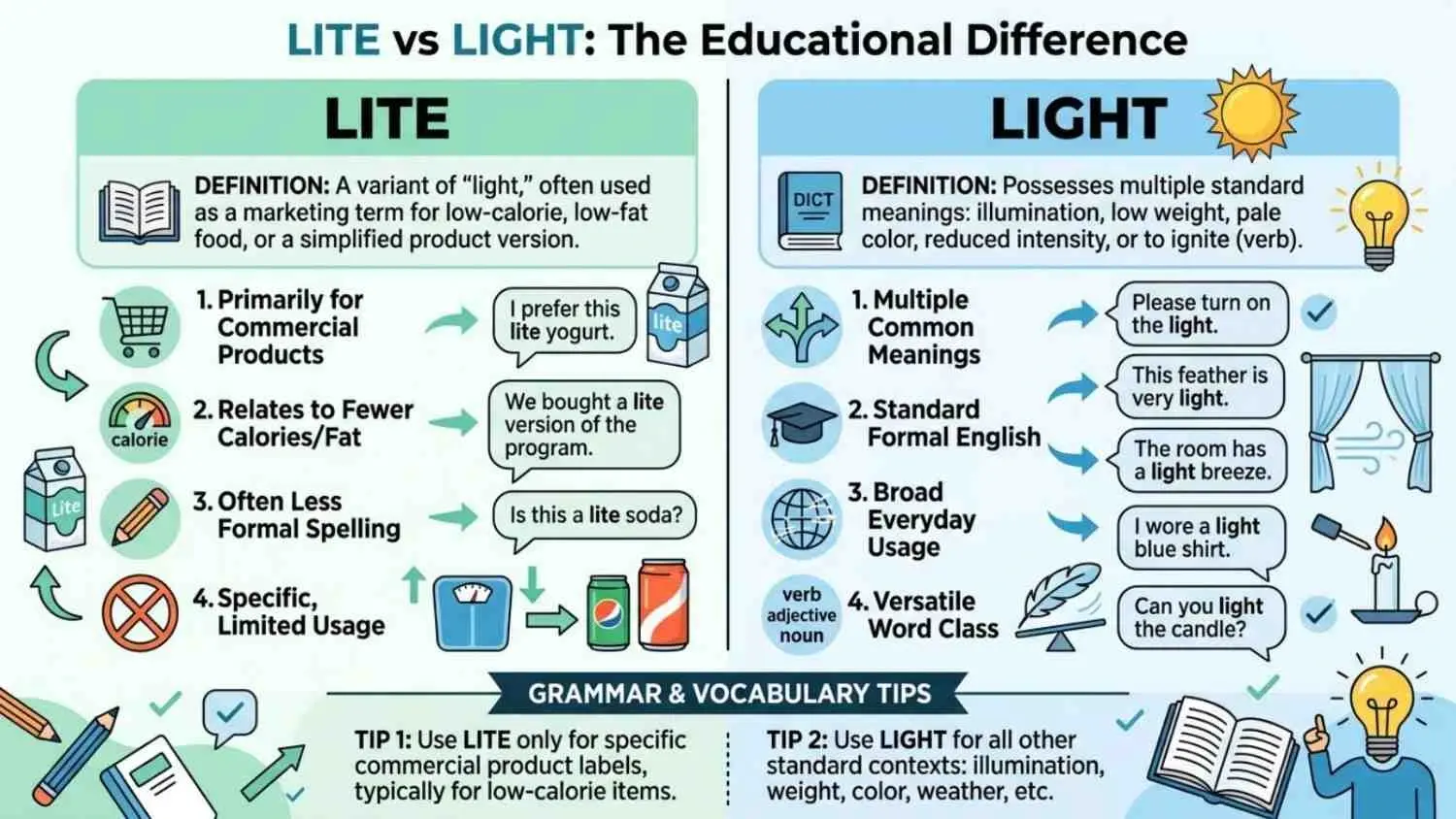
“Light” is the correct standard spelling. It means not heavy, not dark, or low in weight. “Lite” is an informal version of “light”. Brands and marketers use “lite” to mean low in calories, fat, or features.
For example:
- “The bag is light.” (correct standard use)
- “Turn on the light.” (correct standard use)
- “Try our new Lite version.” (used in branding)
- “Bud Lite is a popular drink.” (brand name)
So, “light” works in almost all writing. “Lite” works mostly in product names and casual style.
The Origin of Lite vs Light
The word “light” is very old. It comes from Old English “lēoht”. It meant brightness or not heavy. The word goes back over a thousand years. It has stayed in English in the same form for centuries.
“Lite” is much newer. It started in the 1950s in the United States. Companies wanted catchy product names. They changed “light” to “lite” to sound modern and fun. The first big use was in food and drink ads. Soon, “Lite” became a label for low-calorie items.
Today, “lite” also means a simple or basic version of something. For example, a “lite app” has fewer features. The spelling difference exists because of marketing, not grammar rules. “Light” is the proper word. “Lite” is a creative spin for branding and casual writing.
British English vs American English Spelling
Both British and American English use “light” as the correct spelling. There is no difference in standard rules. The word “light” works the same in London, New York, Sydney, or Toronto.
“Lite” is more common in American English. US brands use it often. Think of “Miller Lite” or “Coke Lite”. British English also uses “lite” in branding, but less often. UK writers prefer “light” in most cases, even in casual notes.
Here is a quick table:
| Feature | American English | British English |
| Standard spelling | light | light |
| Informal/branding | lite | light (preferred) |
| Common in ads | Yes, very common | Sometimes |
| Formal writing | light | light |
| Example | “Bud Lite” | “Lighter beer” |
As you see, “light” wins in formal writing in both styles. “Lite” stays mostly in ads and product names.
Which Spelling Should You Use?
Pick your spelling based on your audience and purpose.
If you write for a US audience, you can use “lite” in product names, ads, and casual posts. But for emails, reports, and articles, stick with “light”. It is safer and looks professional.
If you write for a UK or Commonwealth audience like Australia, Canada, or India, use “light” most of the time. British readers find “lite” too American or too commercial. Use “lite” only if it is a brand name.
For a global audience, always pick “light”. Save “lite” for fun, marketing, or app names.
Common Mistakes with Lite vs Light
Many writers mix up these two words. Here are the most common mistakes.
First, people use “lite” in formal writing. For example, “The box is lite.” This is wrong. The correct form is “The box is light.”
Second, some write “lite rain” or “lite breeze”. This is also wrong. Weather terms always use “light”. Say “light rain” or “light breeze”.
Third, writers use “light” when a brand name needs “lite”. For example, “Bud Light” is correct as a brand, but “Coke Lite” must keep its “lite” spelling. Always check the official brand name.
Fourth, people think “lite” means lower quality. That is not always true. “Lite” can mean simpler, lighter, or low-calorie, depending on the context.
Fifth, some capitalize “lite” in normal sentences. Only capitalize it when it is part of a brand or title.
Lite vs Light in Everyday Examples
Let us see how these words work in real life.
In emails, you might write: “Please send the light version of the file.” Here, “light” means smaller or simpler.
In the news, a headline could read: “Light Showers Expected This Weekend.” “Light” is the standard choice in journalism.
On social media, you may see: “Just downloaded the Lite app. So fast!” Here, “Lite” refers to a basic app version.
In formal writing, always use “light”. For example, “The report highlights light economic growth.” Never use “lite” in business or academic work.
In ads, “lite” shines. You will spot it on drinks, snacks, and software. It feels fresh and modern. But outside of brands, “light” is the safe and correct pick.
Lite vs Light – Google Trends & Usage Data
Google Trends shows that “light” is far more popular than “lite”. People search “light” millions of times each month worldwide. They look for light bulbs, light recipes, light rain, and more.
“Lite” has steady but smaller search traffic. Most “lite” searches come from the United States. Users look for “lite apps”, “lite beer”, or “lite versions” of software. India, Brazil, and Indonesia also rank high. There, people often search for “Facebook Lite” or “YouTube Lite” because these apps save mobile data.
In the UK, Australia, and Canada, “light” dominates. “Lite” appears mostly in product searches. Over the years, “lite” has grown thanks to tech and app branding. But “light” remains the king in everyday English use.
Comparison Table: Lite vs Light Variations
Here is a side-by-side look at both words:
| Word | Meaning | Best Use | Example |
| Light | Not heavy, not dark | Standard, formal, casual | “The bag is light.” |
| Lite | Low-calorie, basic version | Branding, marketing | “Coke Lite” |
| Lighter | More light than before | Comparisons | “This box is lighter.” |
| Lightly | In a soft way | Adverb use | “Press lightly.” |
| Lite app | Simple app version | Tech, mobile | “Facebook Lite” |
This table helps you pick the right word for the right moment.
FAQs:
1. Is “lite” a real word?
Yes, “lite” is a real word. But it is informal. It is mostly used in branding and ads.
2. Can I use “lite” in school essays?
No. Use “light” in school, college, and formal writing. “Lite” is too casual.
3. Why do brands use “lite” instead of “light”?
Brands use “lite” to sound modern, catchy, and easy to remember. It also signals a lower-calorie or basic version.
4. Is “light” correct in British English?
Yes. “Light” is the correct spelling in both British and American English.
5. Does “lite” mean low-calorie?
Often, yes. In food and drink, “lite” means fewer calories or less fat. But it can also mean a simpler version of an app or product.
6. Can I write “lite rain” or “lite wind”?
No. Always use “light” for weather. Say “light rain” or “light wind”.
7. Is “lite” used worldwide?
Yes, but mostly in branding. In daily writing, most countries prefer “light”.
Conclusion:
The choice between “lite” and “light” is simple once you know the rules. “Light” is the correct standard word. It works in all settings, from emails to news to school papers. “Lite” is a fun, informal spelling. It belongs in ads, brand names, and app titles.
If you want to play it safe, always pick “light”. It is correct in American, British, and global English. It fits formal and casual writing alike. Save “lite” for moments when you talk about a brand, a low-calorie product, or a simple app version.
Remember the key tips. Use “light” for weather, weight, and brightness. Use “lite” only in branding or casual style. Never mix them in formal work. Check brand spellings carefully before you write.
Now you can write with full confidence. You know the history, the rules, and the smart way to choose. The next time you see “lite” or “light”, you will know which one fits best. Your writing will look clean, correct, and professional in every place.

Welcome to the official author page of Clara Wordsmith, grammar writer at Wordnomic. Clara specializes in explaining confusing English words, grammar rules, spelling differences, and vocabulary topics with clear examples and beginner-friendly explanations.