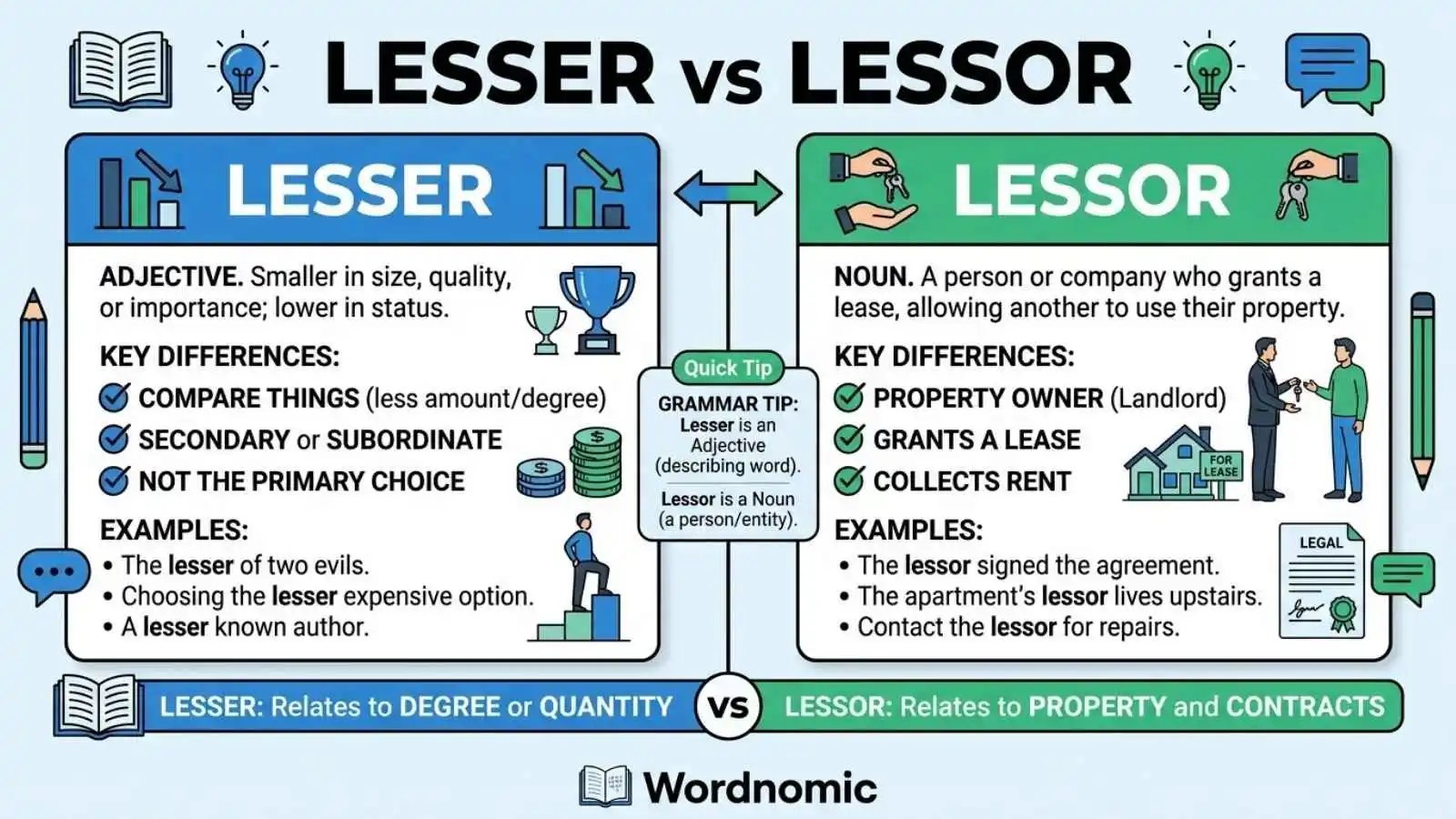
You are writing a sentence. Maybe you want to say that one thing is not as big as another. Or maybe you are writing about a person who rents out a home or a car. You type one of these words: “lesser” or “lessor.” Then you stop. Are they the same word? Do they mean the same thing? Which one fits your sentence?
This is a question that trips up a lot of people. The two words look almost the same. They sound almost the same. But they mean very different things. One is used in everyday talk. The other is used in legal and business writing.
Students get confused when writing essays. Business writers pause when working on contracts. Even people who read a lot stop and check before using either word.
The good news is the answer is not hard. Once you know what each word means, you will never mix them up again.
In this guide, you will get a fast and clear answer first. Then you will learn where each word came from, how to use each one in real sentences, and which one fits your writing. You will also get a memory trick and a practice exercise. By the end, you will always pick the right word.
Lesser vs Lessor Quick Answer
These are two different words with two very different meanings.
Lesser means smaller in size, amount, or value. It is used when you compare two things and one is not as big or not as important as the other. This is an everyday word that anyone can use.
Lessor is a legal and business word. It means a person or a company that lets someone else use something in return for payment. In simple words, a lessor is the person who rents something out to another person.
Quick examples:
- She chose the lesser of two bad options.
- He picked the lesser amount and saved the rest for later.
- The lessor signed the contract before giving the keys to the tenant.
- The lessor owns the building and rents it to a business.
Easy rule: If you are comparing two things and one is smaller or less important, use “lesser.” If you are talking about the person who rents something out, use “lessor.”
The Origin of Lesser and Lessor
Let us look at where each word came from. This makes it much easier to understand why they work so differently.
“Lesser” is a very old word. It comes from the Old English word “læssa” which meant smaller or less. Over many hundreds of years, “lesser” became a common word in English. People used it to compare two things when one was not as great as the other.
You will find “lesser” in old books, old stories, and old texts going back hundreds of years. It has always been a simple word used in everyday talk. When you say “the lesser of two evils,” you mean the option that is bad but not as bad as the other one.
“Lessor” has a different history. It comes from old French and then old English law. The word is built from the word “lease” plus the ending “or.” In English, the ending “or” often means “a person who does something.” So “lessor” means “a person who leases” or “a person who rents something out.”
This word has been part of English law for a very long time. But it stayed mostly in legal and business writing. You would not hear it in casual daily talk. You would see it in rental contracts, property papers, and business agreements.
This is why “lesser” feels like a normal everyday word and “lessor” feels like something out of a contract.
British English vs American English Spelling
This is not a British vs American spelling issue. Both countries spell these words the exact same way.
In the United States, “lesser” means smaller and “lessor” means the person who rents something out.
In the United Kingdom, the same rules apply. “Lesser” is the everyday word and “lessor” is the legal word.
There is no UK version or US version of either word. The spelling stays the same all over the world.
| Feature | Lesser | Lessor |
| Spelling in the US | lesser | lessor |
| Spelling in the UK | lesser | lessor |
| Used in daily talk | Yes | No |
| Used in legal writing | Rarely | Yes, very often |
| Meaning | Smaller, not as great | Person who rents something out |
| Part of speech | Adjective | Noun |
Which Word Should You Use?
The choice depends only on what you are trying to say.
Use “lesser” when:
- You compare two things and one is smaller or not as important.
- You talk about a smaller amount or a lower level of something.
- You use the phrase “the lesser of two evils.”
- You write for any audience in any kind of writing.
Use “lessor” when:
- You write about a person or company that rents something to someone else.
- You work with rental contracts, lease papers, or property documents.
- You write for a legal or business audience.
For US readers: Use “lesser” in daily writing. Use “lessor” only in legal or rental contexts.
For UK readers: Same rule. “Lesser” for everyday writing. “Lessor” for legal and business documents.
For readers all over the world: “Lesser” is understood by everyone. “Lessor” is mostly known in legal and business contexts.
When not sure: If you are not writing about renting or leasing, use “lesser.” It is the safe word for almost every situation.
Common Mistakes with Lesser and Lessor
Here are the most common errors people make with these two words, with easy fixes.
Mistake 1: Using “lessor” when you mean smaller or not as great. Wrong: “She picked the lessor amount.” Right: “She picked the lesser amount.”
Mistake 2: Using “lesser” when writing about the person who rents something out. Wrong: “The lesser signed the rental contract.” Right: “The lessor signed the rental contract.”
Mistake 3: Thinking “lessor” is just a different spelling of “lesser.” They are not the same word at all. They come from different roots and mean completely different things.
Mistake 4: Confusing “lessor” with “lessee.” The “lessor” is the person who rents something OUT. The “lessee” is the person who rents something and PAYS for it. Think of it this way: the lessor owns it and lets it go. The lessee uses it and pays.
Mistake 5: Using “lesser” in a legal document when “lessor” is needed. In a rental contract or lease paper, using the wrong word can cause confusion. Always use “lessor” when you mean the person renting something out.
Easy tip: Ask yourself one question before you write. Am I comparing two things? Use “lesser.” Am I talking about the person renting something out? Use “lessor.”
Lesser and Lessor in Everyday Examples
Let us see how each word looks in real writing.
email (lesser): “We went with the lesser cost option to stay within our budget.”
news headline (lesser): “Voters Asked to Choose the Lesser of Two Bad Options at the Polls”
social media post (lesser): “Sometimes the best choice is just the lesser of two hard options. Life is not always easy. 💭”
formal report (lesser): “The team chose the lesser risk path after reviewing all the data.”
legal document (lessor): “The lessor agrees to keep the property in good condition for the full length of the lease.”
business email (lessor): “Please confirm that the lessor has signed all the required papers before we move in.”
In a rental contract (lessor): “The lessor will provide one set of keys to the lessee on the first day of the lease.”
Notice the clear pattern. “Lesser” shows up in everyday talk, news, and general writing. “Lessor” only shows up in legal, rental, and business writing.
Lesser vs Lessor Google Trends and Usage Data
Search data shows that “lesser” is searched far more often than “lessor.” This makes sense because “lesser” is used in everyday English by everyone. It shows up in news, books, social media, and daily talk.
“Lessor” gets steady searches too, but mostly from people working in real estate, law, and business. Searches for “lessor” often come with other legal words like “lessee,” “lease agreement,” and “rental contract.”
Searches for “lesser vs lessor” come from students, writers, and business people who are not sure which word to use before they send a document or finish a piece of writing.
| Word | Correct? | How Often Searched | Common Use |
| Lesser | Yes | Very often | Daily talk, news, essays |
| Lessor | Yes | Moderate | Legal, rental, business |
| Lessee | Yes | Moderate | Legal, rental papers |
| Lease | Yes | Very often | Rental, business, property |
Did You Know?
The phrase “the lesser of two evils” is one of the oldest and most used phrases in English. It means choosing the option that is bad but not as bad as the other choice. This phrase goes all the way back to ancient Greek thinking. The Greek writer Aristotle talked about this idea over two thousand years ago. The phrase is still used every day in news, politics, and daily talk. It is one of the most common ways the word “lesser” shows up in modern English.
Memory Trick
Here is a very easy way to remember the difference between these two words.
Think of the letter “R” at the end of “lessor.” The “R” stands for “Rent.” A lessor is the person who rents something out. If you see the “r” at the end of “lessor,” think of rent.
“Lesser” has no “r” at the end in the same way. It ends in “er” like many other comparing words, such as “bigger,” “smaller,” and “faster.” These are all words that compare two things.
Say this to yourself: “LessoR = Rent. LessER = Compare.”
Once this sticks in your head, picking the right word takes just one second.
Parts of Speech
Knowing how each word works in a sentence helps you use it right every time.
“Lesser” is a describing word (adjective). It describes a noun by telling us it is smaller, lower, or not as great as something else.
| Word | Example |
| Lesser | She took the lesser risk. |
| Lesser | He is the lesser known of the two singers. |
| Lesser | We went with the lesser cost option. |
“Lessor” is a naming word (noun). It names a person or company that rents something out to someone else.
| Word | Example |
| Lessor | The lessor owns the flat and rents it out. |
| Lessor | Both the lessor and lessee signed the paper. |
| Lessors | Three lessors were listed in the contract. |
Practice Exercise
Fill in the blank with the right word: lesser or lessor.
- She always tries to choose the ________ of two bad options when things get hard.
- The ________ agreed to fix the broken door before the tenant moved in.
- He took the ________ amount of work so he could finish faster.
- The contract listed the ________ as the owner of the building.
- Between the two plans, they picked the ________ risky one.
- The ________ and the lessee both signed the lease on the same day.
- She chose the ________ role in the play but still worked very hard.
- The ________ raised the rent at the start of the new year.
Answer Key:
- lesser comparing two bad options, one is not as bad
- lessor the person who rents out the flat or home
- lesser comparing two amounts, one is smaller
- lessor the owner who rents the building to others
- lesser comparing two plans, one has less risk
- lessor the person renting the property out
- lesser comparing two roles, one is smaller or not as big
- lessor the person who owns and rents out property
How did you do? 8 out of 8 Well done! You know both words perfectly. 5 to 7 Good job! Read the quick answer one more time. Below 5 No problem. Go back through the examples slowly and try again.
Frequently Asked Questions
1. Are “lesser” and “lessor” the same word? No. They look close but they are two very different words. “Lesser” means smaller or not as great. “Lessor” means a person who rents something out to someone else.
2. What does “lessor” mean in simple words? A lessor is the owner of something who lets another person use it in return for payment. Think of a landlord who rents out a flat. The landlord is the lessor.
3. What is the difference between a lessor and a lessee? The lessor owns the thing and rents it out. The lessee is the person who rents it and pays for it. They are opposites in a rental deal.
4. Is there a British or American spelling difference? No. Both words are spelled the same way in British and American English.
5. Can I use “lesser” in a legal document? “Lesser” can appear in legal documents when comparing things. But if you mean the person renting something out, always use “lessor.”
6. What is the most common use of “lesser” in everyday talk? The most common use is the phrase “the lesser of two evils.” This means choosing the option that is bad but not as bad as the other choice.
7. Is “lessor” used in everyday talk? Rarely. “Lessor” is mostly a legal and business word. You will see it in rental contracts and property papers. In everyday talk, people usually just say “landlord” or “owner” instead.
Conclusion:
“Lesser” and “lessor” look almost the same but mean very different things. “Lesser” is the everyday word that means smaller, lower, or not as great as something else. You can use it in any kind of writing, for any reader, in any country. It is a simple and common English word.
“Lessor” is a legal and business word. It means the person or company that rents something out to another person. You will mostly see it in rental contracts, lease papers, and property documents. It is not a word you would use in daily talk.
There is no British or American spelling difference. Both words stay the same everywhere in the world. The only thing that changes is the meaning and the place where each word belongs.
Remember the easy trick: LessoR = Rent. LessER = Compare. Keep this in your head and you will always pick the right word with full confidence every time you write.

Welcome to the official author page of Clara Wordsmith, grammar writer at Wordnomic. Clara specializes in explaining confusing English words, grammar rules, spelling differences, and vocabulary topics with clear examples and beginner-friendly explanations.










