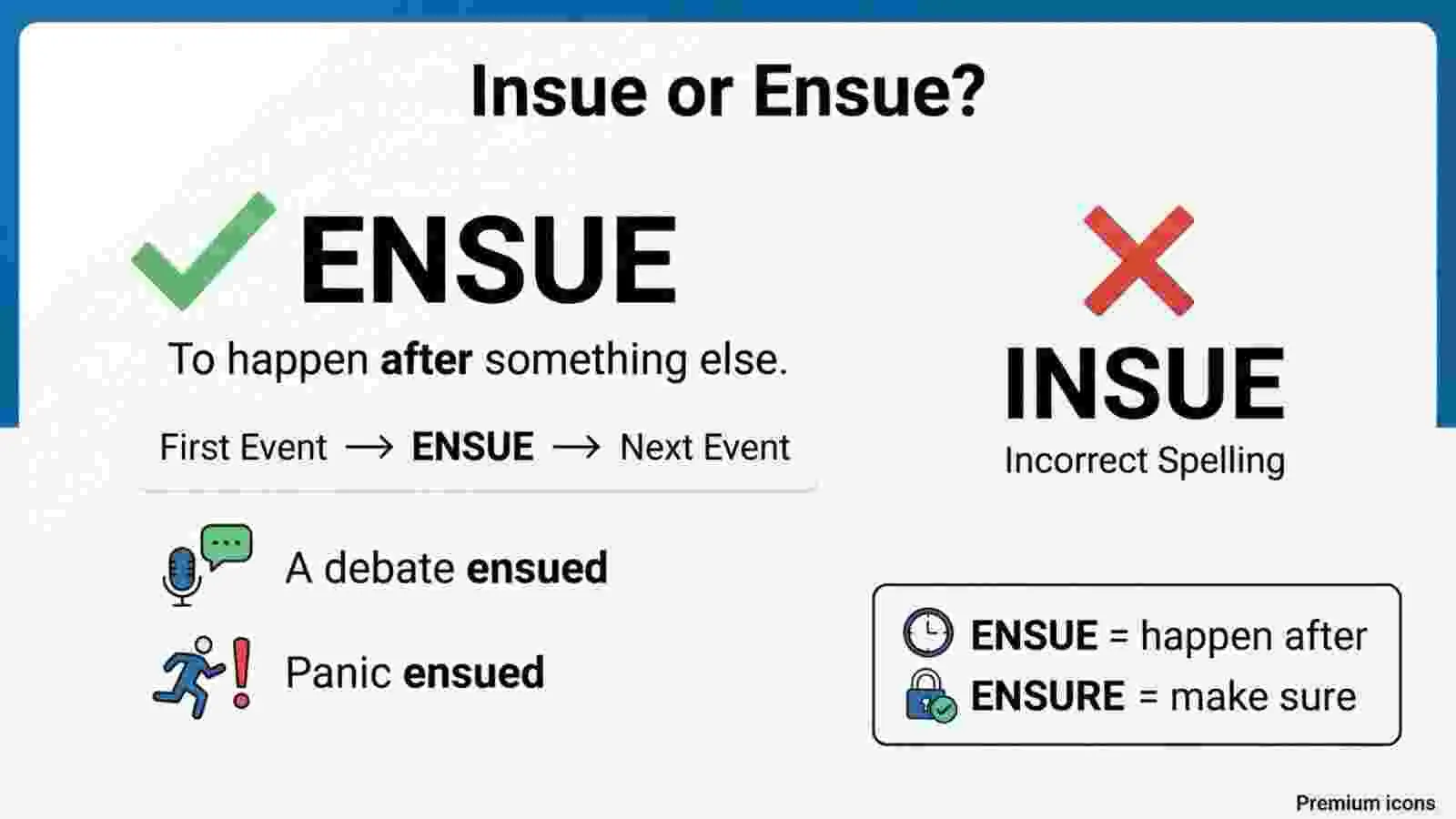
Have you ever written a sentence and stopped at insue or ensue? These two spellings look very close, so it is easy to mix them up. You may see a word that sounds like “in-soo” and wonder if it starts with in or en.
The correct spelling is ensue.
Ensue is a verb that means to happen after something else. It often means that one event happens as a result of another event. For example, you can say, “A loud argument ensued after the meeting.”
Insue is not the standard spelling of this word in modern English.
The confusion often comes from the sound of ensue. In American English, it is pronounced roughly like in-SOO, which can make the spelling seem unclear. Cambridge gives the US pronunciation as /ɪnˈsuː/.
This guide explains insue or ensue, the meaning of ensue, how to use it, common mistakes, and easy examples.
Insue or Ensue – Quick Answer
Ensue is the correct spelling.
Insue is not the standard spelling when you mean “to happen after something else.”
Ensue means:
to happen after something else, often as a result of it.
Correct
A fight ensued after the argument.
Incorrect
A fight insued after the argument.
The correct form is ensued when you use the past tense.
Easy way to remember
Think:
event → ensue → next event
Something happens first. Then another event ensues.
What Does Ensue Mean?
Ensue means to happen after something else.
It often shows a clear link between two events. The first event happens, and the second event follows.
For example:
The lights went out, and confusion ensued.
First, the lights went out. Then confusion happened.
Another example is:
A long silence ensued.
This means a long silence happened after something else.
Cambridge lists follow and result as close meanings of ensue. It also marks the word as formal.
Simple meaning
You can think of ensue as:
- happen next
- follow
- happen as a result
- come after
What Does Insue Mean?
Insue is not the standard spelling of the verb you want here.
If you want to say that something happened after another event, use ensue.
For example:
A heated discussion ensued.
Not:
A heated discussion insued.
The spelling mistake may happen because ensue sounds like it begins with the sound in in American English. Cambridge gives the US pronunciation as /ɪnˈsuː/.
So, the sound can cause the spelling mistake.
Ensue vs Insue: Main Difference
The main difference is simple:
- Ensue is the correct standard word.
- Insue is not the standard spelling for this meaning.
Ensue is a verb.
It describes something that happens after another event.
For example:
An argument ensued.
This means an argument happened after something else.
You may also see:
- ensues
- ensued
- ensuing
These are related forms of the same word. Cambridge lists ensued as the past tense and past participle of ensue.
How to Use Ensue
Ensue often comes after a situation, event, or action.
Common patterns include:
Something ensued.
Something ensued when something happened.
Examples
A debate ensued.
Panic ensued after the alarm sounded.
A long discussion ensued.
Silence ensued after the announcement.
You can also use ensued for something that already happened:
A fight ensued after the game.
Here, ensued is the past tense.
Ensue, Ensued, and Ensuing
These three forms are easy to mix up.
Ensue
Ensue is the base verb.
Problems may ensue.
Ensued
Ensued is the past tense.
Problems ensued.
Ensuing
Ensuing is an adjective. It describes something that happens afterward. Cambridge defines ensuing as happening after something and because of it.
The ensuing debate lasted two hours.
This means the debate happened after the earlier event.
Quick comparison
| Word | Type | Simple Meaning | Example |
| ensue | Verb | happen afterward | Problems may ensue. |
| ensues | Verb | happens afterward | Trouble ensues. |
| ensued | Verb | happened afterward | A fight ensued. |
| ensuing | Adjective | happening afterward | The ensuing debate was long. |
Origin and History of Ensue
Ensue has a long history in English. The word came into English through Old French and ultimately traces back to Latin roots related to following.
Over time, English used ensue for something that follows another event.
Its modern meaning still has this basic idea:
something happens after something else
The modern word can describe events, problems, arguments, discussions, changes, and other things that follow an earlier event.
The related adjective ensuing keeps the same basic idea of something coming afterward.
British English vs American English
There is no major spelling difference between British and American English here.
Both use:
ensue
The main difference can appear in pronunciation.
Cambridge gives the British pronunciation as approximately /ɪnˈsjuː/ and the American pronunciation as approximately /ɪnˈsuː/.
The meaning stays the same in both forms of English.
So:
- British English: ensue
- American English: ensue
Do not change the spelling to insue because of the pronunciation.
Which One Should You Use?
Use ensue.
This applies to:
- everyday writing
- school writing
- academic writing
- business writing
- emails
- formal writing
- British English
- American English
- online writing
For formal writing
Ensue can work well in formal writing.
Further problems may ensue if the rule is ignored.
For simple everyday writing
You may want to use happen next or follow because these words are more common and easier.
Instead of:
Confusion ensued.
You could write:
Confusion followed.
Or:
Confusion happened next.
The best choice depends on your audience.
Common Mistakes
1. Writing Insue
Incorrect:
A fight insued.
Correct:
A fight ensued.
Why?
The standard spelling is ensued.
2. Writing Insued
Incorrect:
A long debate insued.
Correct:
A long debate ensued.
Why?
The past tense of ensue is ensued, not insued.
3. Writing Insues
Incorrect:
Trouble insues after the change.
Correct:
Trouble ensues after the change.
Why?
The third-person form comes from ensue, so the correct spelling is ensues.
4. Using Ensue When You Mean Ensure
Incorrect meaning:
Please ensue that the door is locked.
Correct:
Please ensure that the door is locked.
Why?
Ensure means make sure.
Ensue means happen afterward.
These words look similar but have very different meanings.
5. Confusing Ensue With Insist
Incorrect:
I ensue that this is true.
Correct:
I insist that this is true.
Why?
Insist means to say something strongly or firmly. Ensue means to happen afterward.
Ensue vs Ensure
This is another common spelling problem.
| Word | Meaning | Example |
| ensue | Happen afterward | A debate ensued. |
| ensure | Make sure | Please ensure the door is closed. |
Remember
Ensue = happen after
Ensure = make sure
For example:
A fight ensued after the argument.
But:
Please ensure that everyone is safe.
These two words should not be used in place of each other.
Everyday Examples
Here are simple examples with ensue and its related forms:
- A long silence ensued.
- A heated debate ensued.
- Confusion ensued after the announcement.
- A fight ensued outside the store.
- Panic ensued when the alarm rang.
- Several problems ensued after the change.
- A lively discussion ensued.
- Trouble may ensue if we ignore the warning.
- The ensuing meeting lasted two hours.
- The ensuing debate became very long.
- A period of calm ensued after the storm.
- The argument ended, and silence ensued.
Real-Life Usage
In Conversation
Someone might say:
What happened after the announcement?
You could answer:
A long discussion ensued.
This means a long discussion happened afterward.
In an Email
The client raised several questions, and a short discussion ensued.
This sounds formal and works well in business writing.
At School
A debate ensued after the teacher asked the question.
This tells the reader that the debate followed the teacher’s question.
At Work
Several problems ensued after the system update.
This means the problems happened after the update.
In Social Media
You may see phrases such as:
Chaos ensued.
This means a chaotic situation happened afterward.
In Formal Writing
Ensue appears more often in formal writing than in casual speech. Cambridge labels the verb as formal.
For simple writing, follow or happen next may sound more natural.
Related Search Questions
Is Ensue the Correct Spelling?
Yes. Ensue is the standard spelling of the verb meaning to happen after something else.
A discussion ensued.
Insue is not the standard spelling for this meaning.
How Do You Use Ensue in a Sentence?
Use ensue when one event happens after another.
A serious debate ensued after the announcement.
For past events, use ensued:
A serious debate ensued after the announcement.
What Is the Past Tense of Ensue?
The past tense is ensued.
A fight ensued after the argument.
The present form is ensue, while the past form is ensued.
What Is the Difference Between Ensue and Ensure?
Ensue means to happen after something.
Ensure means to make sure something happens or is true.
A problem may ensue.
Please ensure the form is complete.
What Does Ensuing Mean?
Ensuing means happening after something else.
The ensuing discussion lasted an hour.
It is often used before a noun, such as ensuing days, ensuing months, or ensuing debate.
Usage and Search Trends
Exact search volume for insue or ensue can change over time. Reliable public sources do not provide a fixed search number that would be useful for this article.
The spelling confusion is easy to understand because ensue starts with a sound that can sound like in in American English. Cambridge lists the US pronunciation as /ɪnˈsuː/.
People who search for this word may also use questions such as:
- insue or ensue which is correct
- is insue a word
- is ensue a word
- ensue meaning
- ensued meaning
- ensuing meaning
- how to use ensue
- ensue vs ensure
- ensue in a sentence
These searches show that spelling, meaning, and correct usage are closely linked.
Comparison Table
| Term | Correct? | Meaning | Example |
| ensue | Yes | Happen afterward | Problems may ensue. |
| insue | No, for this meaning | Not the standard spelling | Do not write “problems may insue.” |
| ensued | Yes | Happened afterward | A debate ensued. |
| ensuing | Yes | Happening afterward | The ensuing debate was long. |
| ensure | Yes, but different word | Make sure | Ensure the door is locked. |
FAQs
1. Is it insue or ensue?
The correct spelling is ensue. It means to happen after something else, often because of it. For example, “A heated discussion ensued.” Insue is not the standard spelling of this word. The spelling can cause confusion because the word’s pronunciation can sound like it starts with “in.”
2. What does ensue mean in simple English?
Ensue means that something happens after another thing. It often shows that the second event came as a result of the first. For example, “The alarm rang, and panic ensued” means that panic happened after the alarm rang.
3. Is insue a word?
Insue is not the standard spelling for the verb that means “to happen afterward.” If you want this meaning, use ensue. The past tense is ensued, and the related adjective is ensuing.
4. What is the difference between ensue and ensure?
Ensue and ensure have different meanings. Ensue means to happen after something else. Ensure means to make sure something happens or remains true. For example, “A fight ensued” and “Please ensure the door is locked” use the two words correctly.
5. What is the past tense of ensue?
The past tense of ensue is ensued. For example, “A long argument ensued after the meeting.” It means that the argument happened after the meeting. Ensued is also the past participle of ensue.
6. Is ensue formal English?
Yes. Cambridge labels ensue as a formal verb. It is common in formal writing, news writing, reports, and other serious contexts. In casual speech, people may choose simpler words such as follow or happen next.
7. What does ensuing mean?
Ensuing means happening after something else. It is an adjective and usually comes before a noun. For example, “the ensuing discussion” means the discussion that happened after an earlier event. You can also say “the ensuing months” for the months that followed.
Conclusion
When choosing between insue or ensue, use ensue.
Ensue is the correct standard spelling for the verb that means to happen after something else. It often shows that one event follows another event or happens because of it.
For example:
A heated argument ensued after the meeting.
The word can also change form. Ensued is the past tense, while ensuing is an adjective that means happening afterward.
Do not confuse ensue with ensure. They look similar, but their meanings are very different. Ensue means something happens after another event. Ensure means to make sure something happens or is true.
The spelling insue often causes confusion because of the way ensue sounds. In American English, the word is pronounced roughly like “in-SOO.” However, the spelling remains ensue.
So, the simple rule is:
Ensue = correct
Insue = incorrect for this meaning
If you remember that ensue means happen after, you can use the word with confidence.

Emily Carter is an English grammar writer based in Portland, Oregon, with 7+ years of experience turning tricky grammar rules into simple, easy lessons.