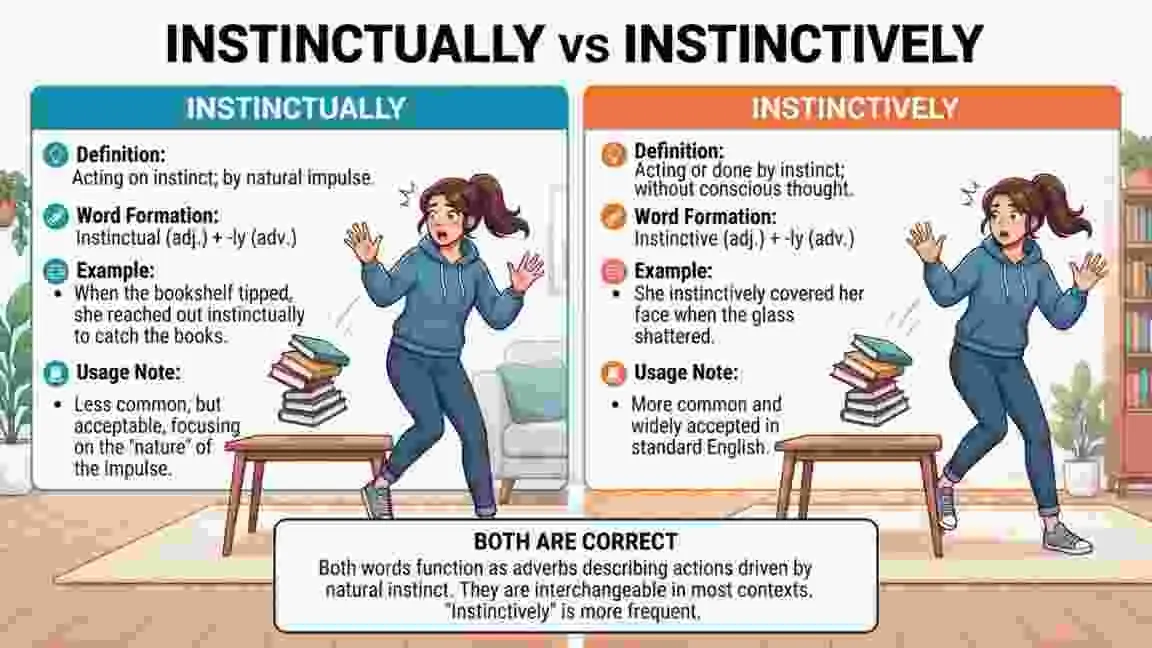
Have you ever written a sentence and stopped at instinctually vs instinctively? Both words look right, and both can describe an action that happens without careful thought. This makes the choice confusing.
The good news is that both instinctually and instinctively are real English words. They are adverbs, and they have very similar meanings. They can describe something done in a natural way, without planning or conscious thought. Cambridge gives this meaning for both words.
For example:
She instinctively moved away from the danger.
You can also find instinctually in similar sentences:
She instinctually moved away from the danger.
The main difference is not a British vs American spelling rule. Instead, the two words come from different adjective forms: instinctive and instinctual.
In this guide, you will learn the simple difference between instinctually vs instinctively, how each word is formed, where people use them, common mistakes, and which one may fit your sentence best.
Instinctually vs Instinctively: Quick Answer
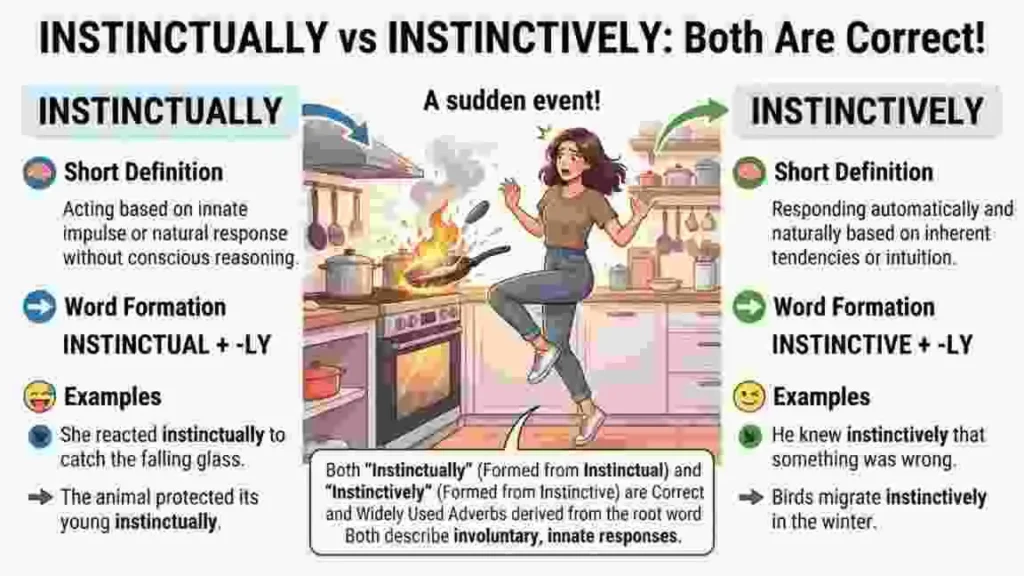
Both words are correct.
Instinctively means doing something naturally, without thinking or planning it.
He instinctively reached for the phone.
Instinctually has a very similar meaning.
He instinctually reached for the phone.
Cambridge defines instinctually as doing something naturally rather than thinking about it, planning it, or learning it through training. It gives a very similar definition for instinctively.
The simple difference
| Word | Meaning | Correct? |
| Instinctively | In a natural way, without conscious thought | Yes |
| Instinctually | In an instinctual or natural way | Yes |
For many everyday sentences, you can use either word without changing the main meaning.
However, instinctively is the more direct form because it comes from the common adjective instinctive. Dictionary.com also lists instinctually as a variation of instinctively.
The Origin of Instinctually vs Instinctively
The two words come from the same basic idea: instinct.
An instinct is a natural feeling or response that does not need careful thought.
From instinct, English developed the adjective instinctive.
Instinctive + ly = instinctively
The adjective instinctive has been used in English for centuries. Dictionary.com dates its first recorded use to the 1640s or 1650s.
English also developed the adjective instinctual.
Instinctual + ly = instinctually
So the two forms follow this pattern:
instinct → instinctive → instinctively
instinct → instinctual → instinctually
Wiktionary lists instinctually as a form made from instinctual + -ly.
This explains why the two words look so similar. They both describe something connected with instinct.
British English vs American English Spelling
There is no simple British vs American spelling difference between these two words.
Both instinctively and instinctually can be found in English on both sides of the Atlantic.
Cambridge provides British and American information for both words.
Collins also lists instinctively or instinctually as adverb forms in its British English material.
Comparison Table
| Topic | British English | American English |
| Instinctively | Correct | Correct |
| Instinctually | Correct | Correct |
| Main meaning | Natural or without thought | Natural or without thought |
| Spelling rule | No special change | No special change |
| Common adjective | Instinctive | Instinctive |
| Other adjective | Instinctual | Instinctual |
So you should not think of instinctually as a British spelling and instinctively as an American spelling.
The difference comes from word choice and word formation, not from country.
Which Spelling Should You Use?
Because both words are correct, your choice depends on the sentence and the style you want.
For everyday English
Instinctively is a simple choice.
I instinctively stepped back.
It is easy for most readers to understand.
For school writing
Instinctively is also a clear choice.
The child instinctively moved toward her mother.
For work writing
You can use either when it fits the sentence.
The team instinctively reacted to the problem.
For academic writing
Both forms can appear, but always check the style used in your field.
For a global audience
Instinctively may be the easier choice because it connects directly to the very common word instinctive.
Still, instinctually is not wrong. Cambridge and other dictionaries recognize it.
Common Mistakes With Instinctually vs Instinctively
Mistake 1: Thinking Instinctually Is Wrong
❌ Wrong idea:
Instinctually is not a real English word.
✅ Correct:
Instinctually is a real English word.
Cambridge lists it as an adverb, and Dictionary.com describes it as a variation of instinctively.
Mistake 2: Thinking Instinctively Is Wrong
❌ Wrong idea:
Instinctually is the only correct form.
✅ Correct:
Instinctively is also a standard English word.
Cambridge defines it as acting without thought, planning, or training.
Mistake 3: Treating Them as British and American Spellings
❌ Wrong:
Instinctually is British English and instinctively is American English.
✅ Correct:
Both words are used in British and American English.
Mistake 4: Confusing the Adjectives
Remember:
Instinctive = adjective
It was an instinctive reaction.
Instinctual = adjective
It was an instinctual reaction.
Instinctively = adverb
She reacted instinctively.
Instinctually = adverb
She reacted instinctually.
Mistake 5: Using an Adjective Where an Adverb Is Needed
❌ Wrong:
She reacted instinctive.
✅ Correct:
She reacted instinctively.
The word instinctive describes a noun.
The word instinctively describes how an action happens.
Instinctually vs Instinctively in Everyday Examples
These words can appear in many types of writing.
In Emails
I instinctively checked the file again.
She instinctively knew that something was wrong.
In News Stories
The player instinctively moved toward the ball.
The animal instinctually moved away from the noise.
On Social Media
I instinctively reached for my phone.
We instinctually protect the people we care about.
In Formal Writing
The body can react instinctively to sudden danger.
The animal responded instinctually to the change in its surroundings.
In Conversations
Friend: “Why did you move so quickly?”
Person: “I just reacted instinctively.”
In School Writing
The child instinctively looked toward her teacher.
In Work Writing
The manager instinctively noticed the problem.
Instinctually vs Instinctively: Google Trends & Usage Data
People search for instinctually vs instinctively because the two words look almost the same and have very similar meanings.
The main search intent is usually a word-choice question. People want to know whether one word is wrong, whether the words have different meanings, or whether one belongs to British or American English.
Dictionary sources show that both forms are established.
Cambridge lists instinctually as an adverb meaning to act naturally rather than through planned thought or training.
Cambridge gives a closely matching meaning for instinctively.
Dictionary.com lists instinctually as a variation of instinctively.
Collins also lists instinctively or instinctually as adverb forms.
Because public search interest can change over time, exact Google Trends numbers should be checked for a specific country and date range before publishing numerical claims.
Instinctually vs Instinctively Comparison Table
| Word | Part of Speech | Basic Meaning | Example |
| Instinctively | Adverb | Naturally, without conscious thought | She instinctively stepped back. |
| Instinctually | Adverb | In an instinctual way | She instinctually stepped back. |
| Instinctive | Adjective | Natural or based on instinct | It was an instinctive reaction. |
| Instinctual | Adjective | Related to instinct | It was an instinctual response. |
| Instinct | Noun | A natural feeling or response | He trusted his instinct. |
More Examples With Instinctively
- She instinctively moved away from the edge.
- He instinctively reached for the door.
- I instinctively knew something was wrong.
- The child instinctively looked at her mother.
- He instinctively raised his hand.
- She instinctively stepped back.
- The player instinctively moved toward the ball.
- I instinctively checked my phone.
- He instinctively knew what to do.
- The dog instinctively moved away from the loud noise.
More Examples With Instinctually
- The baby instinctually moved toward its mother.
- The animal instinctually avoided danger.
- She instinctually reacted to the sudden sound.
- He instinctually moved away from the heat.
- The fish instinctually moved upstream.
- They instinctually protected their young.
- She instinctually reached for the falling glass.
- He instinctually turned toward the sound.
- The animal instinctually searched for safety.
- People may instinctually react to sudden danger.
Cambridge itself gives examples of instinctually used for natural actions, including people reacting without time to form a plan and animals moving in natural ways.
Frequently Asked Questions
Is instinctually a correct word?
Yes. Instinctually is a correct English word. Cambridge lists it as an adverb, and Dictionary.com calls it a variation of instinctively.
Is instinctively a correct word?
Yes. Instinctively is a standard English adverb. It means doing something naturally, without planned thought or training.
What is the difference between instinctually and instinctively?
The two words have almost the same basic meaning. Both describe something done in a natural way, without conscious thought. The main difference is their base adjective: instinctually comes from instinctual, while instinctively comes from instinctive.
Is instinctually British or American?
It is not limited to one variety of English. Dictionaries list instinctually in English without treating it as a British-only or American-only spelling. Cambridge provides both UK and US information for the word.
Is instinctively more common?
Instinctively is a very common and widely recognized form. However, both words are valid. Dictionary.com lists instinctually as a variation of instinctively.
Can I use instinctually in formal writing?
Yes. Instinctually is a real English adverb, so it is not automatically wrong in formal writing. Still, choose the word that fits your sentence and the style of your audience.
Which should I use, instinctually or instinctively?
Both are correct. If you want the simple and widely familiar choice, instinctively is a good option. Use instinctually when it fits your writing or when you want to connect the word directly with instinctual.
Conclusion
Both instinctually and instinctively are correct English words. They are adverbs, and both describe an action that happens naturally, without careful thought or planning.
The main difference comes from their base adjectives. Instinctively comes from instinctive, while instinctually comes from instinctual. Both adjectives describe things related to instinct.
This is not a simple British vs American spelling issue. Both forms can be used in English, and dictionaries recognize both. Cambridge gives very similar meanings for the two words.
If you want a simple word for everyday writing, instinctively is a clear choice. It works well in school writing, emails, work, and general English.
However, instinctually is not a spelling mistake. It is a valid word with a very similar meaning.
The easiest rule is:
Instinctively = correct
Instinctually = also correct
Choose the form that best fits your sentence and your writing style.