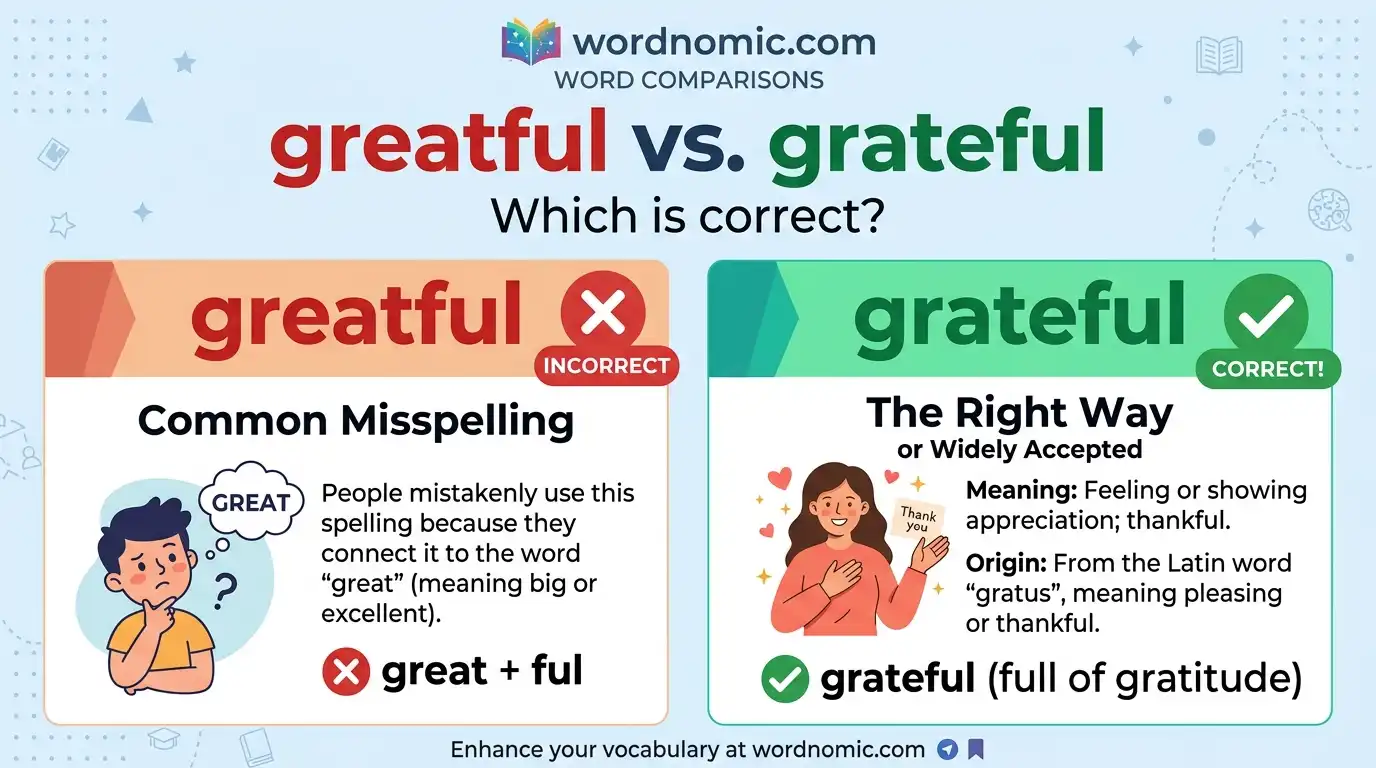
If you are wondering whether “greatful” or “grateful” is correct, the answer is grateful.
Grateful is the standard English spelling. It means feeling or showing thanks because someone helped you, gave you something, or did something kind for you. Cambridge and Oxford both list grateful as the correct adjective.
Greatful is a common spelling mistake. It looks logical because the word great is spelled with “ea,” but grateful does not contain the word “great.”
So, remember:
Correct: grateful
Incorrect: greatful
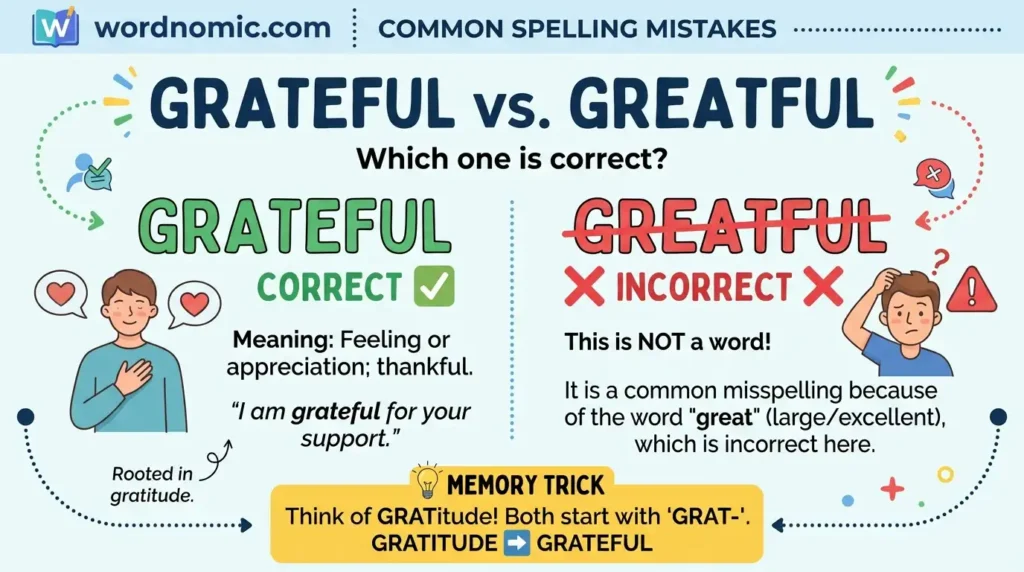
Greatful or Grateful: Quick Answer
| Spelling | Correct? | Meaning |
| grateful | ✅ Yes | Feeling or showing thanks |
| greatful | ❌ No | Common spelling mistake |
Examples
- I am grateful for your help.
- We are grateful to our teachers.
- She felt grateful for the support.
- I am grateful that you came to help.
Do not write:
- I am greatful for your help. ❌
- We are greatful to you. ❌
Write:
- I am grateful for your help. ✅
- We are grateful to you. ✅
What Does Grateful Mean?
Grateful is an adjective. It describes a person who feels thankful for something.
You can feel grateful when someone:
- helps you
- gives you something
- supports you
- does you a favor
- shows you kindness
- gives you useful advice
- helps you during a difficult time
For example:
I am grateful for your kindness.
This means that you feel thankful because of the person’s kindness.
Another example is:
She was grateful to her parents for their support.
Here, grateful describes how she feels toward her parents because they supported her.
Oxford defines grateful as feeling or showing thanks because someone has done something kind or done what you asked.
Why Do People Spell It “Greatful”?
The mistake is easy to understand.
When people hear grateful, they may connect it with the word great:
great + ful = greatful
That looks like it should make sense.
English, however, does not always form words in the way they seem to sound or look.
The correct spelling is:
grateful
There is no second e after the t.
Look at the difference
Greatful ❌
G R E A T F U L
Grateful ✅
G R A T E F U L
The difference is small, but it matters in correct English writing.
Why Is “Grateful” Spelled This Way?
The spelling becomes easier to remember when you look at the word family.
You have:
- grateful
- gratefully
- gratitude
The words are related to the idea of being thankful. Oxford gives the word origin of grateful as coming from an older form related to Latin gratus, meaning pleasing or thankful.
This is also why thinking of great + ful can lead you toward the wrong spelling.
Instead, remember the family:
grateful → gratefully → gratitude
For everyday writing, you do not need to remember the historical origin. Simply remember the correct spelling grateful.
How to Use Grateful Correctly
There are several common sentence patterns with grateful.
1. Grateful for something
Use grateful for when you want to say what you appreciate.
Examples:
I am grateful for your help.
She is grateful for the opportunity.
We are grateful for your support.
He was grateful for the advice.
This is one of the most common patterns.
2. Grateful to someone
Use grateful to when you want to identify the person you feel thankful toward.
Examples:
I am grateful to my parents.
She is grateful to her teacher.
We are grateful to everyone who helped us.
3. Grateful to someone for something
You can use both patterns together.
I am grateful to my parents for their support.
She is grateful to her teacher for the extra help.
We are grateful to everyone for their hard work.
This pattern clearly tells the reader who you are thanking and why.
4. Grateful to do something
You can also use grateful to + verb.
For example:
I am grateful to have this opportunity.
She was grateful to be there.
We are grateful to have another chance.
This means the person feels thankful about being able to do or experience something.
5. Grateful that…
You can also use grateful that followed by a clause.
I am grateful that you came.
He was grateful that nobody was hurt.
She was grateful that her friends stayed with her.
Cambridge lists these different patterns, including grateful to someone, grateful for something, grateful to do something, and grateful that….
Grateful vs Greatful in Real Sentences
Here are some common examples.
| Incorrect | Correct |
| I am greatful for your help. | I am grateful for your help. |
| She is greatful to her mother. | She is grateful to her mother. |
| We are greatful for this chance. | We are grateful for this chance. |
| He was greatful for the advice. | He was grateful for the advice. |
| I am greatful that you came. | I am grateful that you came. |
The problem in each sentence is the same: greatful should be replaced with grateful.
Grateful vs Thankful
Another question people sometimes have is whether grateful and thankful mean the same thing.
They are very close in meaning, and they can often be used in similar situations.
Grateful usually focuses on feeling or showing thanks because another person has been kind or helpful.
For example:
I am grateful for your support.
Thankful can also mean grateful, but it is often used when someone feels relief that something bad did not happen.
For example:
I am thankful that everyone is safe.
Cambridge explains this distinction: grateful is commonly used when someone has been kind or done you a favor, while thankful is often used when a person is relieved that something unpleasant or dangerous did not happen.
There is some overlap, so this is not an absolute rule.
Grateful vs Gratitude
Do not confuse grateful with gratitude.
They are related, but they have different grammatical jobs.
Grateful
Grateful is an adjective.
I am grateful for your help.
It describes how someone feels.
Gratitude
Gratitude is a noun.
It means the feeling of being grateful or the expression of thanks.
Example:
I want to express my gratitude for your support.
So:
- grateful = adjective
- gratitude = noun
Another related word is gratefully, which is an adverb.
She gratefully accepted the gift.
Oxford lists gratefully as the adverb related to grateful.
A Simple Memory Trick
If you often write greatful, try this memory trick:
Think “grateful,” not “great + ful.”
Break it like this:
GRATE + FUL = GRATEFUL
Not:
GREAT + FUL = GREATFUL
You can also remember the word family:
grateful → gratefully → gratitude
If you see greatful in your writing, stop and check it.
The correct spelling is always:
GRATEFUL
Common Mistakes With Grateful
Mistake 1: Adding the extra “e”
I am greatful for your help. ❌
Correct:
I am grateful for your help. ✅
This is the main spelling mistake behind the greatful or grateful question.
Mistake 2: Using “grateful” with the wrong preposition
A common pattern is:
grateful for something
For example:
I am grateful for your advice.
When identifying the person, use:
grateful to someone
For example:
I am grateful to my teacher.
You can combine them:
I am grateful to my teacher for her advice.
Mistake 3: Confusing grateful with gratitude
Do not write:
I am grateful for your help. ❌
Write:
I am grateful for your help. ✅
Or:
I feel gratitude for your help. ✅
The first uses an adjective, while the second uses a noun.
Is Greatful Ever Correct?
For standard English, greatful is not the spelling you should use for the meaning “thankful.”
If you want to say that you appreciate someone’s kindness or help, use grateful.
For example:
I am grateful for everything you have done.
Not:
I am greatful for everything you have done.
If you see greatful online, in a message, or in someone’s writing, it is usually a spelling error rather than an alternative spelling of grateful.
Grateful in Formal Writing
Grateful is suitable for both everyday and formal English.
You can use it in:
- emails
- school assignments
- thank-you messages
- business communication
- letters
- speeches
- applications
- personal messages
For example:
I am grateful for your time and consideration.
It can also be used in a polite formal request:
I would be grateful if you could send me the information.
Oxford specifically lists this use of grateful in requests and formal situations.
Grateful in Everyday English
You do not need to use grateful only in formal situations.
It is very common in normal conversation.
For example:
I’m really grateful for your help.
I’m so grateful you came.
We are grateful to have you here.
I will always be grateful to you.
These sentences sound natural and are easy to understand.
Pronunciation of Grateful
Grateful is pronounced roughly like:
GRAYT-ful
The pronunciation is the same in British and American English, with dictionary pronunciation guides showing the word as /ˈɡreɪtfəl/.
The spelling can be confusing because the word does not look exactly like it sounds.
That is another reason some people write greatful.
However, pronunciation should not be used to decide the spelling.
When writing, remember:
grateful ✅
Examples You Can Use
Here are some natural examples with the correct spelling:
- I am grateful for your help.
- She was grateful to her parents.
- We are grateful for this opportunity.
- He is grateful to everyone who supported him.
- I am grateful that you came.
- They were grateful to have another chance.
- I will always be grateful for your kindness.
- She felt grateful for the advice.
- We are deeply grateful to our teachers.
- I would be grateful if you could reply soon.
Notice that grateful works in many different situations.
Quick Comparison: Greatful vs Grateful
| Feature | Greatful | Grateful |
| Standard spelling | ❌ No | ✅ Yes |
| Means thankful | ❌ No | ✅ Yes |
| Used in formal writing | ❌ No | ✅ Yes |
| Used in everyday English | ❌ No | ✅ Yes |
| Dictionary word for this meaning | ❌ No | ✅ Yes |
| Example | I am greatful. | I am grateful. |
FAQs
Is “greatful” or “grateful” correct?
Grateful is correct. Greatful is a common spelling mistake.
Why do people spell grateful as greatful?
The mistake probably comes from seeing the word great and assuming that grateful is formed from “great” plus “ful.” The correct spelling is grateful.
What does grateful mean?
Grateful means feeling or showing thanks because someone has helped you, been kind to you, or done something good for you.
Is grateful an adjective?
Yes. Grateful is an adjective.
Example:
I am grateful for your help.
Is gratitude the same as grateful?
They are related but have different roles. Grateful is an adjective, while gratitude is a noun.
I am grateful for your help.
I want to express my gratitude.
Is “I am grateful for you” correct?
Yes, it can be correct. It means you feel thankful that the person is in your life or has been part of your experience.
For a specific action, grateful for your help or grateful to you for your help may be clearer.
What is the easiest way to remember the spelling?
Remember:
GRATE + FUL = GRATEFUL
Do not spell it greatful.
Final Takeaway
When choosing between greatful or grateful, always use grateful.
Grateful is the correct standard spelling for the adjective meaning thankful or appreciative. Greatful is a spelling mistake.
The easiest rule is:
Grateful = correct
Greatful = incorrect
If you remember the related words grateful, gratefully, and gratitude, the spelling becomes much easier to keep straight.

Emily Carter is an English grammar writer based in Portland, Oregon, with 7+ years of experience turning tricky grammar rules into simple, easy lessons.