You are writing an email. You want to say “please send this forward.” But you stop. Is it foward or forward?
Many people make this spelling mistake every day. It is one of the most searched spelling questions online. The word looks simple. But many people miss one letter and get it wrong.
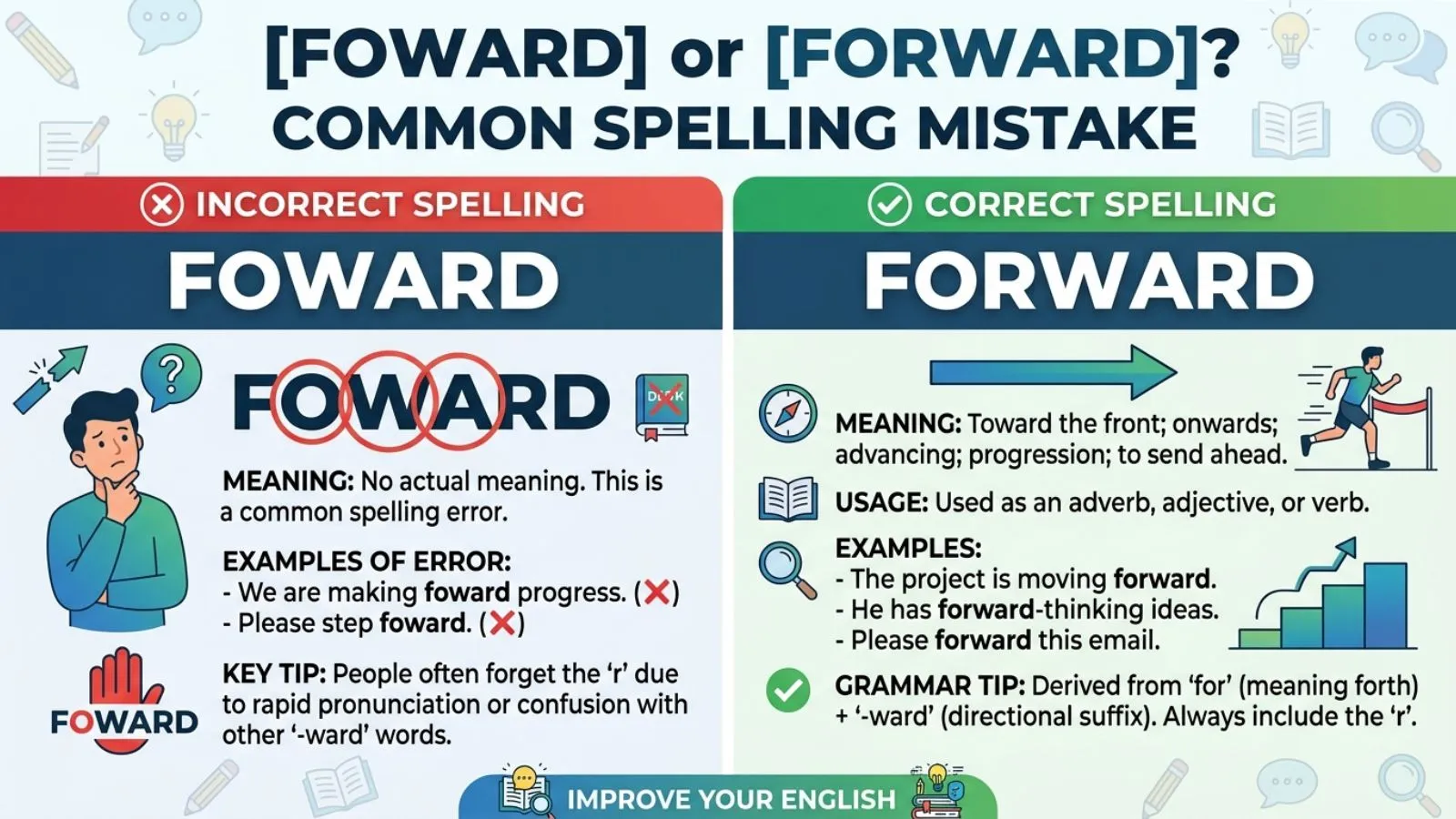
Here is the truth — only one spelling is correct. Forward is the right word. Foward is always a spelling mistake. There is no such word as foward in English.
But do not feel bad. This is a very easy word to get wrong. The letters in the middle can be tricky. Once you know the right way to spell it, you will never get it wrong again.
This guide will show you the correct spelling. It will tell you what the word means. It will give you easy examples. And it will show you the most common mistakes so you can avoid them.
No hard words. Just simple, clear help.
Let us go!
Foward or Forward – Quick Answer
Here is the fast answer:
- Forward ✅ = correct spelling
- Foward ❌ = always wrong — this word does not exist
Forward means:
- Toward the front
- Ahead in time or place
- To send something on to someone else
Examples:
- “Please move forward.” ✅
- “I will forward the email to you.” ✅
- “We need to look forward, not back.” ✅
- “Please move foward.” ❌ (Wrong spelling!)
Simple rule: Always spell it F-O-R-W-A-R-D. There are two R’s — one near the start and one near the end.
Other Words That Use “-ward”
“Forward” is not alone. English has a whole family of direction words built with the same “-ward” ending. Knowing them helps you spell “forward” correctly too:
- Forward – toward the front
- Backward – toward the back
- Upward – toward up
- Downward – toward down
- Onward – moving ahead, continuing
- Afterward – later, after
- Awkward – not smooth or graceful
- Wayward – hard to control, going its own way
- Homeward – toward home
- Toward – in the direction of
Notice the pattern: none of these words drop a letter in the middle. If you can spell “backward” correctly, you already know the pattern for “forward.”
The Origin of the Word Forward
Where did the word forward come from? Let us look at its history.
The Root of Forward
The word forward comes from very old English. The old words were foreweard or forweard. They meant “toward the front” or “in the direction you are facing.”
It is made of two old parts:
- For = before or in front
- Ward = direction or way
So forward literally means “in the direction of the front.” People have used this word for over 1000 years.
Why Do People Spell It Wrong?
The word forward has the letters R-W in the middle. When we say it fast, the first R is very quiet. We almost do not hear it. So many people write foward instead of for-ward.
Say it slowly — FOR-WARD. You can hear both parts clearly. That is the key to spelling it right.
British English vs American English Spelling
Great news — forward is spelled the same way in both British and American English. No difference at all.
But there is one small thing. British English sometimes uses forwards (with an S at the end). American English almost always uses forward without the S.
Comparison Table: British vs American English
| Feature | American English | British English |
| Correct spelling | Forward | Forward |
| Wrong spelling | Foward | Foward |
| With S at the end | Rare | Common (forwards) |
| Meaning difference | None | None |
| Used as a verb | ✅ Yes | ✅ Yes |
| Used as an adjective | ✅ Yes | ✅ Yes |
Forward or Forwards?
- Forward — used in the USA almost all the time
- Forwards — used in the UK, mostly when talking about direction
Examples:
- “Move forward.” (American) ✅
- “Move forwards.” (British) ✅
- Both are correct — just different styles
For most writing — emails, reports, and everyday use — forward without the S is fine everywhere.
Popular Phrases That Use “Forward”
“Forward” shows up in many common English phrases. Here are the ones you’ll see most often:
| Phrase | Meaning | Example |
| Fast forward | Skip ahead | “Let’s fast forward to the good part.” |
| Forward-thinking | Modern, open to new ideas | “She has a forward-thinking approach.” |
| Forward slash | The “/” symbol | “Type a forward slash before the word.” |
| Put forward | To suggest or propose | “He put forward a new plan.” |
| Bring forward | Move to an earlier time | “We brought the meeting forward to Monday.” |
| Step forward | Volunteer or come ahead | “Please step forward if you can help.” |
| Going forward | From now on | “Going forward, we’ll meet every Friday.” |
Learning these phrases helps you use “forward” naturally, not just spell it correctly.
What Does Forward Mean?
Forward can be used in many ways. Let us look at all of them simply.
1. Forward as a Direction
It means toward the front. Away from where you were.
- “Take one step forward.”
- “The car moved forward slowly.”
- “Look forward, not back.”
2. Forward as a Verb (Sending Something)
To forward something means to send it on to another person.
- “Can you forward that email to me?”
- “I will forward your message to the manager.”
- “She forwarded the letter to the right office.”
3. Forward in Time
It can also mean ahead in time.
- “We are looking forward to your visit.”
- “Let us move forward with the plan.”
- “From this day forward, things will be different.”
Comparison Table: Ways to Use Forward
| Use | Meaning | Example |
| Direction | Toward the front | “Step forward.” |
| Verb | To send on to someone | “Forward the email.” |
| Time | Ahead or in the future | “Looking forward to it.” |
| Adjective | Confident, sometimes too bold | “He was very forward at the meeting.” |
Other Forms of the Word
“Forward” changes slightly depending on how you use it in a sentence:
- Forward – base word (“Move forward.”)
- Forwards – British direction style (“She walked forwards.”)
- Forwarding – action happening now (“I am forwarding the email.”)
- Forwarded – already done (“I forwarded it yesterday.”)
- Forwarder – a person or company that sends things on (used in shipping and logistics)
All of these keep the same “for-ward” spelling pattern. The double R rule stays the same in every form.
Which Spelling Should You Use?
This one is very simple. There is only one correct spelling — forward.
Foward is never correct. It is always a spelling mistake. No country uses foward. No dictionary has foward in it.
If You Are Writing for Any Audience
Always use forward.
- Writing an email → forward
- Writing a school paper → forward
- Writing a social media post → forward
- Writing a formal letter → forward
One Small Choice: Forward or Forwards?
If you are in the UK or writing for a British audience, forwards is fine when talking about direction.
- “She walked forwards into the room.” (British style) ✅
- “She walked forward into the room.” (American style) ✅
For everything else — emails, business writing, online writing — just use forward without the S.
Common Mistakes with Forward
Let us look at the most common errors. Then we will fix them.
Mistake 1: Spelling it as “foward”
This is the most common mistake of all.
❌ “Please step foward.” ✅ “Please step forward.”
Remember: FOR + WARD = FORWARD. Two parts. Two R’s.
Mistake 2: Spelling it as “froward” or “fowared”
Some people mix up the letters even more.
❌ “Move froward.” ❌ “Move fowared.” ✅ “Move forward.”
Tip: Say it slowly — FOR-WARD. Write what you hear.
Mistake 3: Writing “foreward” instead of “foreword”
This is a different word. A foreword is the intro at the start of a book. It is not the same as forward.
- Forward = direction, to send on, or ahead ✅
- Foreword = the opening pages of a book ✅
❌ “Please read the forward of the book.” ✅ “Please read the foreword of the book.” ✅ “Please move forward.”
Mistake 4: Saying “forwards” in American formal writing
In American English, using forwards can sound odd in formal writing.
❌ “Please move forwards with the project.” (American formal writing) ✅ “Please move forward with the project.” (Better for American writing)
Mistake 5: Using “forward” when you mean “onward”
Sometimes people use forward when onward fits better.
- “From this point onward…” (talking about time continuing)
- “Step forward…” (talking about physical movement)
Both words are fine — just know which one fits your sentence.
Forward in Everyday Examples
Let us see this word used in real life.
In an Email
“Hi Sara, please forward this email to the whole team. Thank you!”
“I am forwarding your message to our support team. They will help you soon.”
In the News
“The two teams agreed to move forward with the new deal.”
“The army was ordered to move forward at dawn.”
On Social Media
“So excited! Looking forward to the weekend “
“Big news coming soon — stay tuned and look forward to something amazing!”
In Everyday Talk
“Can you forward that link to me?” “Let us move forward and stop thinking about the past.” “Take one step forward, please.”
In Formal Writing
“We look forward to hearing from you.”
“Please forward all complaints to the main office.”
“The board agreed to move forward with the new plan.”
Foward or Forward – Google Trends & Usage Data
Many people search for this spelling question every month. Let us look at the data.
Who Searches for This?
- Students who are not sure of the spelling
- Office workers writing emails and reports
- People learning English as a second language
- Anyone who has typed foward and seen a red line under it
Where Is It Most Searched?
- India and Pakistan — Very high search. English is used in school and work every day.
- United States — High search. Even native speakers sometimes type it too fast and miss the R.
- United Kingdom — Moderate search. The word is very common in business emails.
- Nigeria and Philippines — High search. English is used in school and at work a lot.
Comparison Table: Foward vs Forward
| Feature | Foward | Forward |
| Is it a real word? | ❌ No | ✅ Yes |
| Found in the dictionary | ❌ No | ✅ Yes |
| Correct to use | ❌ Never | ✅ Always |
| Spell checker flags it | ✅ Yes — as an error | ❌ No |
| Used in emails | ❌ Mistake | ✅ Very common |
| Used in formal writing | ❌ Never | ✅ Yes |
Test Yourself
Pick the correct spelling:
- Please (foward / forward) the email to me.
- We are looking (foward / forward) to the trip.
- The soldiers moved (foward / forward) at dawn.
- She wrote the (forward / foreword) for her friend’s new book.
Answers: 1. forward 2. forward 3. forward 4. foreword
If you got all four right, you’ve got it down. If not, just remember: FOR + WARD, two R’s, every time.
FAQs:
1. Is “foward” ever correct?
No. Foward is never correct. It is always a spelling mistake. The right word is always forward with two R’s.
2. How do I remember the right spelling?
Think of it as two words put together — FOR + WARD. Say it slowly: FOR-WARD. Write it the same way you say it.
3. What does “forward” mean?
It has a few meanings. It can mean toward the front (“step forward”). they can mean to send something to someone (“forward the email”).
4. What is the difference between “forward” and “forwards”?
They mean the same thing. Forward is used in American English. Forwards is sometimes used in British English when talking about direction. For most writing, forward without the S is fine everywhere.
5. What is the difference between “forward” and “foreword”?
These are two different words.
- Forward = direction, to send on, or ahead in time
- Foreword = the short intro at the start of a book
6. Can “forward” be used as a verb?
Yes! To forward something means to send it on to another person.
- “Please forward this email to John.”
- “She forwarded the letter to the right office.”
7. Is it “look forward to” or “look forwards to”?
In most writing, say look forward to. This is the correct phrase in both American and British English.
- ✅ “I look forward to meeting you.”
- ❌ “I look forwards to meeting you.” (This sounds odd)
8. What words sound like “forward”?
Some people mix up:
- Forward — direction or to send on
- Foreword — intro of a book
- Reward — something you get for doing good
- Toward — in the direction of
None of these are the same. Each one has its own meaning.
Conclusion:
Now you know the clear answer. Foward is never correct. It is always a spelling mistake. The right word is always forward.
Forward is spelled F-O-R-W-A-R-D. It has two R’s. Think of it as two parts — FOR and WARD. Say it slowly and you will always get it right.
Here are the key things to remember:
- Forward ✅ = always correct
- Foward ❌ = always wrong — not a real word
- Two parts: FOR + WARD
- Two R’s in the word — do not forget the first one
- In the UK, forwards with an S is also fine for direction
- Foreword is a different word — it is the intro of a book
- “Look forward to” is the correct phrase — not “look forwards to”
Next time you type this word, just slow down for one second. FOR-WARD. Two parts. Two R’s. That is all you need to remember!