Some phrases sound simple but become confusing when you see them online. “Fix your hearts or die” is one of those phrases. People may search for fix your hearts or die because they have seen the phrase in a post, meme, video, quote, or discussion and want to know what it means.
The phrase is not a normal everyday English expression. Its meaning depends on the context in which it appears. The key word is “hearts.” Here, “hearts” can refer to a person’s feelings, attitude, character, or inner state. “Fix” can mean to repair, correct, or improve something.
So, in simple words, “fix your hearts or die” can be understood as a strong warning to correct your inner attitude, feelings, or behavior. The word “die” makes the statement sound extreme and dramatic.
This guide explains the meaning of the phrase, where it may come from, how to understand it in different contexts, and how to use it naturally. It also explains why the phrase can sound harsh or unusual in normal conversation.
Fix Your Hearts or Die – Quick Answer
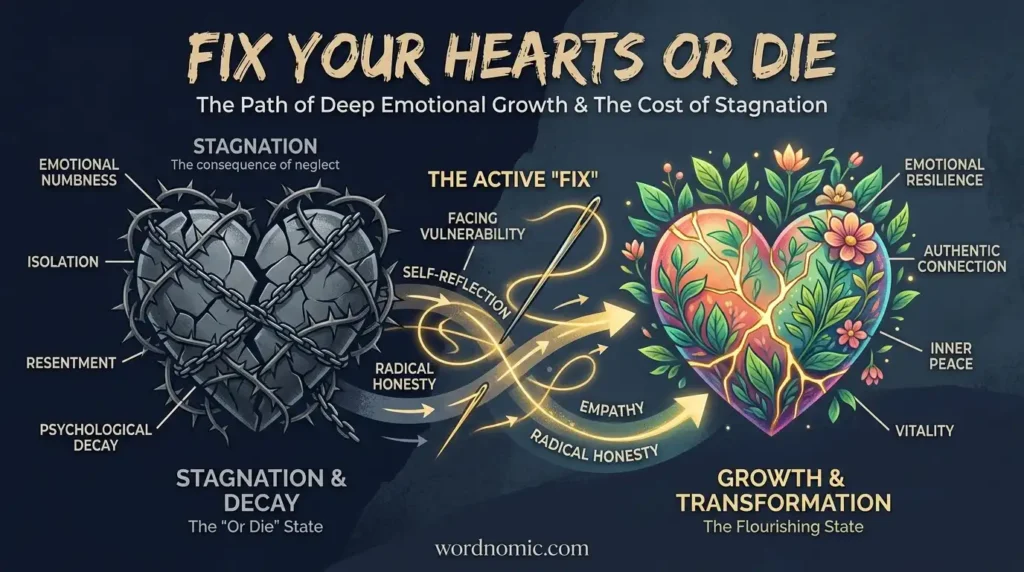
“Fix your hearts or die” means to change or correct your inner feelings, attitude, character, or behavior, with “die” used as an extreme warning.
The phrase can be read as:
Fix what is wrong inside you, or face a serious consequence.
Here, “fix” means correct or improve, while “hearts” can mean a person’s inner feelings or character.
It is a dramatic phrase, not a common everyday expression.
What Does “Fix Your Hearts or Die” Mean?
The phrase has three main parts:
- Fix = repair, correct, or make better.
- Your hearts = your inner feelings, attitude, character, or emotional state.
- Or die = a very strong statement about the consequence of not changing.
The word heart often has a meaning beyond the physical organ.
For example:
- “She has a kind heart.”
- “He spoke from the heart.”
- “Change your heart.”
- “His heart was full of anger.”
In these examples, heart relates to feelings, character, or inner thoughts.
Therefore, “fix your hearts” can mean correct what is wrong inside you.
The phrase becomes much stronger when “or die” is added. It creates a sense of urgency, danger, or extreme consequence.
Main Difference: Literal vs Figurative Meaning
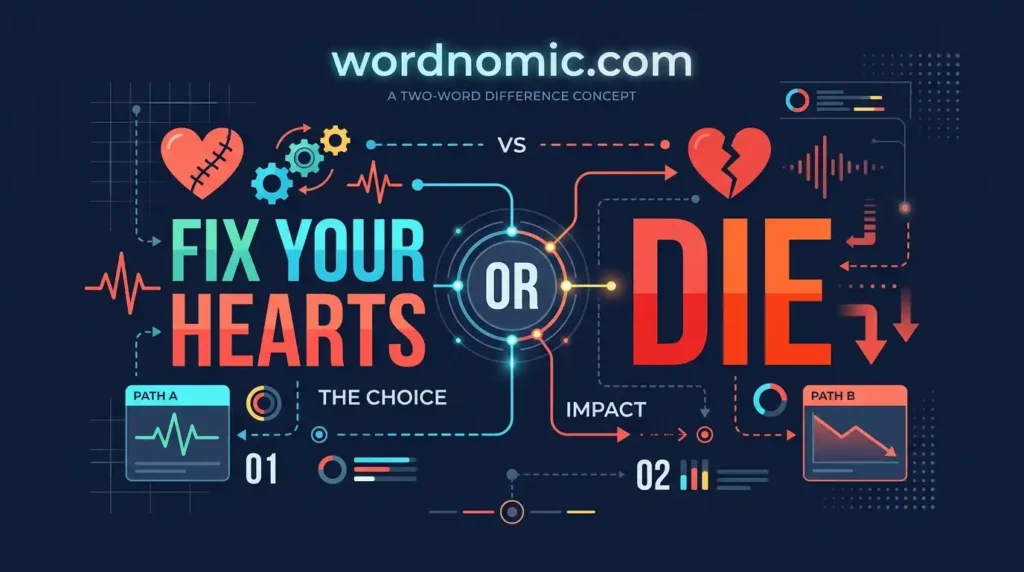
The phrase can have two basic readings.
Figurative meaning
The most natural reading in many online or inspirational contexts is figurative.
It may mean:
Change your attitude, feelings, values, or behavior before it causes serious problems.
Literal meaning
If someone uses the phrase in a real-life situation involving physical danger, “die” could have a literal meaning.
However, you should not automatically assume that the phrase is a literal threat. Context matters.
For example:
“Fix your hearts or die trying.”
This may be dramatic or motivational language rather than a literal statement about death.
Why Does “Heart” Mean Feelings?
English often uses heart to talk about a person’s inner life.
The heart can represent:
- Love
- Kindness
- Courage
- Feelings
- Character
- Desire
- Moral values
That is why phrases such as “a good heart” and “broken heart” are common.
In “fix your hearts,” the plural form can suggest that the speaker is talking to more than one person.
For example:
“You both need to fix your hearts.”
This means the speaker thinks both people need to change something about their feelings, attitude, or behavior.
Origin and History

The exact origin of the phrase “fix your hearts or die” should not be assumed without a reliable source.
The individual ideas behind the phrase are much older.
English has long used heart as a metaphor for a person’s emotions, character, and inner self. The word fix also has a long history of meanings connected with making something firm, correct, or repaired.
The structure “X or die” is also a dramatic form of language. People use similar structures to show that something feels extremely important.
Because the exact phrase can appear in different online contexts, its specific origin should be confirmed from the original post, song, book, video, or other source where it was encountered.
British English vs American English
There is no important British English or American English difference in the phrase “fix your hearts or die.”
The spelling is the same in both forms of English:
- fix
- your
- hearts
- or
- die
The meaning also stays broadly the same.
However, the phrase is unusual in both British and American everyday English. A person would normally use more direct wording if they wanted to tell someone to change their attitude or behavior.
For example:
“You need to change your attitude.”
is much more natural in everyday speech than:
“Fix your heart or die.”
Which One Should You Use?
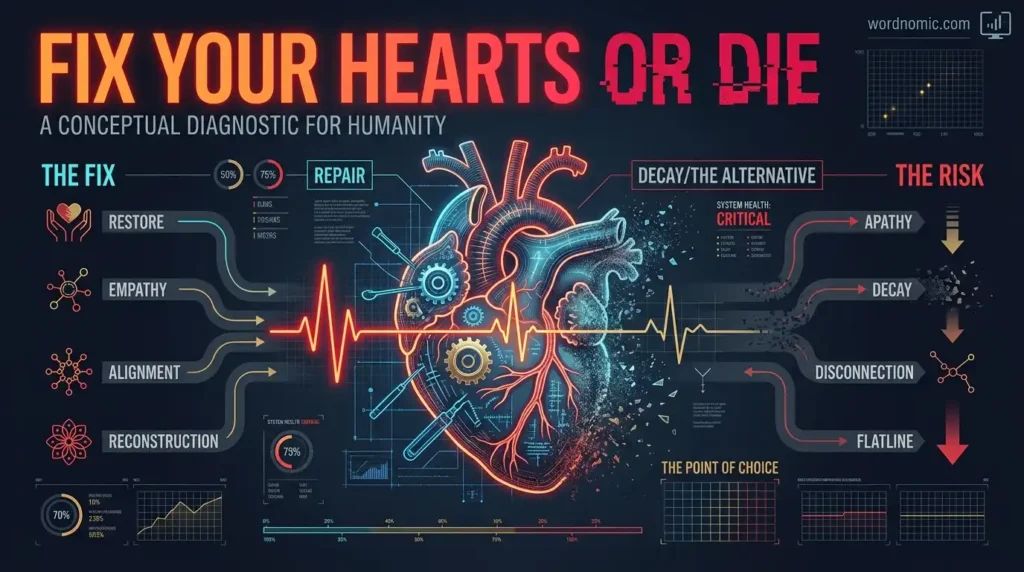
If you are writing normal English, avoid “fix your hearts or die” unless you specifically want a dramatic, poetic, humorous, or intense tone.
Everyday writing
Use:
“You need to change your attitude.”
Formal writing
Use:
“People should reflect on their values and behavior.”
Friendly conversation
Use:
“You need to work on how you feel about this.”
Dramatic or creative writing
You can use:
“Fix your hearts or die.”
The phrase can work well in fiction, poetry, dramatic dialogue, memes, or stylized online content.
Common Mistakes
1. Treating “fix” as only a mechanical word
Incorrect idea: “Fix” only means repair a broken object.
Correct: “Fix” can also mean correct or improve something.
Example:
“You need to fix your attitude.”
2. Assuming “heart” always means the body organ
Incorrect idea: “Heart” always refers to the physical organ.
Correct: “Heart” can also describe feelings or character.
Example:
“She has a kind heart.”
3. Assuming “or die” is always a literal threat
Incorrect idea: The phrase always means someone will physically die.
Correct: Context can make “die” dramatic, figurative, or literal.
Example:
“I will finish this project or die trying.”
This is often dramatic language.
4. Using the phrase in formal writing
Incorrect: Using “fix your hearts or die” in a formal business report.
Correct: Use clear and neutral wording.
Example:
“People should change harmful attitudes and behavior.”
5. Changing “hearts” to “heart” without checking the context
Incorrect: Assuming both forms mean exactly the same thing.
Correct: “Heart” can refer to one person’s inner feelings, while “hearts” can address multiple people or multiple inner states.
Example:
“Fix your heart.”
versus
“Fix your hearts.”
10 Examples of “Fix Your Hearts or Die”
- “Fix your hearts or die” is a very dramatic statement.
- The writer used “fix your hearts” to tell people to change their attitude.
- The phrase sounds more like poetry than normal conversation.
- She used the words “fix your hearts” in a motivational post.
- The character shouted, “Fix your hearts or die!”
- The phrase can suggest that inner change is necessary.
- He understood “fix your hearts” as a call for personal change.
- The dramatic wording made the quote memorable.
- The phrase does not have one fixed meaning in every context.
- Always check the original context before interpreting the phrase literally.
Real-Life Usage
In conversation
Most people would not normally say “fix your hearts or die” during an everyday conversation.
They would use simpler wording such as:
“You need to change your attitude.”
On social media
The phrase may work better on social media because short, dramatic phrases often attract attention.
For example:
“Fix your hearts. Stop hurting people.”
Here, the phrase has a moral or emotional meaning.
In poetry
The phrase can have a poetic effect.
A writer might use it to represent personal change, emotional pain, or a struggle between good and bad choices.
In fiction
A character can use the phrase to sound angry, intense, threatening, or dramatic.
In formal writing
The phrase is usually too dramatic for academic or professional writing.
A formal writer would explain the idea directly instead.
What Does “Fix Your Heart” Mean?
“Fix your heart” can mean to improve your emotional state, attitude, or character.
The exact meaning depends on context.
For example:
“Fix your heart before you judge others.”
This suggests that the person should examine their own feelings or behavior before judging someone else.
It does not normally mean repairing the physical heart.
What Does “Fix Your Hearts” Mean?
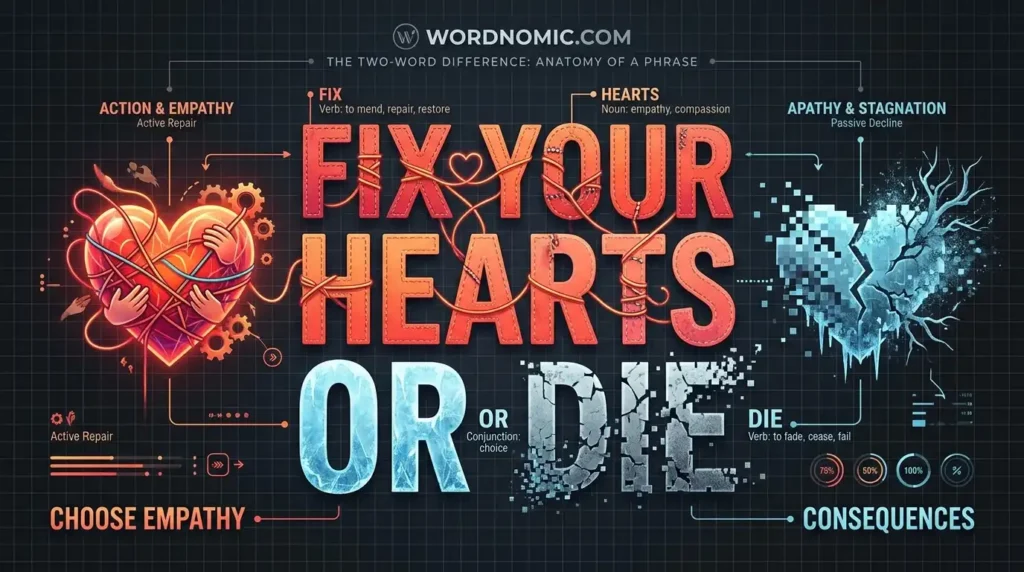
“Fix your hearts” is the plural form.
It can mean:
Correct your feelings, attitudes, values, or behavior.
Because hearts is plural, the phrase can address multiple people.
For example:
“You all need to fix your hearts.”
This suggests that the speaker believes several people need to change something inside themselves.
Is “Fix Your Hearts or Die” Correct English?
Yes, the words can form a grammatically understandable English sentence.
However, grammatically understandable does not mean common or natural.
The phrase is highly dramatic. Its unusual wording makes it sound like a quote, slogan, poem, fictional line, meme, or strong statement.
If you want natural everyday English, a clearer alternative would be:
“Change your attitude before it is too late.”
Does “Die” Always Mean Death?
No.
English often uses die in figurative expressions.
For example:
“I laughed so hard I could die.”
“I would die for that opportunity.”
“Try or die.”
These expressions may not describe literal death.
However, “die” can still sound serious, so the context matters.
Usage and Search Trends
There is no reliable search-volume or trend data provided here, so exact numbers should not be claimed.
The search intent behind “fix your hearts or die” is most likely informational. Someone searching the phrase probably wants to understand its meaning, source, context, or use.
Related searches may include:
- fix your hearts meaning
- fix your heart meaning
- what does fix your hearts mean
- fix your hearts or die meaning
- what does fix your hearts or die mean
- fix your heart quote
- fix your hearts phrase meaning
- meaning of fix your hearts
Because the phrase can have different meanings in different contexts, the original source is useful when someone wants to know exactly what the speaker or writer intended.
Fix Your Hearts or Die: Phrase Comparison
| Phrase | Basic Meaning | Tone | Example |
| Fix your heart | Change your inner attitude or feelings | Personal | “Fix your heart before judging others.” |
| Fix your hearts | Change the inner attitude of multiple people | Strong | “You need to fix your hearts.” |
| Fix your hearts or die | Change or face an extreme consequence | Very dramatic | “Fix your hearts or die.” |
| Change your attitude | Improve your behavior or outlook | Direct | “Please change your attitude.” |
| Work on yourself | Improve personal behavior or feelings | Friendly | “Take time to work on yourself.” |
FAQs
What does “fix your hearts or die” mean?
It generally means that a person or group must correct something within themselves, such as their attitude, feelings, values, or behavior. The phrase adds “or die” to make the message much more intense. The exact meaning can change based on where you saw it.
Is “fix your hearts or die” a common phrase?
No. It is not a common everyday English expression. It sounds dramatic, poetic, or stylized. You may see wording like this in quotes, fiction, social media posts, memes, or other creative contexts.
What does “fix your heart” mean?
“Fix your heart” can mean changing or improving your inner feelings, attitude, or character. It usually has a figurative meaning rather than referring to physical medical treatment. The surrounding sentence is important for understanding exactly what the speaker means.
Is “fix your hearts or die” grammatically correct?
The phrase can be understood grammatically, but it is unusual English. The unusual wording appears intentional because it creates a strong and dramatic effect. It is not the kind of sentence most people would use in normal business, school, or everyday conversation.
What is the difference between “fix your heart” and “fix your hearts”?
“Fix your heart” usually refers to one person’s inner feelings or character. “Fix your hearts” can address several people or refer to more than one person’s inner state. The basic idea remains the same: correct or improve something within yourself or yourselves.
Does “or die” mean literal death?
Not always. English uses “die” in many dramatic or figurative expressions. In this phrase, it may simply emphasize urgency or the seriousness of change. Still, if the phrase appears in a dangerous or threatening context, it should not automatically be treated as figurative.
Can I use this phrase in formal writing?
It is usually better to avoid it in formal writing. The phrase has a strong and dramatic tone. In academic, business, or professional writing, use clearer wording such as “change your attitude,” “correct harmful behavior,” or “reflect on your values.”
Conclusion
“Fix your hearts or die” is a strong and dramatic phrase. In most figurative contexts, it suggests that people should change something inside themselves, such as their feelings, attitude, values, or behavior. The word “fix” means to correct or improve, while “hearts” can represent a person’s inner character or emotions.
The final words, “or die,” make the phrase much more intense. They may describe a serious consequence, but they can also be dramatic or figurative. You should always look at the surrounding context before deciding what the phrase means.
The expression is understandable English, but it is not a common phrase for everyday conversation. It works better in creative writing, poetry, fiction, memes, quotes, or dramatic social media content.
If you need a simple everyday alternative, “change your attitude,” “work on yourself,” or “change what is wrong inside you” will usually sound more natural.
So, the simplest meaning is: correct your inner feelings, attitude, or character before the consequences become serious.