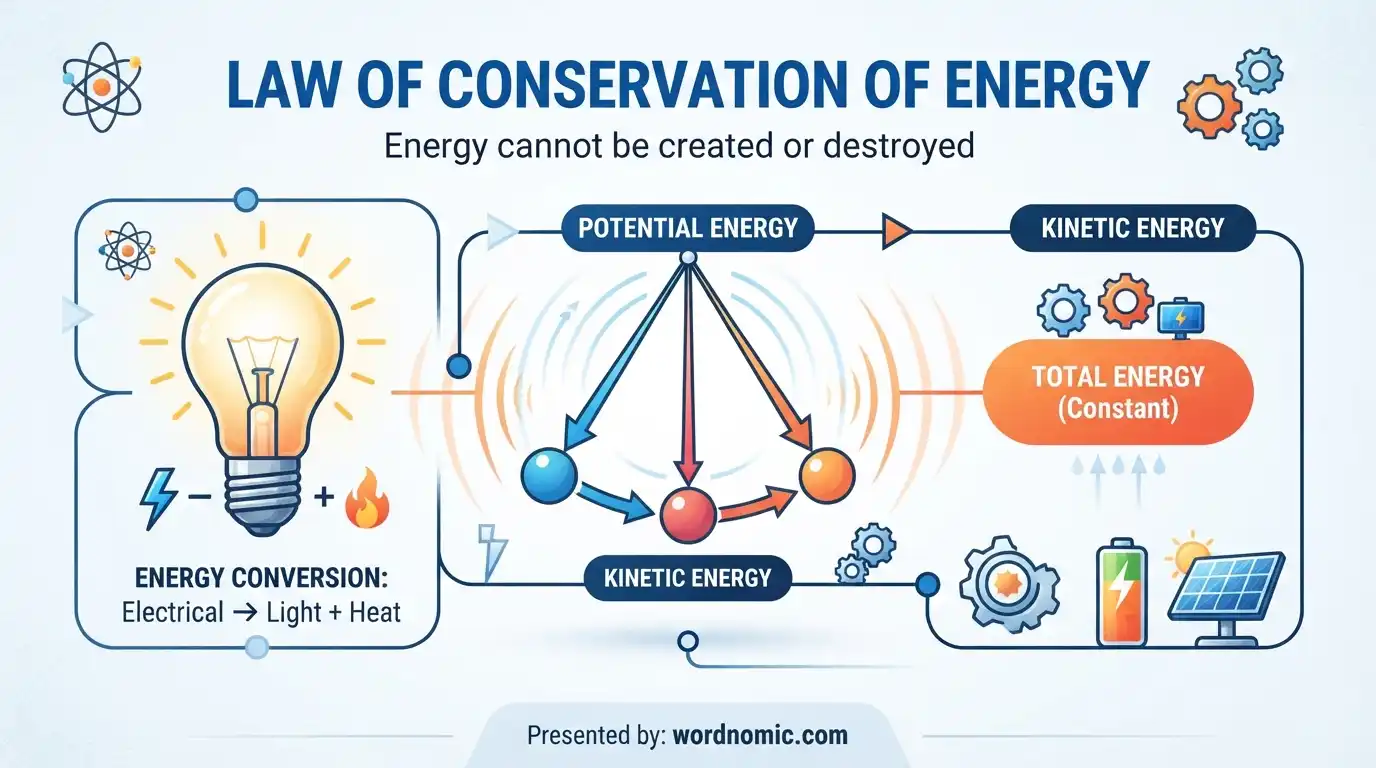
“Energy cannot be created or destroyed” is one of the most important ideas in physics. You may have heard this sentence in a science class, a textbook, or a video about how the universe works.
But what does it really mean?
The statement means that energy cannot simply appear from nothing or disappear completely. Instead, energy changes from one form to another.
For example, when you turn on a light bulb, electrical energy changes into light and heat. The electrical energy does not simply vanish. Part of it becomes light, and much of it becomes heat.
This principle is known as the law of conservation of energy. It tells us that the total amount of energy in a closed system stays constant, even when the energy changes form.
The wording may sound simple, but it explains many things we see every day.
Energy Cannot Be Created or Destroyed – Quick Answer
Energy can change from:
- Chemical energy to heat
- Electrical energy to light
- Chemical energy to movement
- Light energy to chemical energy
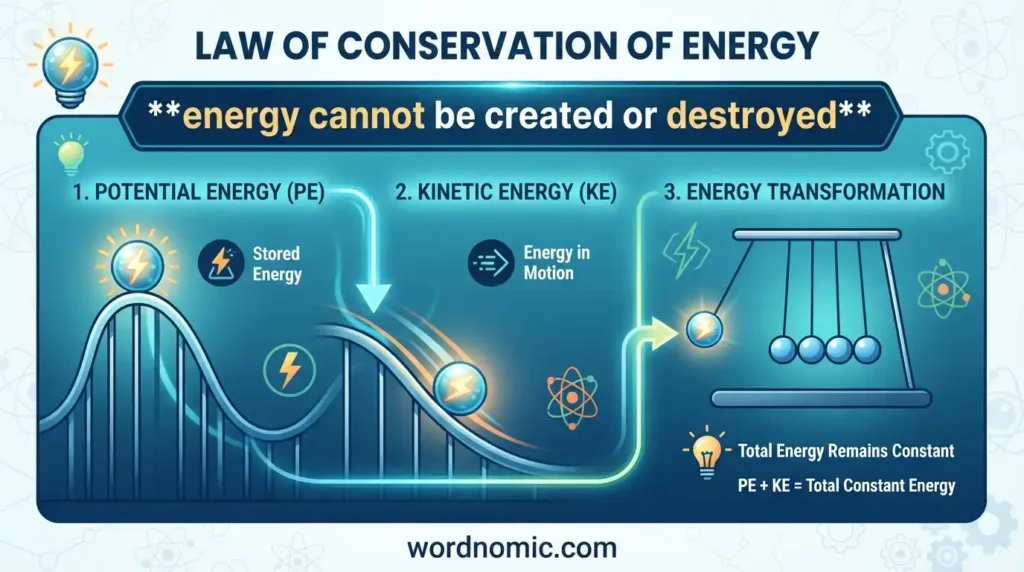
- Potential energy to kinetic energy
- Electrical energy to sound and heat
For example, when you eat food, your body uses the chemical energy stored in that food. Your body can turn that energy into movement and heat.
The energy has not disappeared. It has changed form.
A simple way to remember it is:
Energy changes form, but the total energy remains the same in a closed system.
What Is the Law of Conservation of Energy?
The law of conservation of energy is a basic law of physics.
It says that energy cannot be created or destroyed in an isolated or closed system. It can only move from one place to another or change from one form into another.
Imagine a ball sitting on a high shelf.
The ball has gravitational potential energy because of its position.
When the ball falls, its potential energy changes into kinetic energy, which is the energy of motion.
As the ball hits the ground, some of that energy becomes sound, heat, and other forms of energy.
So the energy does not simply vanish.
It moves and changes.
What Does “Energy Cannot Be Created” Mean?
The first part of the statement says that energy cannot be created from nothing.
This does not mean that we cannot produce energy for useful work.
When we say a power plant “produces electricity,” the plant is actually converting energy from one form into electrical energy.
For example, a power plant may use chemical energy stored in fuel.
That energy can be converted into heat. The heat can produce motion, and the motion can drive a generator to produce electrical energy.
The energy came from another source.
What Does “Energy Cannot Be Destroyed” Mean?
The second part means that energy cannot simply disappear.
Suppose you switch on an electric heater.
You may say that electrical energy is being “used up.”
In everyday language, that is fine. But in physics, the energy has not been destroyed.
The electrical energy is mainly converted into thermal energy, which makes the heater hot and warms the surrounding area.
The energy has moved into other forms.
Energy Can Change From One Form to Another
Energy comes in many forms.
Some common forms include:
- Kinetic energy
- Potential energy
- Chemical energy
- Electrical energy
- Thermal energy
- Light energy
- Sound energy
- Nuclear energy
These forms can change into one another.
Example: A Flashlight
A flashlight gives us a simple example.
The battery stores chemical energy.
When the flashlight is turned on, the chemical energy is converted into electrical energy.
The electrical energy then becomes light and heat.
So we can describe the process like this:
Chemical energy → Electrical energy → Light + Heat
The battery did not create energy.
Example: A Car
A car also shows how energy changes form.
Fuel contains chemical energy.
When the fuel burns inside the engine, that chemical energy is converted into heat and other forms of energy.
The engine uses this energy to produce motion.
Some energy also becomes heat and sound.
A simple version is:
Chemical energy → Heat → Mechanical energy + Heat + Sound
This is why a car engine becomes hot while the car is running.
Example: Food and the Human Body
Your body also follows the law of conservation of energy.
Food contains chemical energy.
When you eat food, your body breaks it down and uses the stored energy.
That energy helps your body:
- Move
- Keep warm
- Grow
- Repair cells
- Keep organs working
So when you eat and then exercise, energy is changing form.
Example: A Light Bulb
A traditional light bulb changes electrical energy into light and heat.
The electrical energy enters the bulb.
Some of it becomes visible light.
A large amount also becomes heat.
It has simply changed form.
Modern LED lights are more efficient because they convert a larger part of the electrical energy into useful light and produce less wasted heat than older incandescent bulbs.
Even then, the basic law remains the same.
Example: Hydroelectric Power
Hydroelectric power is another useful example.
Water stored at a height has gravitational potential energy.
When the water flows downward, that energy changes into kinetic energy.
The moving water turns turbines.
The turbines drive generators that produce electricity.
The process can be simplified as:
Potential energy → Kinetic energy → Mechanical energy → Electrical energy
Again, the energy is changing form
Why Does Energy Seem to Disappear?
Sometimes energy seems to disappear.
For example, imagine pushing a box across the floor.
You use energy to push it.
Eventually, the box stops.
Where did the energy go
This is an important idea.
Energy conservation does not mean that all energy remains equally useful.
Some energy spreads into the surroundings and becomes harder to use for useful work.
Energy Conservation Does Not Mean “No Energy Is Lost”
People often say that energy is “lost.”
In everyday language, this can be useful.
For example, a moving bicycle eventually stops because of friction and air resistance.
This difference is important when studying physics.
Energy Cannot Be Created or Destroyed vs Matter
Energy and matter are related, but they are not exactly the same thing.
In basic physics, we often learn that matter cannot be created or destroyed in ordinary chemical reactions.
Modern physics gives us a deeper picture.
According to Einstein’s famous equation:
E = mc²
This does not mean that the everyday law of conservation of energy is wrong. Instead, modern physics describes conservation in a broader way.
Is Energy Really Never Created or Destroyed?
For basic physics, the short answer is yes: energy is conserved.
But there is an important detail.
The law applies to the total energy of an appropriately defined system. Energy can enter or leave an open system.
For example, your phone may gain electrical energy when you charge it.
From the phone’s point of view, energy has entered the system.
The energy did not appear from nowhere. It came from the electrical system supplying the charger.
This is why scientists carefully define the system they are studying.
Energy Conservation in Everyday Life
You can see energy changes all around you.
A toaster
Electrical energy becomes heat.
A battery
Chemical energy becomes electrical energy.
A solar panel
Light energy becomes electrical energy.
A falling object
Potential energy becomes kinetic energy.
A speaker
Electrical energy becomes sound and heat.
A wind turbine
The kinetic energy of moving air becomes mechanical energy and then electrical energy.
These examples show how often energy changes form.
Energy Cannot Be Created or Destroyed: Simple Table
| Situation | Starting Energy | Main Energy Change |
| Flashlight | Chemical | Light + Heat |
| Car | Chemical | Motion + Heat + Sound |
| Falling ball | Potential | Kinetic + Heat/Sound |
| Solar panel | Light | Electrical |
| Toaster | Electrical | Heat |
| Speaker | Electrical | Sound + Heat |
| Wind turbine | Kinetic | Electrical |
| Human body | Chemical | Movement + Heat |
Why Is the Law of Conservation of Energy Important?
This law helps scientists understand and predict how physical systems work.
- Mechanical engineering
- Electrical engineering
- Chemistry
- Biology
- Astronomy
- Thermodynamics
- Power generation
- Renewable energy
Engineers use energy conservation when designing machines, engines, buildings, power systems, and many other technologies.
Scientists also use it to study systems that are far beyond everyday experience.
Common Misunderstandings
“Energy is used up.”
Energy can be transferred or changed into a form that is less useful, but it is not destroyed.
“A power plant creates energy.”
A power plant converts energy from a source into electricity.
“A battery creates electricity.”
A battery converts stored chemical energy into electrical energy.
“Energy conservation means nothing changes.”
No. Energy can change greatly. What stays constant is the total energy of a closed system.
FAQs About Energy Cannot Be Created or Destroyed
What does “energy cannot be created or destroyed” mean?
It means energy cannot simply appear from nothing or disappear completely. It can be transferred or changed from one form into another.
Can energy change forms?
Yes. Energy can change from one form to another. For example, electrical energy can become light and heat.
Does energy ever disappear?
Energy does not disappear from a closed system. It can spread into the surroundings or change into another form.
Can humans create energy?
Humans can convert energy from one form into another, but we cannot create energy from nothing.
Why is energy conservation important?
It helps us understand how machines, living things, power systems, and many natural processes work.
Conclusion
The statement “energy cannot be created or destroyed” describes the law of conservation of energy. It is one of the basic ideas of physics.
The key point is simple: energy changes form, but the total energy remains conserved in a closed system.
A battery changes chemical energy into electrical energy. A light bulb changes electrical energy into light and heat. A falling object changes potential energy into kinetic energy. Food gives your body chemical energy that can become movement and heat.
Sometimes energy seems to disappear because it changes into heat, sound, or other forms that are harder to use. But this does not mean the energy has been destroyed.
The phrase is therefore more than a science quote. It explains a basic rule that works across many physical processes.
When you see energy being “used,” ask a simple question: What form is the energy changing into?
That question can help you understand the law much more clearly.

Emily Carter is an English grammar writer based in Portland, Oregon, with 7+ years of experience turning tricky grammar rules into simple, easy lessons.