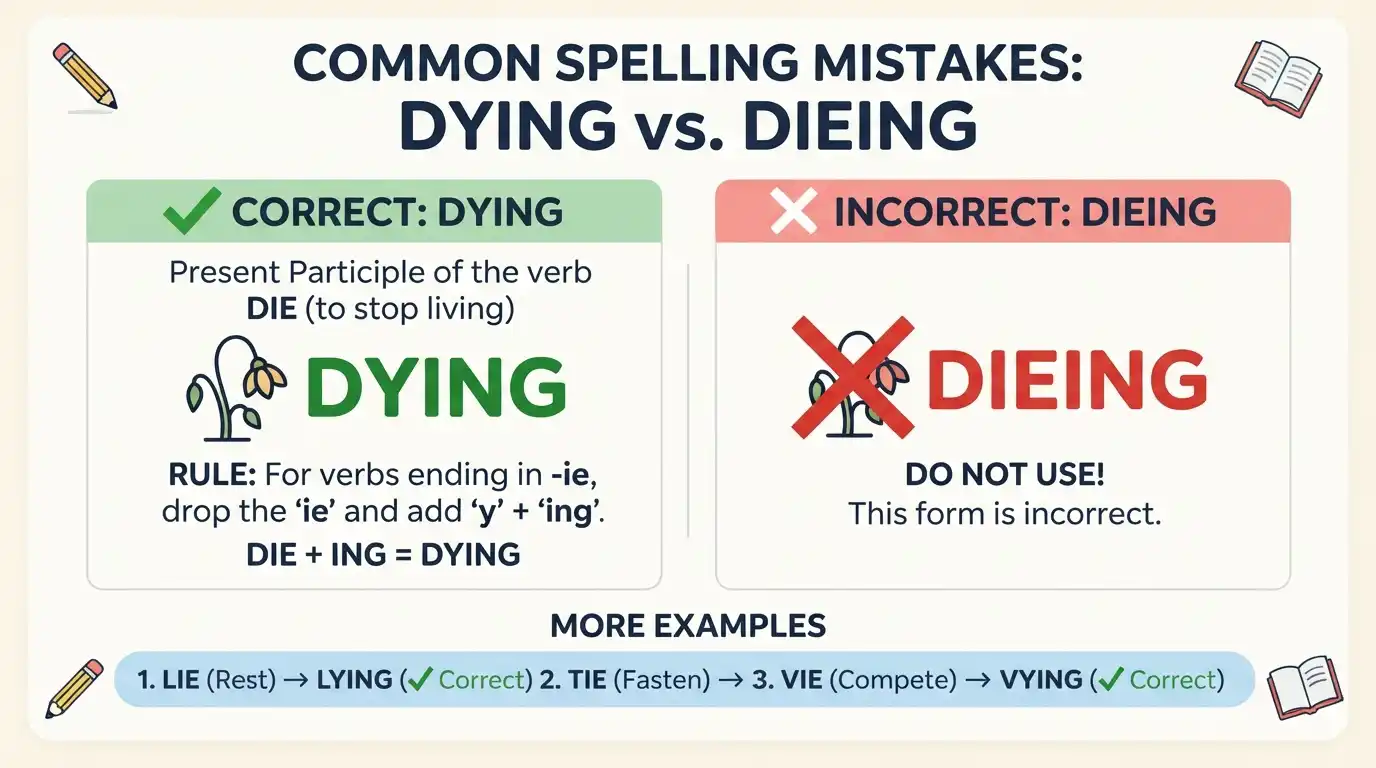
If you are unsure whether to write dying or dieing, the correct spelling is dying.
Dying is the standard English spelling of the -ing form of die. Dieing is generally considered incorrect when you want to say that someone, an animal, plant, or thing is losing life or coming to an end.
For example:
- Correct: The flowers are dying without water.
- Incorrect: The flowers are dieing without water.
The confusion is easy to understand. Many English words keep their final e when -ing is added. For example, make becomes making, and take becomes taking. But die follows a different spelling pattern.
When die becomes an -ing word, the ie changes to y:
die → dying
This same pattern appears in words such as lie → lying and tie → tying.
Dying or Dieing: Quick Answer
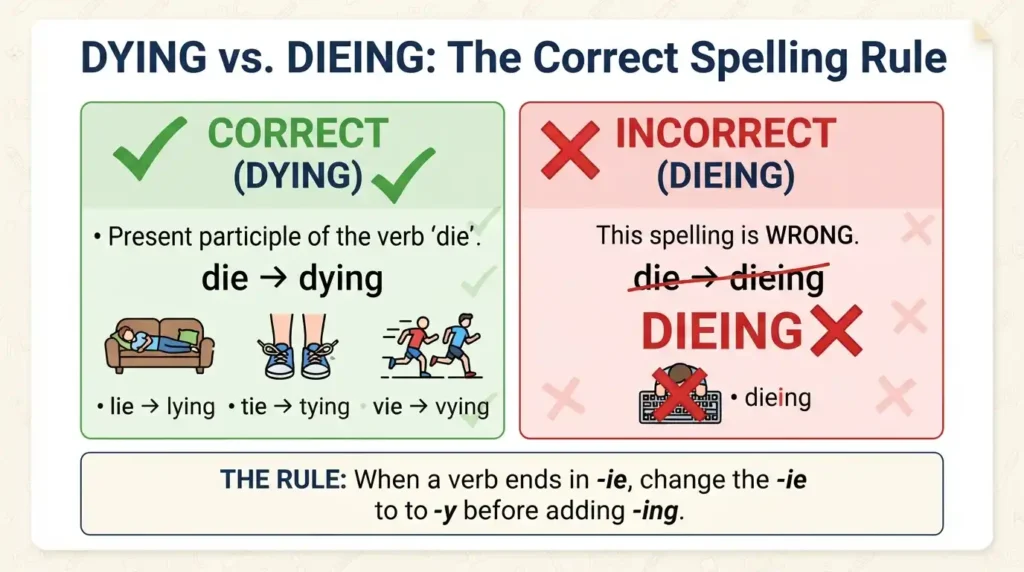
Dying is correct. Dieing is generally incorrect.
Use dying when you need the -ing form of the verb die.
Examples:
- The plant is dying.
- The dog is dying.
- The battery is dying.
- The fire is dying down.
- The old tradition is slowly dying.
So, if you are writing an email, school assignment, article, message, or social media post, use dying.
Why Is It “Dying” Instead of “Dieing”?
The spelling of die changes when we add -ing.
You might think the word should simply become:
die + ing = dieing
But English spelling does not work that way for this verb.
The final ie changes to y, giving us:
die + ing → dying
This pattern is also used with some other verbs that end in -ie.
For example:
- lie → lying
- tie → tying
- die → dying
These examples can make the spelling easier to remember.
A useful trick is to remember that the y replaces the ie before -ing.
What Does Dying Mean?
Dying usually means losing life or being close to death.
For example:
The injured animal is dying.
Here, the word describes an animal that is close to death.
The word can also describe plants and other living things:
The tree is dying because it has no water.
These flowers are dying in the heat.
But dying does not always refer to actual death. It can also describe something that is becoming weaker, stopping, or disappearing.
For example:
The fire is dying out.
This means the fire is becoming weaker and will soon go out.
You can also say:
The old tradition is dying.
This means the tradition is slowly becoming less common.
Dying Can Also Be Used Informally
The word dying can have a strong but non-literal meaning in everyday English.
For example:
I am dying to see the new movie.
This does not normally mean that the person is actually dying. It means they really want to see the movie.
Another example is:
I am dying to know what happened.
Here, the speaker means that they are extremely curious.
You may also hear:
I was dying of laughter.
This usually means the person was laughing very hard. It is an informal expression, not a literal statement about death.
So, the meaning of dying depends on the context.
Examples of Dying in Everyday English
Here are some natural examples:
- The plant is dying because I forgot to water it.
- The flowers are dying in the hot weather.
- The old tree looks like it is dying.
- My phone battery is dying.
- The fire is dying down.
- The injured bird is dying.
- The company is slowly dying because it has lost customers.
- That old custom is dying out.
- I am dying to hear your story.
- She was dying of laughter after hearing the joke.
These examples show that dying can have both literal and informal meanings.
Dying vs. Die vs. Died
Understanding the different forms of the verb can make the spelling much easier.
| Word | Meaning or use | Example |
| Die | Base form | Plants can die without water. |
| Died | Past tense | The plant died yesterday. |
| Dying | -ing form | The plant is dying now. |
The words are related, but they are used differently.
Die
Use die as the basic form of the verb.
Plants can die without enough water.
Died
Use died when talking about something that happened in the past.
The plant died last week.
Dying
Use dying when describing something that is happening or continuing.
The plant is dying.
This distinction is useful because people sometimes focus only on the spelling and forget that the three forms have different grammatical uses.
Why Do People Write “Dieing”?
The spelling dieing is a common mistake because it looks logical.
When people learn that many verbs take -ing, they may simply add the ending to the base word.
For example:
- read → reading
- walk → walking
- jump → jumping
So someone may naturally think:
die → dieing
But die has a spelling change before -ing.
The correct form is:
die → dying
This is why remembering the pattern is more useful than simply trying to guess the spelling.
Common Mistakes With Dying
Mistake 1: Writing “dieing”
Wrong: The flowers are dieing.
Correct: The flowers are dying.
This is the most common spelling problem with this word.
Mistake 2: Using “died” when you mean something is happening now
Wrong: The plant is died.
Correct: The plant is dying.
Use died for a completed past event and dying for an ongoing process.
Mistake 3: Confusing “dying” with “die”
Example:
The plant may die.
Here, die is the base form after may.
But:
The plant is dying.
Here, dying is used after is.
Mistake 4: Assuming every verb follows the same spelling rule
English has many spelling patterns and exceptions. You cannot always add -ing without changing anything.
Words such as lie, tie, and die are useful examples of this spelling pattern.
Dying or Dieing in Formal Writing
In formal writing, use dying.
This applies to:
- School assignments
- University work
- Emails
- Reports
- Articles
- Business writing
- Applications
- News writing
For example:
The report explains why the local plant population is dying.
Using dieing in this sentence would be a spelling error.
If you are proofreading your writing and see dieing, check whether you mean the -ing form of die. In most normal situations, the correct word will be dying.
Is “Dieing” Ever Correct?
For ordinary English, you should not use dieing as the -ing form of die.
If your sentence means that someone or something is losing life, use dying.
There can be rare technical uses of words that look similar to dieing, especially in specialized fields, but these are not the normal spelling question most writers are asking.
For everyday English, the simple rule is enough:
If you mean the -ing form of “die,” write “dying.”
Dying vs. Dieing Examples
The difference becomes clear when the words are placed side by side.
| Incorrect | Correct |
| The tree is dieing. | The tree is dying. |
| My phone is dieing. | My phone is dying. |
| The flowers are dieing. | The flowers are dying. |
| The animal is dieing. | The animal is dying. |
| The fire is dieing out. | The fire is dying out. |
| The plant is dieing from lack of water. | The plant is dying from lack of water. |
| I am dieing to know. | I am dying to know. |
The correct form in all of these normal examples is dying.
How to Remember the Correct Spelling
A simple memory trick is to remember three words together:
lie → lying
tie → tying
die → dying
Notice what happens to the final ie.
It changes to y before the -ing ending.
So:
die + ing = dying
Not:
die + ing = dieing
You can also remember the short rule:
Die becomes dying.
Once you remember this pattern, the spelling is much easier to use correctly.
Is Dying a Verb?
Yes. Dying is the present participle of the verb die. It can also work as a gerund when it functions like a noun.
For example:
The animal is dying.
Here, dying is part of the verb phrase.
In:
Dying can be a natural part of life.
Dying is being used as a noun-like form.
You do not need to know these grammar terms to spell the word correctly, but they explain why dying appears in different types of sentences.
Dying in Different Contexts
The word can appear in several common contexts.
Health and Life
The patient was dying.
Here, it has its direct meaning related to death.
Plants
The plant is dying because the soil is too dry.
Here, it describes a living plant losing health.
Technology
My laptop is dying.
This usually means the battery is almost empty.
Fire
The fire is dying out.
This means the fire is becoming weaker.
Traditions and Ideas
The tradition is slowly dying out.
This means fewer people are continuing the tradition.
Informal Speech
I am dying to try that restaurant.
This means the speaker really wants to try it.
These different uses show why dying is a useful word in everyday English.
Frequently Asked Questions
Is dying or dieing correct?
Dying is correct when you mean the -ing form of die. Dieing is generally an incorrect spelling in normal English.
Why is dying spelled with a Y?
The ie in die changes to y before the -ing ending. Therefore, die becomes dying.
Is dieing a real word?
Dieing is not the standard spelling for the -ing form of die. In normal English writing, use dying.
What is the past tense of die?
The past tense is died.
Example:
The plant died yesterday.
What is the present form of dying?
The base form is die.
For example:
Plants can die without water.
The -ing form is:
The plant is dying.
Is “dying” a correct spelling?
Yes. Dying is the standard spelling of the -ing form of die.
How do you spell dying?
It is spelled:
D-Y-I-N-G
The correct word is dying.
Final Answer: Dying or Dieing?
If you are choosing between dying or dieing, choose dying.
The standard spelling is:
die → dying
Remember that die changes its final ie to y before -ing. The same pattern appears in lie → lying and tie → tying.
So when you write about someone or something that is losing life, becoming weaker, or use the word in an informal expression such as “dying to know,” dying is the spelling you want.











