Is CCl4 polar or nonpolar? This is a common chemistry question, especially when learning about molecular shape, electronegativity, and dipole moments.
The answer is simple: CCl4 is a nonpolar molecule.
CCl4 is carbon tetrachloride. It has one carbon atom in the center and four chlorine atoms around it. Each C-Cl bond is polar because chlorine attracts electrons more strongly than carbon. However, the whole molecule is still nonpolar.
Why? The answer comes from its shape.
CCl4 has a tetrahedral molecular shape. The four chlorine atoms are placed evenly around the central carbon atom. Because of this balanced shape, the four bond dipoles cancel each other. The molecule has no overall dipole moment.
This can seem confusing at first. A molecule can have polar bonds but still be nonpolar overall. In this guide, you will learn why CCl4 is nonpolar, how its shape affects polarity, and how it compares with molecules such as CHCl3.
CCl4 Polar or Nonpolar – Quick Answer
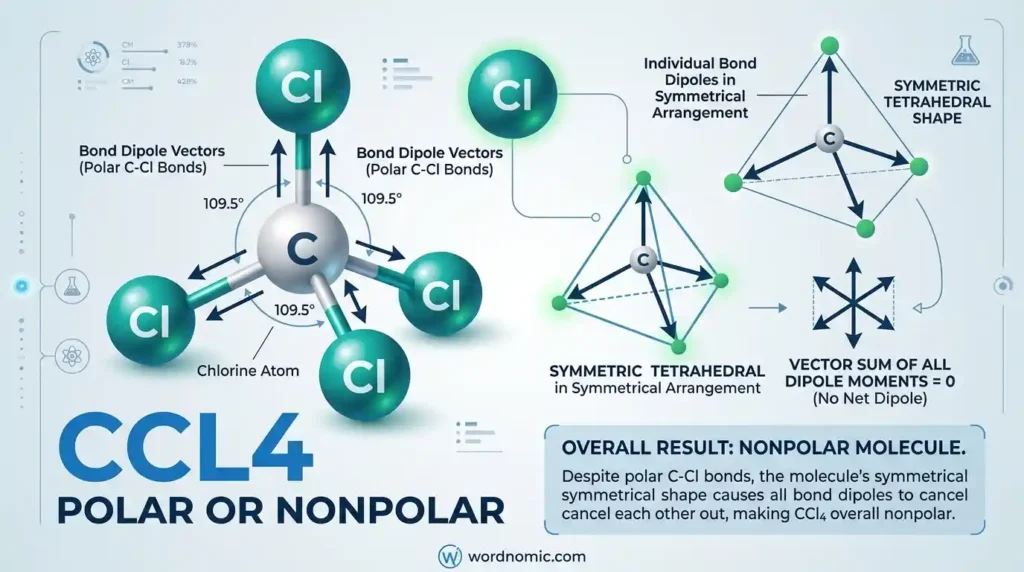
CCl4 is nonpolar.
It has four polar C-Cl bonds, but the molecule has a symmetrical tetrahedral shape. The bond dipoles point in different directions and cancel each other.
As a result, CCl4 has no net dipole moment and is classified as a nonpolar molecule.
Quick rule:
CCl4 has polar bonds, but the whole molecule is nonpolar because its bond dipoles cancel.
Why Is CCl4 Nonpolar?
To understand why CCl4 is nonpolar, you need to look at two things:
- The polarity of its bonds
- The shape of the molecule
1. The C-Cl Bonds Are Polar
Carbon and chlorine do not attract electrons equally.
Chlorine is more electronegative than carbon. It pulls the shared electrons in each C-Cl bond closer to itself.
This makes each C-Cl bond polar.
The chlorine side has a slight negative character, while the carbon side has a slight positive character.
So, it may seem that CCl4 should be polar.
But this is only part of the answer.
2. CCl4 Has a Symmetrical Shape
CCl4 has a tetrahedral shape.
The carbon atom sits in the center. Four chlorine atoms surround it.
The bonds point in four different directions. They are arranged symmetrically around the carbon atom.
Because all four C-Cl bonds are the same, their dipole effects cancel.
Chemistry LibreTexts specifically uses CCl4 as an example of a molecule with polar bonds but no overall dipole because of its symmetrical tetrahedral structure.
3. The Net Dipole Moment Is Zero
A molecule is polar when it has an overall separation of charge.
CCl4 does not have this overall charge separation.
The individual bond dipoles cancel, giving CCl4 a net dipole moment of zero in the usual introductory chemistry model.
That is why CCl4 is nonpolar.
What Is CCl4?
CCl4 stands for carbon tetrachloride.
Its IUPAC name is tetrachloromethane. Its molecular formula is CCl4. PubChem lists CCl4 as carbon tetrachloride and gives the molecular formula CCl4.
The molecule contains:
- 1 carbon atom
- 4 chlorine atoms
- 4 C-Cl bonds
- A tetrahedral shape
- No net dipole moment
- Overall nonpolar character
CCl4 is also called tetrachloromethane.
CCl4 Molecular Geometry
The shape of CCl4 is one of the most important parts of its polarity.
CCl4 has a tetrahedral molecular geometry.
You can picture carbon at the center of a three-dimensional shape, with four chlorine atoms around it.
The four C-Cl bonds are spread out evenly. This gives the molecule a high level of symmetry.
Because the four chlorine atoms are identical and arranged evenly, the bond dipoles cancel.
This is why the molecular shape matters so much when you decide if a molecule is polar or nonpolar.
CCl4 Lewis Structure
A simple Lewis structure has:
- Carbon in the center
- Four single bonds from carbon
- One chlorine atom on each bond
- Three lone pairs on each chlorine
- No lone pairs on the central carbon
The central carbon forms four bonds, giving the molecule its tetrahedral shape.
CCl4 Polarity: Bond Polarity vs Molecular Polarity
This is where many students get confused.
Bond polarity and molecular polarity are not always the same thing.
A C-Cl bond is polar because chlorine and carbon have different electronegativities.
But molecular polarity depends on the whole shape of the molecule.
For CCl4:
C-Cl bonds = polar
Whole CCl4 molecule = nonpolar
The four bond dipoles cancel because of the symmetrical arrangement.
This is a key chemistry idea. A molecule can contain polar bonds and still have no overall dipole.
Main Differences: Polar Bond vs Nonpolar Molecule
| Feature | C-Cl Bond | CCl4 Molecule |
| Bond type | Polar covalent | Molecular polarity is nonpolar |
| Atoms involved | Carbon and chlorine | 1 carbon + 4 chlorine |
| Shape | One bond | Tetrahedral molecule |
| Electron attraction | Unequal | Balanced overall |
| Dipole | Present in each bond | Cancels overall |
| Net dipole moment | Not zero for one bond | Zero |
| Overall polarity | Polar bond | Nonpolar molecule |
The most important point is that a polar bond does not automatically make the entire molecule polar.
Why Does Molecular Shape Matter?
Molecular shape controls the direction of bond dipoles.
Imagine four people pulling a box from four balanced directions. Each person pulls, but the box does not move in one direction.
CCl4 works in a similar way.
Each C-Cl bond has a dipole. But the four dipoles point in directions that balance each other.
So there is no single positive or negative side of the whole molecule.
That makes CCl4 nonpolar.
CCl4 vs CHCl3
CCl4 and CHCl3 are useful to compare because both have tetrahedral structures.
The big difference is that CCl4 has four identical chlorine atoms around carbon. CHCl3 has three chlorine atoms and one hydrogen atom.
This breaks the symmetry in CHCl3.
As a result, the bond dipoles in CHCl3 do not completely cancel, so CHCl3 is polar. CCl4, on the other hand, remains nonpolar.
| Molecule | Shape | Are outer atoms identical? | Overall polarity |
| CCl4 | Tetrahedral | Yes | Nonpolar |
| CHCl3 | Tetrahedral | No | Polar |
| CH2Cl2 | Tetrahedral | No | Polar |
| CH3Cl | Tetrahedral | No | Polar |
This comparison shows why symmetry matters more than simply counting polar bonds.
Origin and History of the Name
CCl4 is commonly called carbon tetrachloride.
The name tells you what the molecule contains:
- Carbon refers to the central carbon atom.
- Tetra- means four.
- Chloride refers to the four chlorine atoms.
Its systematic name is tetrachloromethane. PubChem lists both carbon tetrachloride and tetrachloromethane as names for CCl4.
For basic chemistry questions, the name carbon tetrachloride is very common.
British English vs American English
There is no important British vs American English difference in the chemistry answer.
Both British and American chemistry texts use terms such as:
- carbon tetrachloride
- CCl4
- polar molecule
- nonpolar molecule
- dipole moment
- tetrahedral
The scientific meaning stays the same.
The spelling nonpolar is common in American English. You may also see non-polar in some British or other scientific writing.
Both forms refer to the same idea.
Which One Should You Use?
If your question is whether CCl4 is polar or nonpolar, the correct answer is:
Use nonpolar.
For school, college, or university chemistry, you can write:
CCl4 is a nonpolar molecule because its four polar C-Cl bond dipoles cancel due to its symmetrical tetrahedral shape.
For a short exam answer, you can write:
CCl4 is nonpolar because its tetrahedral symmetry causes the bond dipoles to cancel.
For a longer answer, explain both the polar bonds and the symmetrical molecular shape.
Do not simply say that CCl4 is nonpolar because “C and Cl have similar electronegativity.” That explanation is not correct. The C-Cl bonds are polar. The molecule is nonpolar because the bond dipoles cancel.
Common Mistakes About CCl4 Polarity
Mistake 1: Saying CCl4 has nonpolar bonds
Incorrect:
“CCl4 has four nonpolar C-Cl bonds.”
Correct:
“CCl4 has four polar C-Cl bonds.”
Why?
Carbon and chlorine have different electronegativities.
Example:
Each C-Cl bond has a bond dipole, but the four dipoles cancel in the whole molecule.
Mistake 2: Saying CCl4 is polar because chlorine is more electronegative
Incorrect:
“CCl4 is polar because chlorine attracts electrons.”
Correct:
“CCl4 is nonpolar because its bond dipoles cancel.”
Why?
You must look at the entire molecular shape, not only one bond.
Mistake 3: Ignoring molecular geometry
Incorrect:
“CCl4 has polar bonds, so it must be polar.”
Correct:
“CCl4 has polar bonds, but its tetrahedral shape makes the molecule nonpolar.”
Why?
The four bond dipoles balance each other.
Mistake 4: Calling CCl4 ionic
Incorrect:
“CCl4 is an ionic compound.”
Correct:
“CCl4 is a covalent molecular compound.”
Why?
Carbon and chlorine share electrons in covalent bonds.
Mistake 5: Saying CCl4 has a net dipole
Incorrect:
“CCl4 has a large net dipole.”
Correct:
“CCl4 has no net molecular dipole.”
Why?
The four bond dipoles cancel because of the molecule’s symmetry.
Mistake 6: Confusing CCl4 with CHCl3
Incorrect:
“CCl4 and CHCl3 have the same molecular polarity.”
Correct:
“CCl4 is nonpolar, while CHCl3 is polar.”
Why?
CHCl3 has different atoms around the central carbon, so its bond dipoles do not cancel completely.
10 Everyday and Chemistry Example Sentences
- CCl4 is a nonpolar molecule.
- The C-Cl bonds in CCl4 are polar.
- CCl4 has a tetrahedral molecular shape.
- The four bond dipoles in CCl4 cancel each other.
- CCl4 has no overall dipole moment.
- Molecular symmetry makes CCl4 nonpolar.
- A polar bond does not always make a molecule polar.
- CCl4 is a useful example of a nonpolar molecule with polar bonds.
- Students often use CCl4 to learn about molecular polarity.
- The tetrahedral shape of CCl4 helps explain its nonpolar nature.
Real-Life Usage
In Chemistry Class
Teachers often use CCl4 to show that bond polarity and molecular polarity are different.
A student may first identify the C-Cl bonds as polar. Then the student looks at the tetrahedral shape and sees that the dipoles cancel.
In Homework
A question may ask:
“Is CCl4 polar or nonpolar? Explain.”
A good answer is:
CCl4 is nonpolar. Although its C-Cl bonds are polar, the four bonds are arranged symmetrically in a tetrahedral shape, so their dipoles cancel.
In Exams
For a short-answer question, mention three points:
- C-Cl bonds are polar.
- CCl4 has a tetrahedral shape.
- The bond dipoles cancel.
That gives the key reason without adding unnecessary detail.
In Formal Chemistry Writing
You may see CCl4 used as an example when explaining:
- molecular symmetry
- bond dipoles
- net dipole moment
- polar and nonpolar molecules
- molecular geometry
Chemistry references commonly use CCl4 for this exact purpose.
Related Search Questions
Is CCl4 polar or nonpolar?
CCl4 is nonpolar. Its four C-Cl bonds are polar, but their dipoles cancel because the molecule has a symmetrical tetrahedral shape.
Why is CCl4 nonpolar?
CCl4 is nonpolar because its four identical C-Cl bond dipoles cancel each other. The molecule has a symmetrical tetrahedral structure and no net dipole moment.
Are the bonds in CCl4 polar?
Yes. Each C-Cl bond is polar because chlorine attracts electrons more strongly than carbon. However, the whole CCl4 molecule is nonpolar because the four bond dipoles cancel.
What is the shape of CCl4?
CCl4 has a tetrahedral molecular geometry. Carbon is at the center, with four chlorine atoms arranged around it.
Does CCl4 have a dipole moment?
CCl4 has no net molecular dipole moment. The individual bond dipoles cancel because of its symmetrical structure.
Is CCl4 more like CO2 or H2O in polarity?
CCl4 is like CO2 because both are nonpolar overall even though their bonds are polar. H2O is polar because its bent shape prevents its bond dipoles from canceling.
Is carbon tetrachloride the same as tetrachloromethane?
Yes. Carbon tetrachloride is the common name, while tetrachloromethane is its IUPAC name. Both refer to CCl4.
Usage and Search Trends
People searching this topic usually want a quick chemistry answer, often for homework, exam preparation, or a molecular polarity question.
Common search forms include:
- Is CCl4 polar or nonpolar?
- Is carbon tetrachloride polar?
- Is CCl4 a polar molecule?
- Why is CCl4 nonpolar?
- CCl4 molecular polarity
- CCl4 dipole moment
- CCl4 Lewis structure and polarity
- CCl4 molecular geometry
- Is CCl4 polar or nonpolar and why?
- Why does CCl4 have polar bonds but remain nonpolar?
There is no need to use made-up search volume or trend numbers to answer these questions. The chemistry answer is based on molecular structure, symmetry, and dipole moments.
CCl4 Polarity Comparison Table
| Property | CCl4 |
| Common name | Carbon tetrachloride |
| IUPAC name | Tetrachloromethane |
| Formula | CCl4 |
| Central atom | Carbon |
| Outer atoms | Four chlorine atoms |
| Molecular shape | Tetrahedral |
| C-Cl bonds | Polar |
| Molecular symmetry | High |
| Net dipole moment | Zero |
| Overall polarity | Nonpolar |
| Main reason | Bond dipoles cancel |
The molecular formula and chemical identity of CCl4 are also listed by PubChem.
FAQs
1. Is CCl4 polar or nonpolar?
CCl4 is nonpolar. The C-Cl bonds are individually polar because chlorine is more electronegative than carbon. However, the four bonds are arranged symmetrically in a tetrahedral shape. Their dipoles cancel, so the molecule has no net dipole moment.
2. Why does CCl4 have polar bonds but remain nonpolar?
Each C-Cl bond has a dipole because the two atoms attract electrons differently. But CCl4 has four identical C-Cl bonds arranged symmetrically. The dipoles point in different directions and cancel each other. Therefore, the entire molecule has no overall dipole.
3. What is the molecular shape of CCl4?
CCl4 has a tetrahedral shape. The central carbon atom connects to four chlorine atoms. The four bonds spread out in three dimensions. This balanced arrangement gives CCl4 the symmetry needed for its bond dipoles to cancel.
4. Does CCl4 have a net dipole moment?
No. CCl4 has no net molecular dipole moment. Each C-Cl bond has polarity, but the four bond dipoles cancel because of the molecule’s symmetrical tetrahedral structure. Chemistry LibreTexts gives CCl4 as a standard example of this effect.
5. Is the C-Cl bond polar in CCl4?
Yes. The C-Cl bond is polar because chlorine has a stronger pull on the shared electrons than carbon. The important difference is between bond polarity and molecular polarity. The bonds are polar, while the complete CCl4 molecule is nonpolar.
6. Why is CHCl3 polar but CCl4 nonpolar?
Both molecules have tetrahedral structures, but their atoms are arranged differently. CCl4 has four identical chlorine atoms, so its bond dipoles cancel. CHCl3 has three chlorine atoms and one hydrogen atom. This breaks the symmetry, so the dipoles do not fully cancel.
7. How can I quickly tell if CCl4 is nonpolar?
Look at its shape and the atoms around carbon. CCl4 has four identical chlorine atoms in a symmetrical tetrahedral arrangement. The bond dipoles cancel. So the quick answer is CCl4 is nonpolar.
Conclusion
So, is CCl4 polar or nonpolar? CCl4 is nonpolar.
The reason is its molecular shape. CCl4 contains one carbon atom and four chlorine atoms. Each C-Cl bond is polar because chlorine attracts the shared electrons more strongly than carbon.
However, bond polarity is not the same as overall molecular polarity.
CCl4 has a symmetrical tetrahedral structure. The four identical C-Cl bond dipoles point in different directions and cancel each other. This gives the molecule no net dipole moment.
This is why CCl4 is a useful example in chemistry. It shows that a molecule can contain polar bonds but still be nonpolar overall.
The key idea to remember is simple:
Polar bonds + symmetrical shape = nonpolar molecule, when the bond dipoles fully cancel.
For CCl4, the correct answer is therefore nonpolar.

Emily Carter is an English grammar writer based in Portland, Oregon, with 7+ years of experience turning tricky grammar rules into simple, easy lessons.