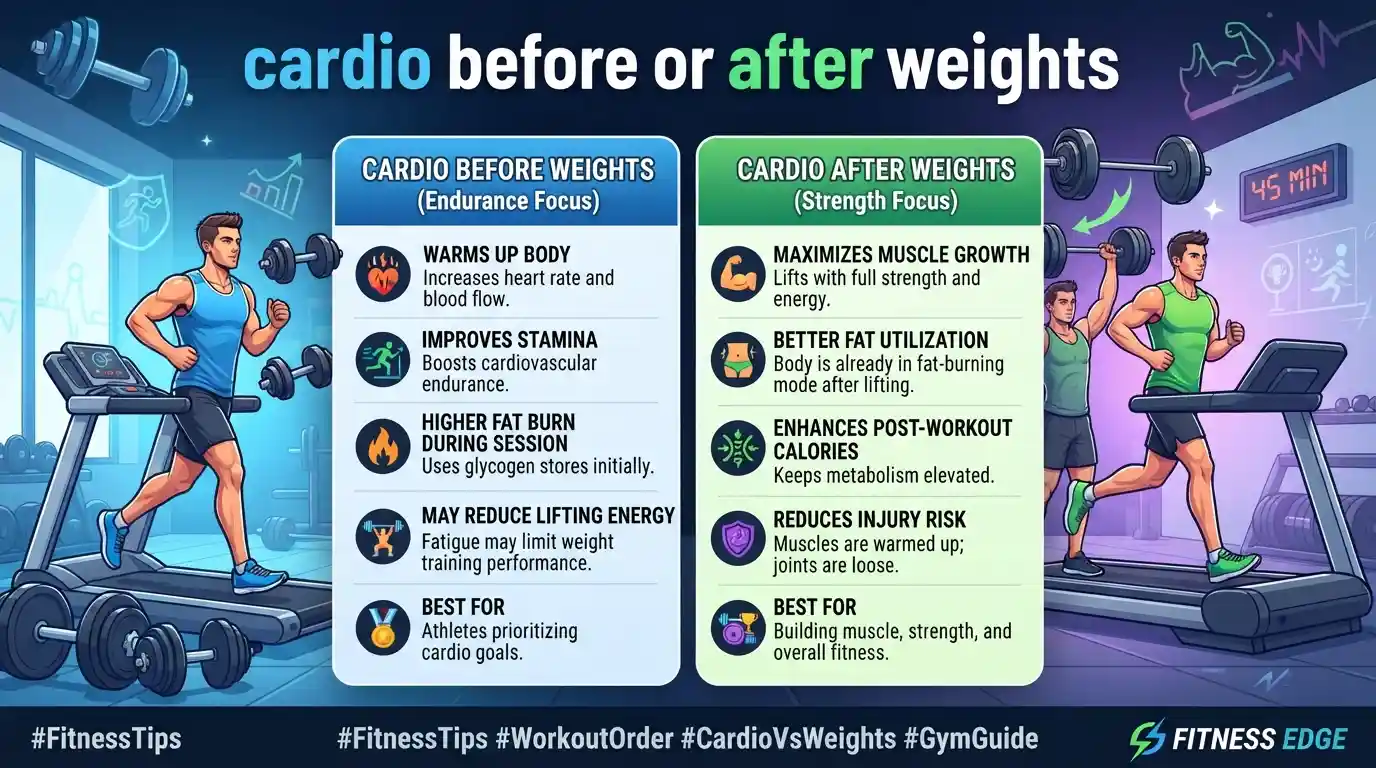
Should you run on the treadmill before lifting weights, or save cardio for the end of your workout? The answer can change how well you perform during each part of your training.
Many people search for cardio before or after weights because they want to lose fat, build muscle, get stronger, or improve their fitness. But different goals can call for different workout plans. Doing a hard run before lifting may leave your legs tired. Lifting first may make a long run feel harder later.
The good news is that you do not have to choose one type of exercise forever. Both cardio and weight training can be part of a healthy workout plan. The key is to do the exercise that matters most to your goal when you have the most energy.
This guide explains which order to follow for muscle growth, strength, fat loss, and endurance. You will also learn how to warm up, how to combine both workouts, and when it may help to do them at separate times.
Cardio Before or After Weights: Quick Answer
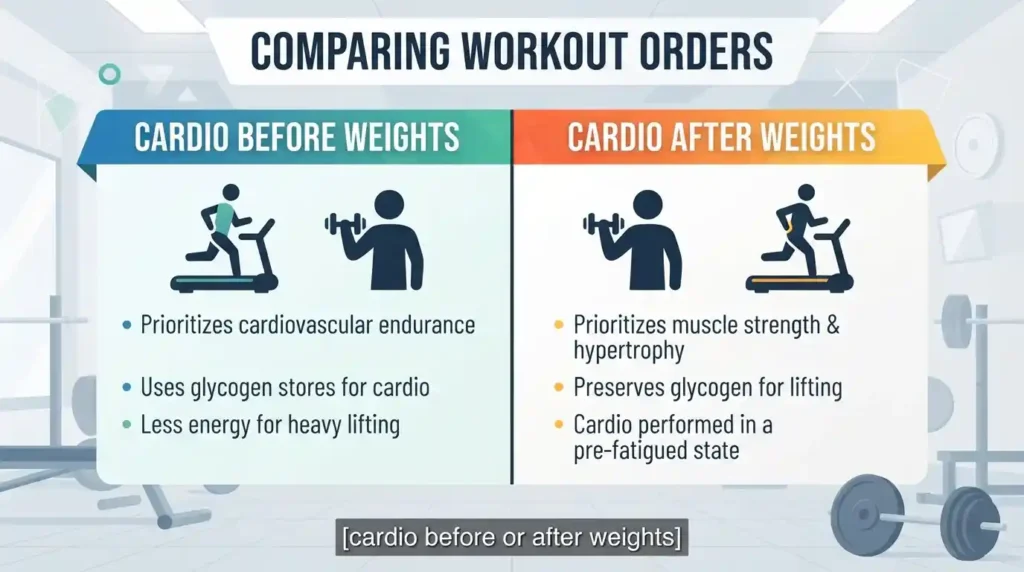
Do weights before cardio if your main goal is to build muscle or strength. Do cardio before weights if your main goal is to improve endurance.
Here is a simple guide:
- Build muscle: Lift weights first, then do cardio.
- Build strength: Lift weights first, then do cardio.
- Improve running or cycling: Do your main cardio workout first.
- Lose fat: Choose the order that helps you train well and stay consistent.
- Improve general fitness: Either order can work.
- Warm up before lifting: Start with 5 to 10 minutes of easy movement if it feels right for you.
A short warm-up is different from a long, hard cardio workout. You can walk or cycle at an easy pace before lifting without turning it into a full cardio session.
These are general guidelines. Your fitness level, workout plan, and recovery needs also matter.
Why Does Workout Order Matter?
Cardio and weight training place different demands on your body.
Cardio includes activities such as walking, running, cycling, and swimming. These activities raise your heart rate and help improve heart and lung fitness.
Weight training uses resistance to make your muscles work harder. You can lift dumbbells, use gym machines, or do bodyweight exercises such as push-ups and squats.
The first part of your workout may affect how much energy you have for the second part.
For example, a hard run may tire your legs before squats. This can make it harder to lift your usual weight with good form.
On the other hand, a heavy leg workout may leave you too tired to complete your planned running session at your target pace.
The simple rule is to do your main goal first. This helps you give that part of your workout more attention and effort.
Should You Do Cardio Before or After Weights for Muscle Growth?
If your goal is to build muscle, do weight training first in most cases.
Muscle growth needs regular training and enough effort over time. You need to complete your planned sets with good form and use a level of resistance that suits your ability.
A long or hard cardio session before lifting may cause tiredness. This can make it harder to complete your usual weight training.
A simple muscle-building workout
- Warm up with easy walking or cycling.
- Do your planned weight exercises.
- Rest between sets as needed.
- Finish with easy or moderate cardio if you have time.
For example, you might lift weights for 40 minutes and then cycle for 15 minutes.
You do not need to avoid cardio to build muscle. Both types of exercise can fit into your routine. The important thing is to manage your total training load and allow time for recovery.
If muscle growth is your main goal and you also do hard endurance training, consider doing the two workouts at different times or on separate days.
Should You Do Cardio Before or After Weights for Strength?
For strength gains, lift weights first.
Heavy lifting requires focus, control, and effort. You want your muscles to be ready for your main exercises.
For example, if you plan to squat, deadlift, or bench press, a long cardio session beforehand may leave you tired.
A better plan is to:
- Do a short, easy warm-up.
- Start with your main strength exercises.
- Use weights that you can control.
- Finish with cardio if it fits your plan.
A review of research on exercise order found that resistance training first can help improve dynamic strength compared with doing endurance exercise first. The best order still depends on your goals and the type of training you do.
Should You Do Cardio Before or After Weights for Fat Loss?
If your goal is fat loss, either order can work.
Fat loss depends on several factors. These include your food intake, daily activity, exercise routine, and ability to follow the plan over time.
Doing cardio after weights does not automatically make you lose more body fat. Nor does doing cardio first guarantee better results.
Choose the order that helps you complete both types of exercise.
For example:
- If you enjoy lifting and want to keep your strength, lift first.
- If you prefer walking before lifting, start with an easy walk.
- If you feel too tired to do both, shorten the sessions or split them across the day.
- If you are new to exercise, begin with a manageable routine and build up slowly.
You do not need to exhaust yourself to make progress. A routine you can follow each week is often more useful than a very hard workout that leaves you unable to train again.
Should You Do Cardio Before or After Weights for Endurance?
If your main goal is to run faster, cycle longer, or improve stamina, do cardio first when it is the main workout of the day.
Endurance training works best when you can give the session the effort it needs. If you lift weights first, your muscles may be tired before you begin your run or ride.
For example, a runner training for a race may complete the planned run before doing a short strength session.
A cyclist may ride first on a day when improving cycling performance is the main goal.
This does not mean that cardio must always come first for people who enjoy running or cycling. On a strength-focused day, lifting first may still make sense.
Your weekly plan matters more than following one fixed order every day.
Can You Do Cardio and Weights on the Same Day?
Yes. Many people combine cardio and weight training in one workout.
Doing both can save time and help you work on different parts of your fitness. You do not have to complete them in separate sessions.
Here are three ways to combine them:
Option 1: Weights, Then Cardio
This suits people who want to focus on muscle growth or strength.
Example:
- 5 minutes of easy warm-up
- 35 minutes of weight training
- 15 minutes of walking or cycling
Option 2: Cardio, Then Weights
This suits people whose main goal is endurance.
Example:
- 5 minutes of easy warm-up
- 25 minutes of running or cycling
- 20 minutes of strength training
Option 3: Separate Workouts
You can do cardio in the morning and lift weights later in the day.
This may help when both sessions need a lot of effort. It also gives you more time between activities.
Choose the plan that fits your goals, schedule, and ability to recover.
How Long Should You Do Cardio Before Weights?
If you are warming up before lifting, keep it easy and brief. Around 5 to 10 minutes is a common starting point, but the right amount depends on the activity and your needs.
You should feel warmer and ready to move, not worn out.
Good warm-up choices include:
- Easy walking
- Slow cycling
- Gentle rowing
- Light movement for the muscles you plan to train
If you plan to do a full cardio workout before weights, think about your main goal. A long or hard session may reduce the energy you have for lifting.
For a strength-focused workout, save most of your cardio for after lifting or another session.
Does Cardio After Weights Burn More Fat?
Not automatically.
You may hear that cardio after lifting burns more fat because your body has already used energy during weight training. But the order alone does not decide whether you lose body fat.
Your overall activity, food intake, training plan, and recovery all play a role.
If you enjoy cardio after lifting, it is a good way to add movement to your day. You can walk, cycle, or use another machine at an effort that suits you.
If you prefer doing cardio first and can still complete your strength workout well, that can work too.
Focus on a routine you can follow. Do not judge your results only by how tired you feel after exercise.
Common Mistakes When Combining Cardio and Weights
1. Doing Hard Cardio Before Heavy Lifting
Problem: Your muscles may feel tired before your main lifts.
Better choice: Warm up with easy movement and save hard cardio for later if strength is your main goal.
2. Skipping the Warm-Up
Problem: You begin lifting before your body feels ready.
Better choice: Start with easy movement and prepare for the exercises you plan to do.
3. Thinking Cardio Stops Muscle Growth
Problem: You avoid all cardio because you want bigger muscles.
Better choice: Combine cardio and lifting in a way that allows you to train and recover well.
4. Doing Too Much Exercise at Once
Problem: You feel worn out and struggle to recover before your next workout.
Better choice: Start with a manageable amount of exercise and increase it over time.
5. Using the Same Order for Every Goal
Problem: You follow one rule even when your training goal changes.
Better choice: Put the main activity first. If you are training for a race, prioritize the planned endurance session. If you want strength, lift first.
6. Ignoring Your Form
Problem: You keep lifting when fatigue makes it hard to control the weight.
Better choice: Reduce the load or stop the set when you cannot maintain safe, controlled movement.
7. Forgetting Recovery
Problem: You train hard every day without enough rest.
Better choice: Plan easier days, get enough sleep, eat well, and adjust your training when you feel unusually tired.
10 Examples of Cardio and Weight Training Plans
These examples show how workout order can change with your goal.
- Muscle growth: Warm up, lift weights, then walk for 15 minutes.
- Strength: Warm up, complete your main lifts, then cycle easily.
- Running endurance: Complete your planned run, then do a short strength session.
- Cycling fitness: Ride first, then complete light resistance exercises.
- General fitness: Walk for 10 minutes, lift weights, and finish with easy cycling.
- Beginner workout: Start with easy movement, use light weights, and add a short walk.
- Upper-body day: Lift first if upper-body strength is your priority, then do cardio.
- Leg day: Train your legs first if strength or muscle growth is the main goal, then do easy cardio.
- Busy schedule: Do a short cardio session in the morning and lift later.
- Recovery-focused day: Choose a comfortable walk and skip hard training if you need rest.
These are examples, not strict rules. Change the time and effort to match your fitness level.
Cardio Before or After Weights: Comparison Table
| Goal | What to Do First | Why |
| Build muscle | Weights | Helps you focus on lifting while fresh |
| Gain strength | Weights | Supports effort and control during main lifts |
| Improve endurance | Cardio | Gives your main endurance session priority |
| Lose body fat | Either | Consistency and overall habits matter |
| General fitness | Either | Both can fit into a balanced routine |
| Warm up for lifting | Easy cardio | Helps you prepare for exercise |
| Train for a running race | Planned run | Prioritizes race-related training |
| Improve cycling | Planned ride | Gives cycling performance priority |
Real-Life Workout Examples
At the Gym
If your goal is to grow your chest and arms, start with your planned upper-body lifts. Then use the treadmill or bike if you have time.
At Home
If you have no gym equipment, you can do push-ups, squats, and other bodyweight moves. Add walking or another form of cardio before or after, based on your goal.
For a Busy Workday
If you only have 30 minutes, you can split your exercise into two short sessions. For example, walk in the morning and lift weights in the evening.
For a New Gym Member
Start with easy exercise and learn how to use the equipment safely. You do not need long cardio sessions and heavy lifting in the same workout from day one.
For a Runner
If you are preparing for a race, put your key running session first when you combine it with weights. You can do strength work later or on another day.
Related Questions About Cardio and Weights
Should I Run Before or After Lifting Weights?
If strength or muscle growth is your main goal, lift first and run afterward. If you are training to improve running performance, run first. Keep any warm-up before lifting easy so it does not leave you tired.
Should I Walk Before or After Weight Training?
Either can work. A short walk before lifting can warm you up. A longer walk after lifting is also a simple way to add activity to your day. Choose the order that helps you complete your main workout comfortably.
Is 20 Minutes of Cardio Enough After Weights?
Twenty minutes may be a useful amount, depending on your pace, fitness level, and weekly activity. You do not need to do the same amount after every lifting session. Start with a level you can manage and build up as needed.
Should Beginners Do Cardio or Weights First?
Beginners can start with a short, easy warm-up. After that, do the type of exercise that matters most to your goal. If you are unsure, a simple plan with both activities and enough recovery can help you build a routine.
Cardio Before or After Weights: Usage and Search Trends
People search for this topic because they want a clear answer about workout order. Many are trying to build muscle, lose fat, improve stamina, or plan a better gym routine.
Related searches often include:
- Should I do cardio before or after lifting weights?
- Cardio before weights for fat loss
- Cardio after weights for muscle growth
- Running before or after weight training
- How much cardio should I do after lifting?
- Can I do cardio and weights on the same day?
These searches show the different goals behind the question. The best answer is not the same for everyone.
Search interest can change by country and over time. Exact search volume or country rankings should only be reported after checking a current, reliable keyword or trend tool. No unverified search numbers are needed to explain the exercise advice.
For general guidance, explains how workout order depends on your fitness goal, while the American College of Sports Medicine provides evidence-based exercise guidance.
FAQs
1. Is it better to do cardio before or after weights?
It depends on your main goal. If you want to build muscle or strength, lift weights first. If you want to improve running, cycling, or other endurance skills, do cardio first. For general fitness, either order can work. A short, easy warm-up before lifting is still useful.
2. Should I do cardio before or after weights to lose belly fat?
Neither order can target belly fat on its own. Fat loss depends on your overall habits, including food intake, daily movement, exercise, and recovery. Choose an order that helps you train well and stay consistent. Both cardio and strength training can be part of a fat-loss plan.
3. Does cardio before weights reduce muscle growth?
A hard or long cardio session may make you too tired to complete your planned lifting workout well. This can make it harder to focus on strength and muscle goals. However, cardio does not automatically stop muscle growth. The amount, effort, timing, and total training plan all matter.
4. Can I do cardio and weights in one workout?
Yes. You can do both in one session or at different times of the day. Put the activity linked to your main goal first. If both sessions are demanding, separating them may help you give each one more effort and manage fatigue.
5. How much cardio should I do after lifting weights?
There is no single amount that suits everyone. Your goal, fitness level, and weekly exercise plan all matter. You might start with a short, easy session and increase it as you feel ready. You can also do cardio on separate days instead of adding it after every lifting workout.
6. Should I do HIIT before or after weights?
HIIT is hard exercise with short periods of high effort. If strength is your main goal, lift first and do HIIT later or on another day. If HIIT performance is your priority, do it first. Avoid adding hard intervals when fatigue makes it difficult to move safely.
7. Can I lift weights after a long cardio session?
Yes, if you feel well and can lift with good control. However, a long or hard cardio session may reduce your lifting performance. If strength or muscle growth is your main goal, consider lifting first or separating the sessions. Stop if you feel dizzy, unwell, or unable to maintain good form.
Conclusion
So, should you do cardio before or after weights? The best choice depends on what you want to improve.
If you want to build muscle or gain strength, lift weights first. This lets you focus on your main lifts before fatigue builds up. If you want to improve your running, cycling, or stamina, do cardio first so you can give that workout your best effort.
If your goal is fat loss or general fitness, either order can work. What matters most is finding a plan you can follow, combining both types of exercise when useful, and allowing enough time to recover.
You can also split cardio and weight training into separate sessions. This may help if you want to work hard at both. Before lifting, use a short, easy warm-up rather than a long, tiring cardio session.
There is no need to make every workout perfect. Start with a simple plan, use good form, and build up at a pace that suits you. If you have a health condition or are new to hard exercise, ask a health professional for advice when needed.
The final rule is simple: do your main goal first, and fit the other workout around it.