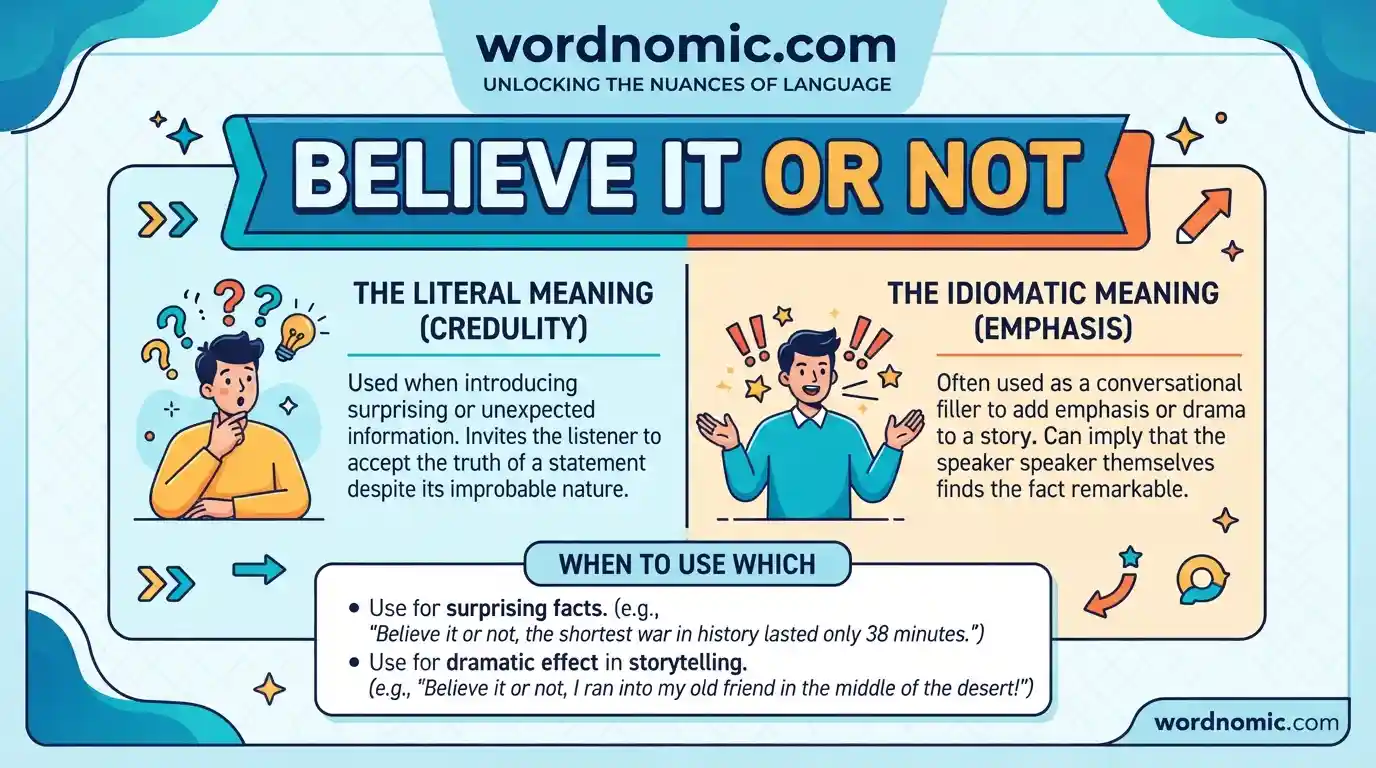
Have you ever heard something that sounds hard to believe? Maybe someone tells you a surprising fact, a strange story, or something you did not expect. In such cases, people often use the phrase Believe It or Not.
This phrase is common in everyday English. You may hear it in conversations, stories, videos, articles, and social media posts. It is usually used before a surprising fact or statement.
For example, someone might say, “Believe It or Not, I have never eaten pizza.” The speaker knows that this may sound surprising to other people.
The phrase is easy to understand once you know how it works. It does not mean that you must literally believe a person. Instead, it tells the listener that the next statement may be surprising or unusual.
This guide explains the meaning, correct use, examples, common mistakes, and other important details in simple English.
Believe It or Not: Quick Answer
Believe It or Not is a common English phrase used before something surprising, unusual, or difficult to believe.
It means something like:
- “This may surprise you.”
- “This sounds strange, but it is true.”
- “You may not believe this, but it is true.”
Example
Believe It or Not, she won the race without any training.
The speaker uses the phrase because the result may surprise the listener.
What Does Believe It or Not Mean?
Believe It or Not means that the information coming next may sound surprising or strange.
The speaker is not always asking a real question. It is often just a way to introduce an unexpected fact.
For example:
Believe It or Not, my brother can remember hundreds of phone numbers.
This tells the listener that the fact may be hard to believe.
The phrase can also make a story more interesting. Writers and speakers often use it when they want people to pay attention.
Is Believe It or Not an Idiom?
Yes. Believe It or Not is commonly used as an idiomatic expression.
An idiom is a group of words that has a common meaning when used together.
In this case, the phrase does not simply mean “believe this or do not believe this.” It is usually used to introduce something surprising.
For example:
Believe It or Not, the little dog found its way home.
The main purpose is to show that the information may surprise the reader or listener.
How Do You Use Believe It or Not?
You can use the phrase at the beginning of a sentence. A comma usually comes after it when it introduces the main statement.
- Believe It or Not, she learned the song in one day.
You can also place the phrase later in a sentence.
The answer is, believe it or not, quite simple.
The exact position can change, but the meaning stays similar.
Why Do People Say Believe It or Not?
People use this expression to make a statement sound more interesting.
It can prepare the listener for something unexpected. It may also show that the speaker knows the information sounds strange.
For example:
Believe It or Not, the shop was empty on Christmas Eve.
The speaker expects the listener to find this unusual.
The phrase is especially common when people tell stories or share interesting facts.
Is Believe It or Not a Question?
Usually, no.
Although the phrase contains the word “believe,” it is normally not a real question.
For example:
Believe It or Not, John does not like coffee.
The speaker is not asking, “Do you believe me?”
Instead, the speaker is saying that the information may surprise you.
However, it can sometimes be written as a direct question in a different context:
Can you believe it or not?
That sentence has a different structure and purpose.
Believe It or Not in Formal and Informal English
The phrase is more common in informal and general English.
You can use it in:
- Everyday conversations
- Stories
- Blogs
- Social media
- News-style writing
- Entertainment content
- Personal messages
It can also appear in formal writing, but it may sound less direct or less professional in some situations.
For formal writing, it is often better to state the fact directly.
Informal
Believe It or Not, the project was completed in two days.
More formal
Surprisingly, the project was completed in two days.
Both sentences give the same basic idea, but the second one sounds more formal.
Each example uses the phrase to introduce information that may surprise someone.
Believe It or Not in Everyday Conversation
People often use this expression when talking with friends or family.
Example conversation
Tom: You will never guess what happened.
Sam: What happened?
Tom: Believe It or Not, I saw my old teacher at the airport.
Sam: Really? After all these years?
Here, the phrase makes the story sound more surprising.
Another example:
A: I have a strange fact for you.
B: What is it?
A: Believe It or Not, some people can sleep with their eyes partly open.
The phrase helps create interest before the fact is given.
Common Mistakes
There are a few common mistakes people make when using this expression.
1. Treating it as a real question
Many people think the speaker is asking them to believe something.
Usually, it is simply an expression used before surprising information.
2. Using it too often
Using the phrase in every paragraph can make your writing repetitive.
Use it only when the next statement is actually surprising or unusual.
3. Forgetting the comma
When the phrase comes at the start of a sentence, a comma is normally used after it.
Correct:
Believe It or Not, he was right.
4. Using it for normal facts
This expression works best with unexpected information.
For example, saying:
Believe It or Not, water is wet.
does not make much sense because the fact is not surprising.
5. Confusing it with “Can you believe it?”
These expressions are related, but they are not always used in the same way.
Can you believe it? is often a direct question about a surprising event.
Believe It or Not usually introduces the surprising information.
Believe It or Not vs Can You Believe It?
These phrases are similar but have different uses.
| Phrase | Main Use | Example |
| Believe It or Not | Introduces surprising information | Believe It or Not, he won. |
| Can You Believe It? | Asks about a surprising event | Can you believe it? He won! |
The first expression often comes before the fact.
The second one is normally a question or reaction.
Believe It or Not vs Surprisingly
These expressions can sometimes introduce the same type of information.
Believe It or Not
Believe It or Not, the test was easy.
Surprisingly
Surprisingly, the test was easy.
Both tell the reader that the result may be unexpected.
However, Believe It or Not sounds more conversational.
Surprisingly is often better for formal or academic writing.
Origin of Believe It or Not
The expression has been used in English for a long time as a way to introduce surprising information.
It became especially well known through Ripley’s Believe It or Not!, a popular entertainment franchise created by Robert Ripley.
The franchise became famous for presenting unusual facts, strange events, and interesting stories from around the world.
Because of this, many people strongly connect the phrase with surprising facts and unusual information.
Today, the expression is still widely used in everyday English. It can appear without any connection to the Ripley brand.
British vs American English
There is no major spelling difference between British and American English for this phrase.
People in both varieties of English use:
Believe It or Not
The meaning is also the same.
You can use the expression in American English, British English, and other forms of English.
The main difference is not spelling. It is the situation in which the phrase is used.
Is Believe It or Not Correct English?
Yes. Believe It or Not is correct and natural English.
It is a common expression used to introduce something surprising.
The phrase can be used in both speech and writing.
For example:
Believe It or Not, the answer was correct.
This is a normal and understandable sentence.
The important thing is to use it when the information is unexpected enough to make the phrase useful.
When Should You Use It?
Use this expression when:
- You are sharing a surprising fact.
- You are telling an unusual story.
- You want to get someone’s attention.
- You think someone may doubt what you are saying.
- You want your writing to sound conversational.
Avoid using it when the information is completely ordinary.
Good use:
Believe It or Not, she climbed the mountain without special equipment.
Less useful:
Believe It or Not, I went to the store today.
The second sentence does not give the reader a strong reason to be surprised.
Related Questions People Ask
People who search for this phrase may also want to know:
- What does this expression mean?
- Is it an idiom?
- Is it a question?
- How do you use it in a sentence?
- Is it formal or informal?
- What is another word for this phrase?
- What is the difference between this phrase and “can you believe it?”
These questions all relate to the same basic idea: introducing information that may seem surprising.
Quick Comparison
| Feature | Believe It or Not |
| Type | Common expression |
| Meaning | This may surprise you |
| Main use | Introducing surprising information |
| Tone | Usually conversational |
| British English | Correct |
| American English | Correct |
| Used in speech | Yes |
| Used in writing | Yes |
| Usually a question | No |
| Comma after it | Usually yes at the start |
FAQs
1. What does Believe It or Not mean?
Believe It or Not means that the information coming next may be surprising or difficult to believe. It is often used before an unexpected fact or story. The speaker is usually not asking a real question. Instead, the phrase prepares the listener for something unusual.
2. Is Believe It or Not an idiom?
Yes, it is commonly treated as an idiomatic expression. Its purpose is usually to introduce surprising information. The words are easy to understand on their own, but the whole phrase has a common conversational use.
3. Is Believe It or Not a question?
Usually, no. It is normally an expression rather than a real question. For example, “Believe It or Not, she won the race” is a statement. The speaker is not directly asking the listener to answer.
4. Is Believe It or Not formal?
It is generally more conversational than formal. You can use it in everyday speech, blogs, stories, and general writing. In formal or academic writing, words such as “surprisingly” may sound more suitable.
5. Do you need a comma after Believe It or Not?
Yes, when the phrase appears at the beginning of a sentence, a comma is normally placed after it. For example: “Believe It or Not, he knew the answer.”
6. Can I use Believe It or Not in writing?
Yes. It is common in many types of writing. You can use it in stories, articles, blogs, messages, and other general content. Just avoid using it too many times because repeated use can make your writing sound unnatural.
7. What is another way to say Believe It or Not?
Depending on the sentence, you can use phrases such as “surprisingly,” “strangely enough,” “believe me,” or “you may be surprised to know.” The best choice depends on the meaning and tone of your sentence.
Conclusion
Believe It or Not is a simple and useful English expression. People use it when they want to introduce something surprising, unusual, or unexpected.
The phrase is common in everyday conversations and general writing. It can make a story more interesting and can prepare the reader for information that may be hard to believe.
It is not normally a real question. Instead, it works as an introduction to a surprising statement. When it comes at the beginning of a sentence, a comma usually follows it.
The expression works in both British and American English. It does not have a different spelling in either variety.
You can use it in conversations, stories, blogs, social media posts, and other casual writing. For formal writing, a word such as “surprisingly” may sometimes be a better choice.
The main rule is simple: use the phrase when the information that follows is actually surprising. That keeps your writing natural, clear, and easy to understand.











