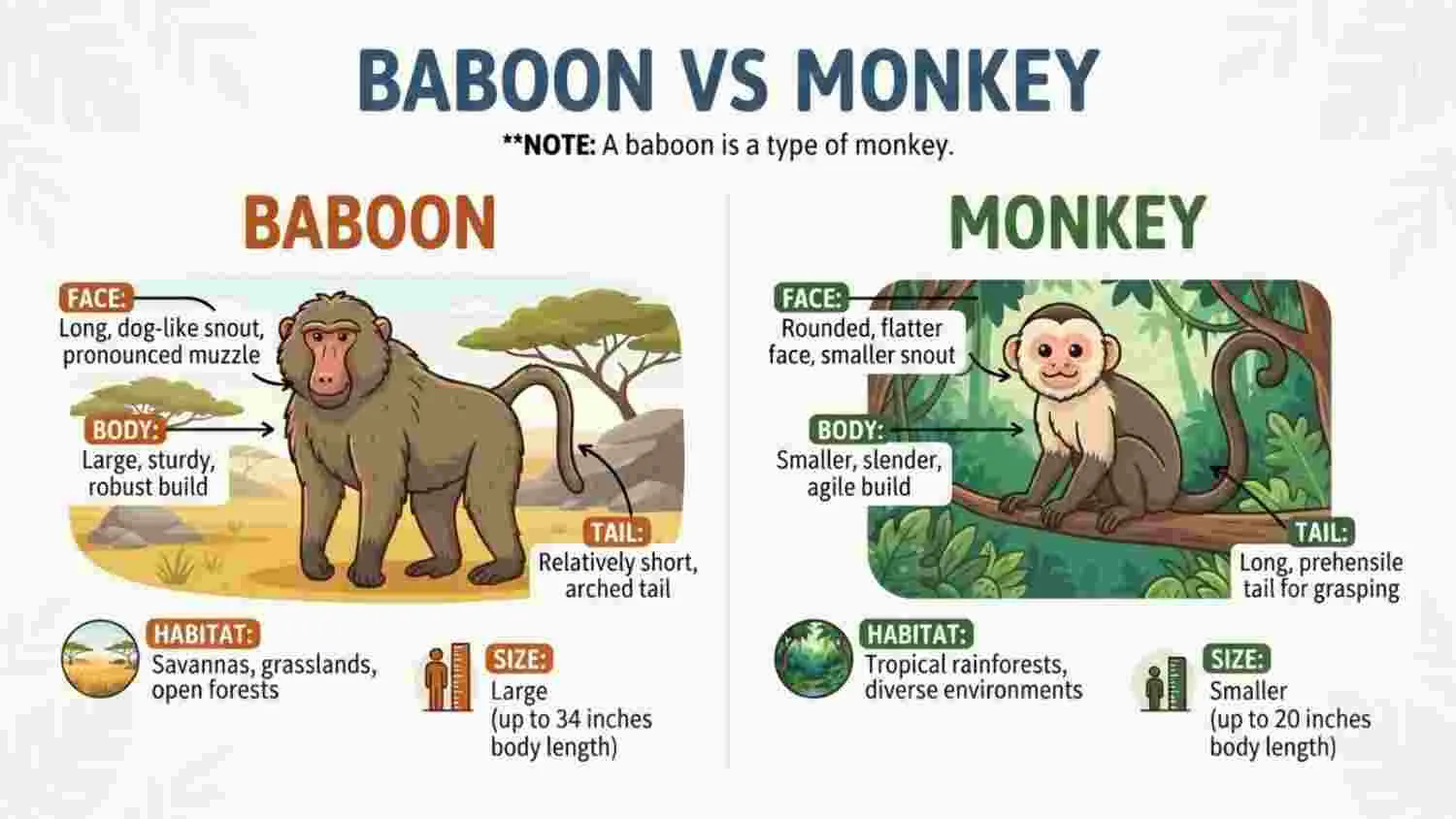
At first, a baboon may look very different from a small monkey. Baboons have long faces, large teeth, strong bodies, and short tails. Monkeys can look very different from one another. Some are small and live in trees, while others are larger and spend a lot of time on the ground.
So, what is the difference between a baboon vs monkey?
The simple answer is that a baboon is a type of monkey. Baboons are Old World monkeys. They are part of the same large monkey group as animals such as macaques and guenons.
The main difference is that “monkey” is a broad word, while “baboon” refers to a more specific group of monkeys. Baboons are known for their long, dog-like faces, large bodies, strong jaws, and fairly short tails.
In this guide, you will learn what a baboon is, what a monkey is, how they are different, where they live, and why a baboon is still a monkey.
Baboon vs Monkey: Quick Answer
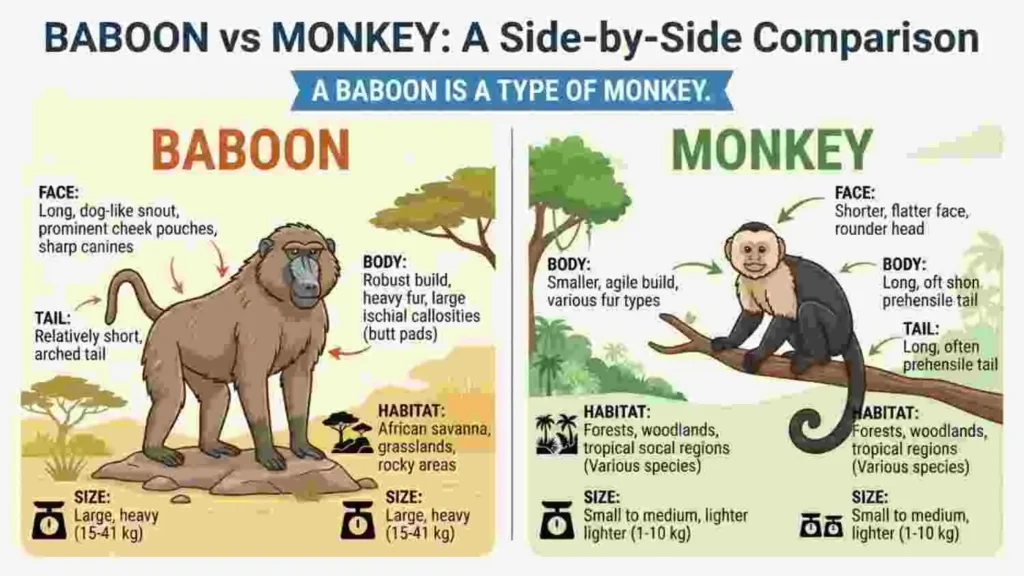
A baboon is a type of monkey.
“Monkey” is a broad name for many kinds of primates. “Baboon” is a name for a specific group of large Old World monkeys.
Here is the simple difference:
| Baboon | Monkey |
| A specific type of monkey | A broad group of animals |
| Usually large | Can be small, medium, or large |
| Has a long, dog-like face | Face shape varies |
| Usually has a short or medium tail | Tail length varies |
| Mostly found in Africa and parts of Arabia | Found in many parts of the world |
| Often spends time on the ground | Many species spend much of their time in trees |
So, all baboons are monkeys, but not all monkeys are baboons.
What Is a Baboon?
A baboon is a large type of Old World monkey.
Baboons are mainly found in Africa. The hamadryas baboon also lives in parts of the Arabian Peninsula.
One easy way to spot a baboon is by its face. Baboons have a long muzzle that can look a little like a dog’s face. They also have strong jaws and large teeth.
Baboons are also strong animals. Many spend a lot of time walking on the ground instead of staying in trees.
They often live in groups. Living in a group can help them find food and watch for danger.
The word baboon has a long history in English. Oxford says it came into English from Middle English and Old French forms linked to words for a muzzle or grimace.
Example
We saw a group of baboons near the rocks.
Here, “baboon” means a specific kind of monkey.
What Is a Monkey?
A monkey is a type of primate.
The word “monkey” covers many different animals. Some monkeys are very small. Others can be quite large.
Some monkeys spend most of their time in trees. Others, such as baboons, spend a lot of time on the ground.
Monkeys can have very different colors, body shapes, faces, and tails.
There are two main groups often called Old World monkeys and New World monkeys.
Old World monkeys are found mainly in Africa and Asia. Baboons are part of this group. Other Old World monkeys include macaques, langurs, colobus monkeys, and mandrills.
New World monkeys are mainly found in Central and South America.
So, “monkey” is much wider than “baboon.”
Main Difference Between Baboon and Monkey
The biggest difference is how specific the word is.
“Monkey” is a general word.
“Baboon” is a specific name for a group of large Old World monkeys.
Think of it like this:
Animal → Primate → Monkey → Old World monkey → Baboon
This means a baboon belongs to the monkey group.
For example, a macaque is a monkey, but it is not a baboon. A baboon is a monkey, but it belongs to a different group.
Baboon vs Monkey: Size
Baboons are usually large compared with many other monkeys.
They have strong bodies and powerful jaws. Some male baboons are much larger than females.
Monkeys, however, come in many sizes.
Some monkeys are small enough to sit easily on a person’s shoulder. Others are much larger.
Because of this, you cannot use size alone to decide if an animal is a baboon.
Still, a large body, long face, strong jaws, and a short tail can be useful clues.
Baboon vs Monkey: Face
The face is one of the easiest ways to tell a baboon apart from many other monkeys.
Baboons have a long muzzle. It can look similar to a dog’s muzzle.
Many other monkeys have shorter and more rounded faces.
For example, a common small monkey may have a short face and large eyes. A baboon has a much longer face.
Simple tip
If you see a large monkey with a very long, dog-like face, it may be a baboon.
Baboon vs Monkey: Tail
Tail shape can also help.
Baboons usually have short or medium-length tails. Their tails are not used like the long gripping tails seen in some New World monkeys.
Monkeys have many different types of tails.
Some have long tails. Some have short tails. They have tails that are very useful for balance.
So, not every monkey has the same kind of tail.
Baboon vs Monkey: Where They Live
Baboons are mainly found in Africa. The hamadryas baboon is also found in parts of the Arabian Peninsula.
Monkeys live in many parts of the world.
Old World monkeys are mainly found in Africa and Asia. New World monkeys are mainly found in Central and South America.
This gives us another easy way to understand the difference.
A baboon has a much smaller natural range than the full group called monkeys.
Baboon vs Monkey: Habitat
Many monkeys live in forests and spend a lot of time in trees.
Baboons are different.
They are well suited to life on the ground. These can live in open areas, rocky places, and wooded areas.
They can also climb trees when they need to.
This means a baboon can live both on the ground and in trees, but it is often more comfortable on the ground than many tree-living monkeys.
Baboon vs Monkey: Teeth
Baboons have strong jaws and large canine teeth.
Large male baboons can have very long canine teeth. These teeth can play a role in displays and fights between males.
Other monkeys can also have sharp teeth.
However, the large teeth of baboons are one of their well-known features.
Baboon vs Monkey: Food
Baboons eat many kinds of food.
Their diet can include fruits, seeds, plants, insects, and other foods. Their exact diet depends on the species and where they live.
Many other monkeys also eat a mix of foods.
Fruit, leaves, seeds, insects, and other small foods can be part of a monkey’s diet.
So, diet alone is not a good way to tell a baboon from another monkey.
Are Baboons Monkeys?
Yes. Baboons are monkeys.
This is the most important point to remember.
Baboons belong to the Old World monkey family. Collins lists baboons as members of the Old World monkey group along with animals such as macaques and mandrills.
You can think of it this way:
Monkey = large group
Baboon = one type within that group
It is similar to saying:
Fruit = group
Apple = one type of fruit
The same idea works here.
Are All Monkeys Baboons?
No.
Only some monkeys are baboons.
There are many types of monkeys. Baboons are just one group.
For example:
- Macaques are monkeys.
- Langurs are monkeys.
- Colobus monkeys are monkeys.
- Guenons are monkeys.
- Baboons are monkeys.
- Mandrills are Old World monkeys.
These animals are related, but they are not all the same type of animal.
Baboon vs Monkey Comparison Table
| Feature | Baboon | Monkey |
| Meaning | A specific type of monkey | A broad animal group |
| Animal group | Old World monkey | Old World or New World monkey |
| Face | Long and dog-like | Shape varies |
| Body | Usually large and strong | Size varies |
| Tail | Usually short or medium | Length varies |
| Main range | Africa and parts of Arabia | Africa, Asia, Central America, and South America, depending on group |
| Habitat | Ground, rocks, and wooded areas | Trees, forests, ground, and other habitats |
| Teeth | Large canine teeth | Teeth vary by species |
| Social life | Often lives in groups | Many species live in groups |
| Example | Olive baboon | Macaque, langur, capuchin |
Common Mistakes About Baboon and Monkey
1. Thinking a baboon is not a monkey
Incorrect: A baboon and a monkey are completely different animals.
Correct: A baboon is a type of monkey.
2. Thinking every monkey is a baboon
Incorrect: All monkeys are baboons.
Correct: Baboons are only one type of monkey.
3. Thinking baboons only live in trees
Baboons often spend a lot of time on the ground.
They can climb trees, but they are not mainly tree-living animals like many other monkeys.
4. Thinking all monkeys are small
This is not true.
Monkeys come in many sizes. Baboons are among the larger monkeys.
5. Thinking baboons are apes
Baboons are monkeys, not apes.
The words “monkey” and “ape” are used for different groups of primates.
6. Thinking every large monkey is a baboon
A large monkey is not always a baboon.
You should also look at the face, tail, body shape, and other features.
7. Using “baboon” for any monkey
“Baboon” is a specific animal name.
If you do not know the exact type, “monkey” may be the better word.
10 Example Sentences
- The baboon walked across the open ground.
- We saw a monkey sitting in a tree.
- The baboon had a long face.
- Baboons are a type of Old World monkey.
- The monkey jumped from one branch to another.
- A group of baboons moved through the grass.
- Many monkeys live in forests.
- The baboon used its strong jaws to eat.
- Some monkeys spend most of their time in trees.
- A baboon is a monkey, but not every monkey is a baboon.
Baboon vs Monkey in Everyday English
The word monkey is much more common in everyday speech.
People often use “monkey” when they do not know the exact species.
For example:
Look at that monkey!
This can be a simple way to talk about a monkey without naming its exact type.
The word baboon is more specific.
For example:
The zoo has a group of baboons.
Here, the speaker knows that the animals are baboons.
In school or science writing, using the exact animal name can make your writing clearer.
British vs American English
There is no major British vs American spelling difference between baboon and monkey.
Both British and American English use:
- baboon
- monkeys
- monkey
- baboons
The pronunciation may have small regional differences, but the spelling and basic meaning stay the same.
Oxford gives baboon as a noun for a large African or Asian monkey with a long face like a dog.
Cambridge also defines a baboon as a type of large monkey found in Africa and Asia.
Which Word Should You Use?
Use monkey when you are talking about monkeys in general.
Monkeys are intelligent primates.
Use baboon when you mean the specific animal.
The baboon walked across the road.
If you are writing about animal science, use the more exact name when you know it.
For example:
The animal was a baboon.
This is clearer than simply saying:
The animal was a monkey.
Both can be true, but “baboon” gives more information.
Related Questions
Is a baboon a monkey?
Yes. A baboon is a type of Old World monkey. Baboons belong to the monkey family that also includes several other groups.
Is a monkey bigger than a baboon?
Not always. Monkeys come in many sizes. Baboons are usually large compared with many other monkeys, but size depends on the species.
What makes a baboon different from a monkey?
The main point is that “monkey” is a broad group, while “baboon” is a specific type of Old World monkey. Baboons are known for their long faces, strong bodies, large teeth, and short or medium tails.
Are baboons aggressive?
Baboons are strong wild animals and can defend themselves when they feel threatened. People should keep a safe distance from wild baboons and should not try to feed or touch them.
Where do baboons live?
Most baboons live in Africa. The hamadryas baboon also lives in parts of the Arabian Peninsula.
Do baboons climb trees?
Yes. Baboons can climb trees, but many spend a lot of time on the ground. Their strong bodies make them well suited to life on the ground.
What is the easiest way to tell a baboon from another monkey?
Look at the face and body. Baboons often have a long, dog-like face, a strong body, large teeth, and a short or medium tail.
Conclusion
The difference between baboon vs monkey is simple once you understand the two words.
A monkey is a broad name for many types of primates. A baboon is one specific type of monkey. Baboons are Old World monkeys and are mainly found in Africa, with the hamadryas baboon also found in parts of the Arabian Peninsula.
Baboons are easy to recognize because they often have long, dog-like faces, strong bodies, large teeth, and short or medium tails. They also spend a lot of time on the ground.
The easiest rule to remember is:
A baboon is a monkey, but a monkey is not always a baboon.
So, if you see a baboon, you can correctly call it a monkey. But if you see a monkey, you should not call it a baboon unless you know that it is one.

Emily Carter is an English grammar writer based in Portland, Oregon, with 7+ years of experience turning tricky grammar rules into simple, easy lessons.