Have you ever stopped while writing because you were unsure whether to use whether or wether? You are not alone. These two words look almost the same, and they sound alike in most accents. However, they have very different meanings and uses.
The good news is that there is a simple way to remember the correct spelling. Whether is the word you need when you talk about choices, options, or possibilities. For example, you might write, “I don’t know whether it will rain today.”
Wether is also a real English word, but it has a much more specific meaning. It refers to a castrated male sheep. Most people rarely need this word in daily writing.
Choosing the wrong spelling can change the meaning of your sentence or make your writing look incorrect. In this guide, you will learn the difference between whether and wether, how to use each word, common spelling mistakes, and simple examples that make the difference easy to remember.
Whether or Wether: Quick Answer
Whether is the correct word when you talk about a choice, doubt, or two possible outcomes.
Wether means a castrated male sheep. It is a real word, but people rarely use it in everyday writing.
Examples:
- Correct: I don’t know whether she will come.
- Correct: The farmer bought a young wether.
Remember: Use whether for choices and possibilities. Use wether only when talking about a castrated male sheep.
What Does Whether Mean?
Whether is a word that introduces a choice or a question with more than one possible answer. It helps show that something is uncertain or that someone must choose between options.
You can use whether when talking about two choices, making a decision, or explaining something you do not know.
For example:
- I cannot decide whether to stay or leave.
- She asked whether I was ready.
- We need to know whether the shop is open.
In each sentence, whether connects an idea to a choice or question.
When Do You Use Whether?
You can use whether in several common situations.
1. When talking about two choices
Use whether when someone must choose between two things.
Example: I cannot decide whether to buy the blue shirt or the black one.
2. When showing doubt
Use whether when you are not sure about something.
Example: I don’t know whether he received my email.
3. When asking an indirect question
Use whether to report a question without asking it directly.
Example: She asked whether I needed help.
4. When talking about something that may or may not happen
Example: We will go outside whether it rains or not.
These uses make whether a common word in everyday conversations, schoolwork, and professional writing.
What Does Wether Mean?
Wether is a noun that means a castrated male sheep. Farmers may use this word when talking about sheep, livestock, and farm animals.
A wether is different from a ram. A ram is an adult male sheep that has not been castrated. A wether is a male sheep that has been castrated.
Examples:
- The farmer bought a young wether.
- A wether stood near the other sheep.
- The farm has several wethers in its flock.
You will mostly see this word in farming, animal care, and livestock-related writing.
It is not a replacement for whether when you want to discuss a choice or possibility.
Whether vs Wether: Main Differences
The main difference is their meaning and use. Both words have similar sounds, but they belong to different parts of everyday language.
| Word | Meaning | Usage | Example |
| Whether | Expresses a choice, doubt, or possibility | Everyday and formal writing | I wonder whether he is home. |
| Wether | A castrated male sheep | Farming and animal care | The wether is in the field. |
Here are the main differences:
- Meaning: Whether talks about choices. Wether refers to an animal.
- Word type: Whether works as a conjunction. Wether is a noun.
- Common use: Whether is common in daily English. Wether is much less common.
- Context: Whether appears in questions and statements. Wether appears in farming and livestock discussions.
The easiest way to remember the difference is to connect whether with choices and wether with sheep.
Whether or Wether: Origin and History
Both words have a long history in English, but they developed from different older words.
Origin of Whether
Whether comes from Old English hwæther, which was used to express a choice between two things. Over time, its spelling and use changed into the modern English word whether.
Today, people use it to introduce choices, possibilities, and indirect questions.
Origin of Wether
Wether comes from Old English wether, a word used for a male sheep, especially a castrated one. The word has kept this animal-related meaning in modern English.
Although the words look similar today, they have different origins and meanings.
Whether vs Wether in British English and American English
There is no major difference between British and American English when it comes to these two words.
Both forms use whether for choices, possibilities, and indirect questions. Both also use wether to describe a castrated male sheep.
The spelling and meaning stay the same in both varieties.
| Word | British English | American English |
| Whether | Correct | Correct |
| Wether | Correct | Correct |
The pronunciation may vary slightly between speakers because of regional accents. However, the difference in meaning does not change.
You should use whether for normal writing in both countries.
Which One Should You Use?
Your choice depends on what you want to say.
Use whether in almost all normal situations involving choices, questions, or uncertainty.
For example:
- Everyday writing: I don’t know whether he is coming.
- School writing: The test will show whether the answer is correct.
- Academic writing: Researchers examined whether the results were accurate.
- Business writing: Please confirm whether the meeting is scheduled.
- Emails: Let me know whether you can attend.
Use wether only when you are writing about sheep or farming.
For example:
- The wether was moved to another field.
- The farmer checked the health of each wether.
If you are writing about a decision, asking a question, or expressing doubt, choose whether.
Common Whether and Wether Mistakes
These are some common mistakes people make when using these words.
1. Using Wether Instead of Whether
Incorrect: I don’t know wether he is coming.
Correct: I don’t know whether he is coming.
Explanation: The sentence talks about uncertainty, so whether is the right word.
2. Using Whether When Talking About a Sheep
Incorrect: The whether is standing in the field.
Correct: The wether is standing in the field.
Explanation: Wether is the correct noun for a castrated male sheep.
3. Writing Wether in an Indirect Question
Incorrect: She asked wether I was ready.
Correct: She asked whether I was ready.
Explanation: Whether introduces the indirect question.
4. Forgetting Whether in a Choice
Incorrect: I cannot decide to stay or leave.
Correct: I cannot decide whether to stay or leave.
Explanation: Whether makes the choice clear. The original sentence is also possible, but whether is useful when presenting the options as a decision.
5. Confusing Whether With Weather
Incorrect: I don’t know whether it will rain because the wether is bad.
Correct: I don’t know whether it will rain because the weather is bad.
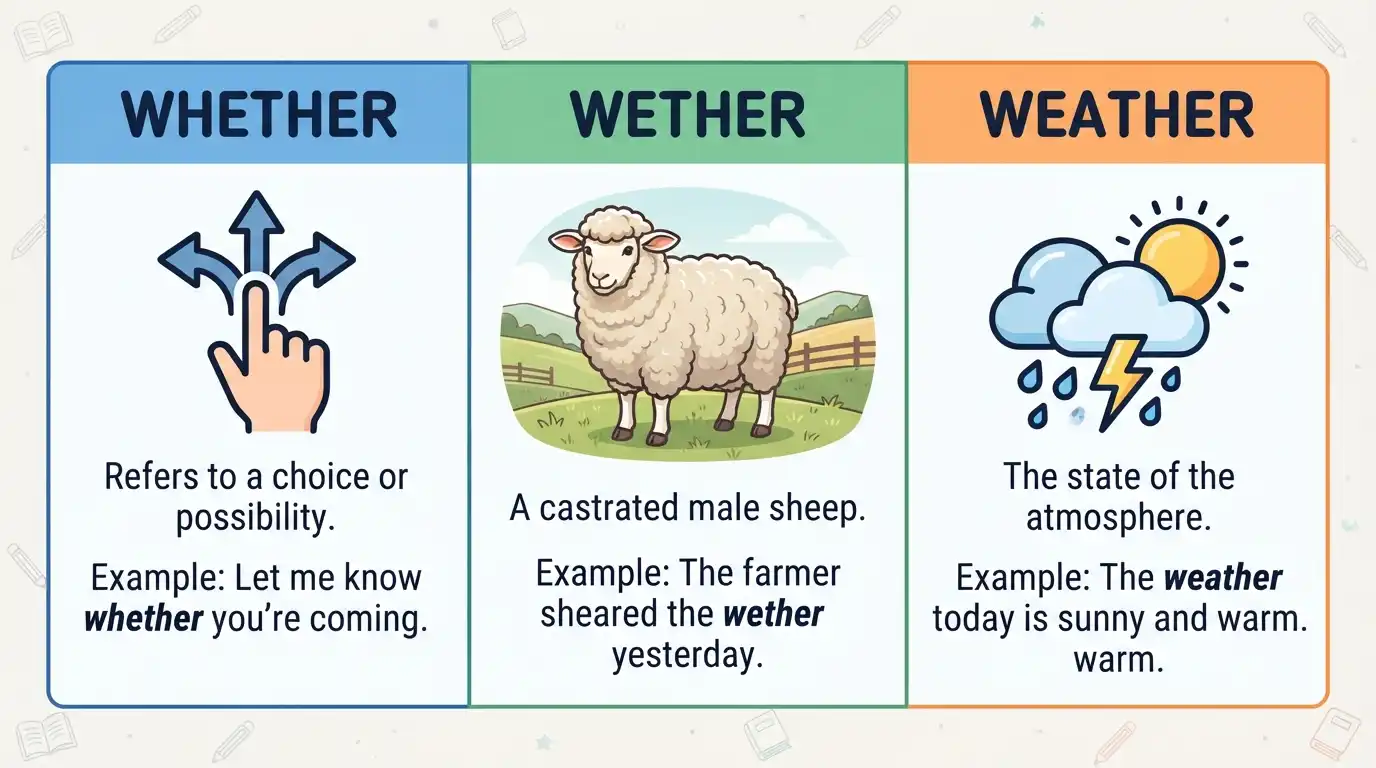
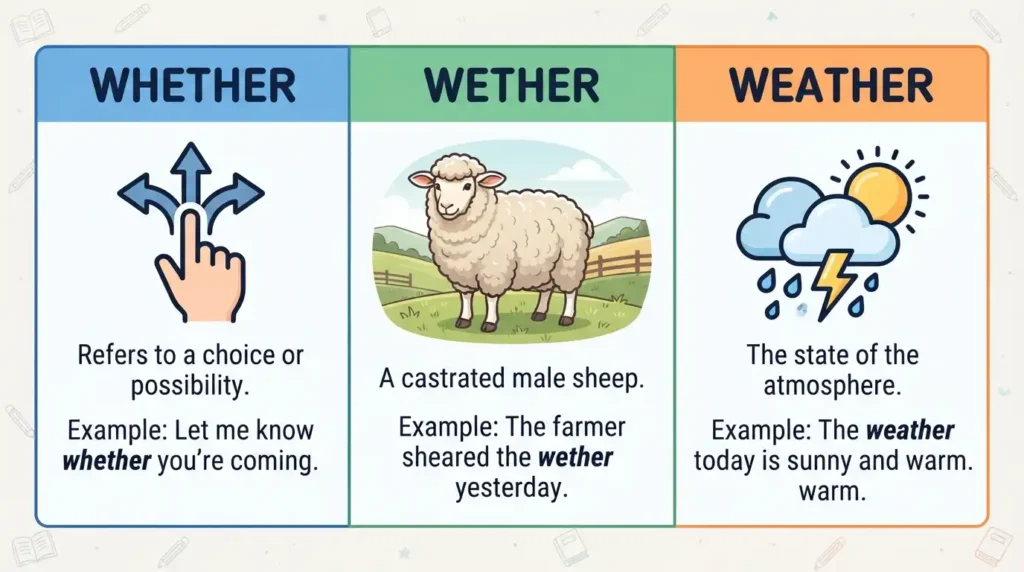
Explanation: Weather refers to conditions such as rain, wind, and sunshine. Whether introduces a choice or possibility.
6. Using Wether in Formal Emails
Incorrect: Please tell me wether you received the file.
Correct: Please tell me whether you received the file.
Explanation: Use whether when asking someone to confirm something.
7. Mixing Up All Three Words
Incorrect: I don’t know wether the weather will change.
Correct: I don’t know whether the weather will change.
Explanation: Whether introduces uncertainty, while weather describes outdoor conditions.
15 Everyday Examples of Whether and Wether
These examples show how both words work in normal sentences.
Examples Using Whether
- I don’t know whether she is at home.
- We need to decide whether to travel today.
- He asked whether I needed a ride.
- Please tell me whether the shop is open.
- She is unsure whether to accept the offer.
- I wonder whether they will arrive on time.
- We will play outside whether it rains or not.
- The teacher asked whether everyone understood the lesson.
- I cannot remember whether I locked the door.
- They discussed whether the plan would work.
- Let me know whether you are free tomorrow.
- I am not sure whether this answer is correct.
Examples Using Wether
- The farmer bought a young wether.
- The wether walked across the farm.
- Several wethers were kept in a separate field.
How to Use Whether and Wether in Real Life
Both words can appear in writing, but they are used in very different situations.
In Everyday Conversations
People use whether when they talk about plans, choices, or doubts.
Example: “I’m not sure whether I should go.”
Wether is unlikely to appear in normal conversations unless someone is discussing sheep or farming.
In Emails and Business Writing
Whether is useful when asking for information or confirming a decision.
Example: “Could you confirm whether the payment has been received?”
Using wether in this sentence would be a spelling mistake.
In School and Academic Writing
Students use whether when discussing questions, results, and possible outcomes.
Example: “The experiment tested whether the water was safe.”
Wether may appear in lessons about farm animals or animal science.
On Social Media
People may use whether in posts and comments when discussing choices.
Example: “I can’t decide whether to watch a movie or read a book.”
Wether is much less likely to appear unless the post is about sheep or farming.
Related Questions About Whether and Wether
Is Whether a Correct English Word?
Yes. Whether is a correct English word. It introduces choices, possibilities, and indirect questions. For example, “I don’t know whether he is coming” uses whether correctly because the speaker is unsure about something.
Is Wether a Real Word?
Yes. Wether is a real English word. It refers to a castrated male sheep. It is mainly used in farming, livestock care, and animal-related writing.
Are Whether and Wether Pronounced the Same?
In most English accents, whether and wether sound the same or very similar. This makes them homophones for many speakers. However, their meanings and spellings are different.
Is Whether More Common Than Wether?
Yes. Whether is far more common in everyday English because people use it to discuss choices, doubts, and questions. Wether has a narrow meaning related to sheep.
Can I Use Whether at the Beginning of a Sentence?
Yes. You can begin a sentence with whether when introducing a choice or question.
Example: “Whether we win or lose, we should enjoy the game.”
What Is the Difference Between Whether and Weather?
Whether introduces a choice or possibility. Weather refers to outdoor conditions such as rain, snow, wind, and sunshine.
Example: “I don’t know whether the weather will improve.”
Which Is Correct: Whether or Wether in an Essay?
Whether is correct when you discuss a choice, question, or possibility. Wether is correct only if your essay discusses castrated male sheep. In most school and college essays, whether will be the word you need.
Whether vs Wether: Usage and Search Trends
People often search for whether or wether because the two words look and sound similar. Many writers want to know which spelling is correct and how to use it in a sentence.
The confusion often comes from typing quickly or relying on pronunciation instead of spelling.
There is no verified search-volume or Google Trends figure included here, so no numerical search claims can be made.
For everyday writing, whether is the spelling most people need. Wether is a specialized word that belongs mainly to farming and animal care.
Whether vs Wether: Quick Comparison Table
| Feature | Whether | Wether |
| Correct English word | Yes | Yes |
| Main meaning | Choice or possibility | Castrated male sheep |
| Part of speech | Conjunction | Noun |
| Common in daily writing | Yes | No |
| Used in questions | Yes | Rarely |
| Used in farming | Sometimes in sentences about choices | Yes |
| Example | I wonder whether he knows. | The wether is young. |
Frequently Asked Questions
1. Should I Write Whether or Wether?
Write whether when you are talking about a choice, possibility, or indirect question. Use wether only when referring to a castrated male sheep. For example, “I wonder whether she is coming” is correct because the sentence expresses uncertainty.
2. Why Do People Confuse Whether and Wether?
People confuse these words because they look almost the same and sound alike in most English accents. Their meanings are very different, though. Remember that whether relates to choices, while wether relates to sheep.
3. Does Whether Mean If?
Yes, whether can sometimes have a meaning similar to if. Both can introduce an indirect question. For example, “I don’t know whether he is home” and “I don’t know if he is home” are both correct.
4. Is Wether the Same as a Ram?
No. A wether is a castrated male sheep, while a ram is an adult male sheep that has not been castrated. Both are sheep, but the terms describe different animals.
5. Can Whether Be Used Without Or?
Yes. Whether does not always need or after it. For example, “I don’t know whether he is ready” is a complete and correct sentence. You can also use it with or to show two possible choices.
6. Is Whether Formal or Informal?
Whether works in both formal and informal English. You can use it in daily conversations, school essays, business emails, and academic writing. It is a standard English word and does not sound too formal for normal use.
7. What Is an Easy Way to Remember Whether and Wether?
Remember that whether is used when you wonder about something or have a choice to make. Wether has an animal-related meaning. If your sentence is about a decision, question, or possibility, whether is almost certainly the correct spelling.
Conclusion: Whether or Wether, Which One Is Correct?
The correct choice between whether and wether depends on the meaning of your sentence. Both are real English words, but they do not mean the same thing.
Whether is the word you need for choices, doubts, possibilities, and indirect questions. It is common in everyday conversations, schoolwork, business emails, and formal writing.
Wether has a much narrower meaning. It refers to a castrated male sheep and mainly appears in farming or animal-related topics.
The easiest way to remember the difference is to connect whether with choices and wether with sheep. For example, write “I don’t know whether he will come” when you are unsure about someone’s plans. Write “The wether is in the field” when talking about a castrated male sheep.
There is no spelling difference between British and American English for these words. Both varieties use them in the same way.
So, if you are writing a normal sentence about a choice or possibility, whether is the correct spelling. Use wether only when its specific animal meaning fits your sentence.