Effect and affect are two commonly confused English words. They sound almost the same, but they usually have different meanings and grammatical roles.
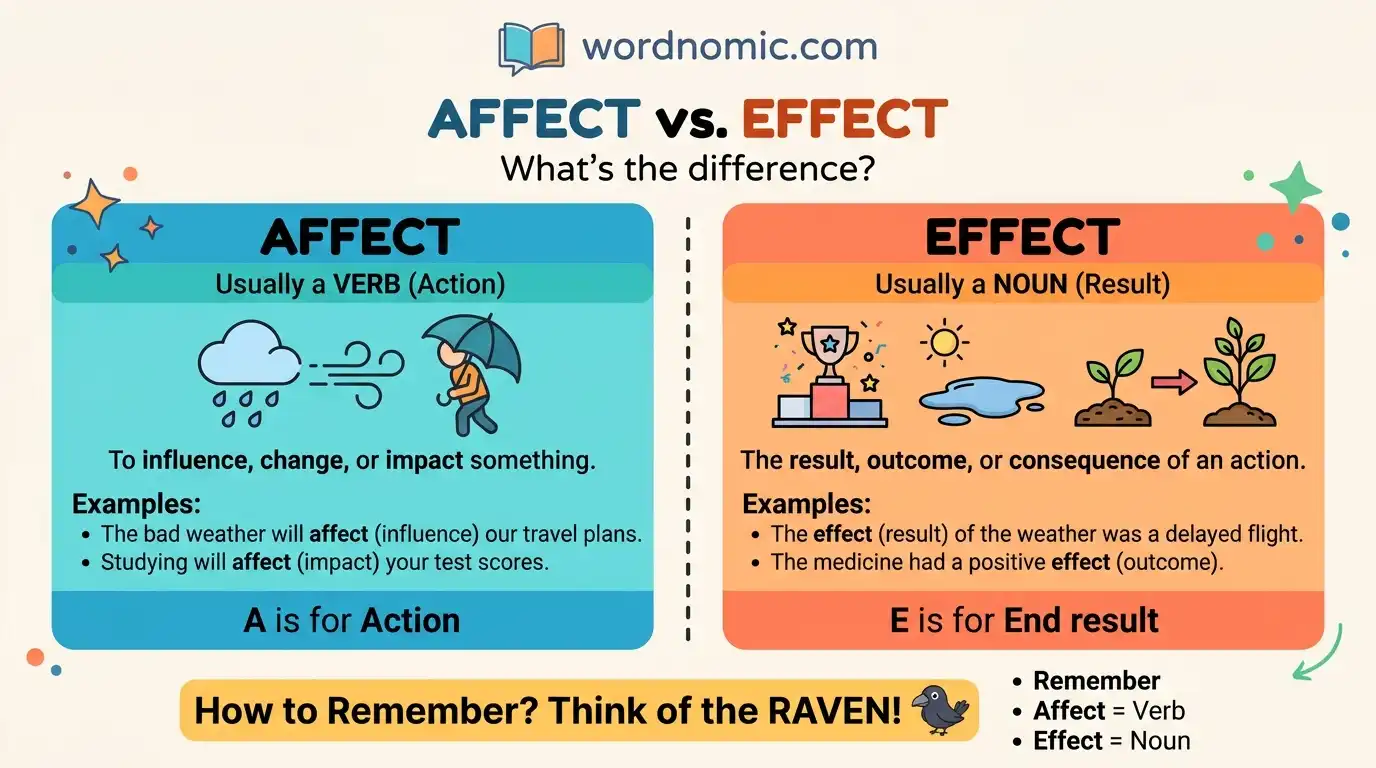
The easiest way to remember the difference is:
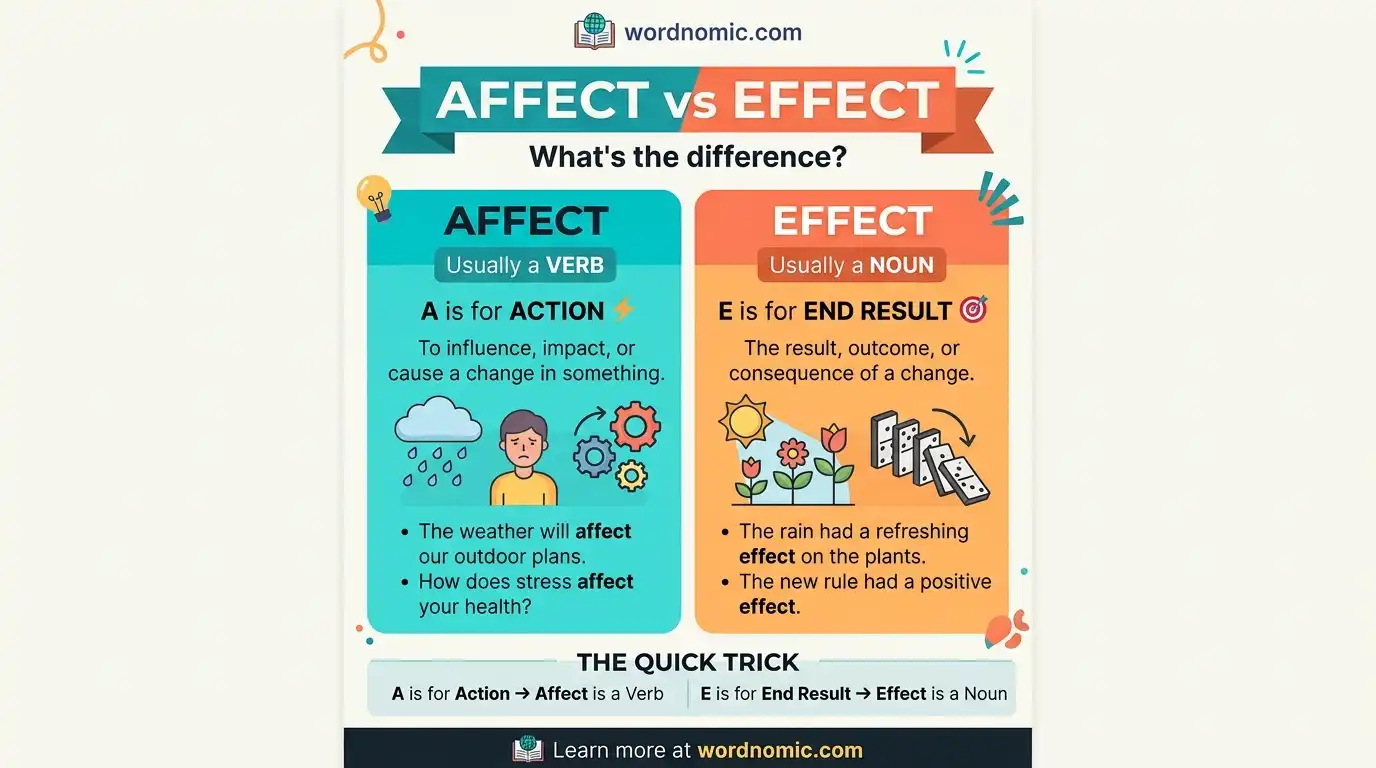
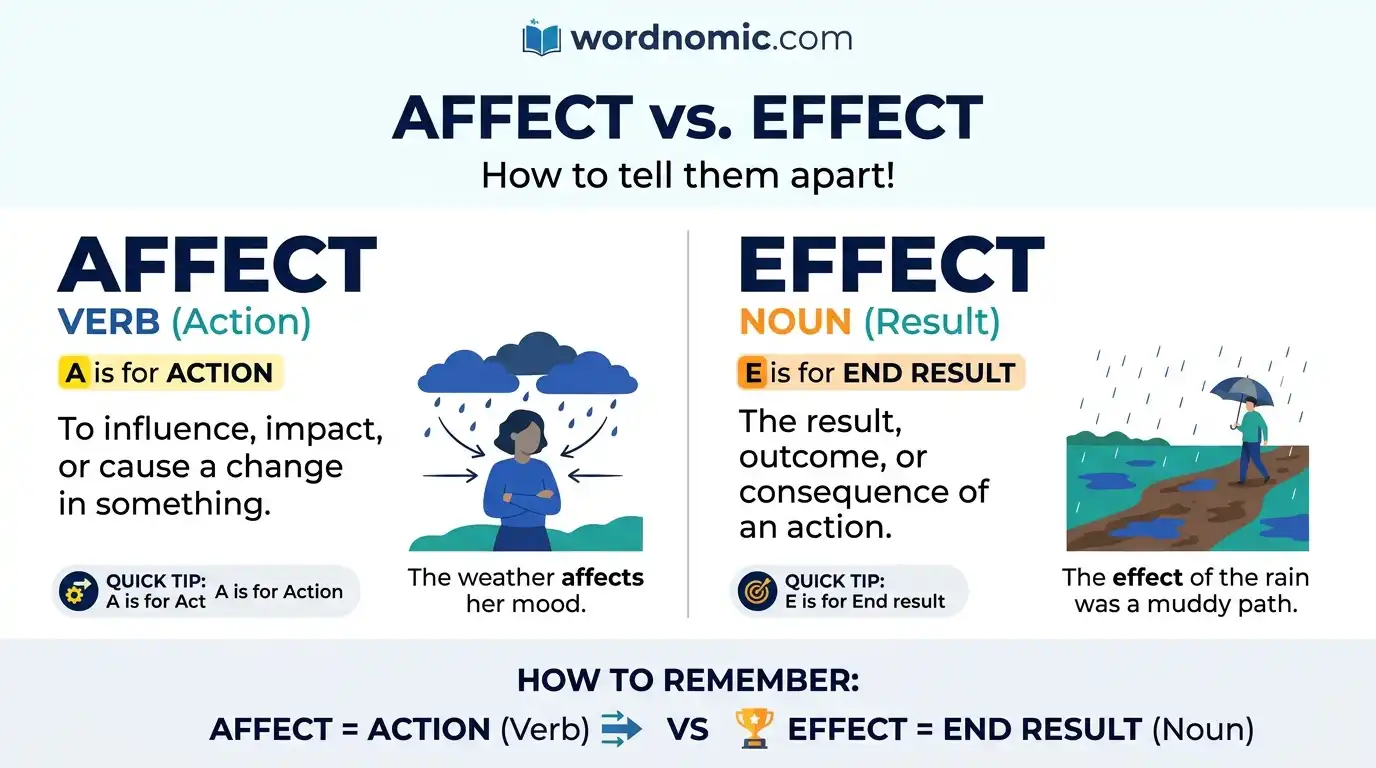
- Affect is usually a verb that means to influence or change something.
- Effect is usually a noun that means a result or outcome.
For example:
- The weather can affect your mood. (The weather can influence your mood.)
- The weather had an effect on my mood. (The weather caused a result.)
Both sentences are correct, but the words perform different jobs.
There is one important exception: effect can also be a verb, and affect can sometimes be a noun. Understanding these less common uses will help you choose the right word in everyday writing, school assignments, emails, and professional communication.
Effect vs. Affect: The Main Difference
The main difference is how you use each word in a sentence.
| Word | Part of Speech | Main Meaning | Example |
| Affect | Verb | To influence or change something | Lack of sleep can affect your health. |
| Effect | Noun | A result or consequence | Lack of sleep has an effect on your health. |
Think of it this way:
Affect = Action
Something affects something else.
Effect = End result
Something produces an effect.
This simple distinction works in most everyday situations.
When to Use Affect
Use affect when you want to describe how one thing influences, changes, or has an impact on another thing.
It is usually an action word, so it functions as a verb.
For example:
- Too much screen time can affect your sleep.
- Her kind words affected my confidence.
- Heavy rain may affect road conditions.
- Stress can affect your ability to concentrate.
- The new rules will affect all employees.
In each sentence, something is influencing or changing something else.
How to Remember Affect
A useful memory trick is:
Affect = Action
Both words begin with the letter A.
When you describe an action or influence, affect is usually the correct choice.
For example:
- The noise affected my concentration.
- His decision affected the entire team.
You can also ask yourself: “Can I replace this word with influence?”
If the sentence still makes sense, you probably need affect.
The noise influenced my concentration.
That sentence has the same basic meaning as the original.
When to Use Effect
Use effect when you are talking about a result, outcome, or consequence.
It is usually a noun.
For example:
- The medicine had a positive effect.
- Exercise has many health benefits and positive effects.
- The new policy had little effect on sales.
- The storm caused serious effects across the region.
- Her speech had a powerful effect on the audience.
In these sentences, effect describes what happened as a result of something.
How to Remember Effect
A simple memory trick is:
Effect = End result
Both words begin with E.
When you are talking about the outcome of an action, effect is usually the correct word.
You can also try replacing effect with “result.”
For example:
- The medicine had a positive effect.
- The medicine had a positive result.
The meaning is similar, so effect is the right choice.
Effect or Affect: Easy Examples in Everyday Sentences
Sometimes, the easiest way to understand the difference is to see both words used in similar situations.
1. School and Education
- Affect: Poor study habits can affect your grades.
- Effect: Poor study habits can have a negative effect on your grades.
The first sentence describes an influence. The second describes the result of that influence.
2. Health and Sleep
- Affect: Not getting enough sleep can affect your health.
- Effect: Lack of sleep can have a serious effect on your health.
3. Work and Business
- Affect: The new schedule may affect employee productivity.
- Effect: The new schedule may have a positive effect on employee productivity.
4. Weather and Environment
- Affect: Extreme heat can affect crop growth.
- Effect: Extreme heat can have a damaging effect on crops.
5. Relationships
- Affect: Her words affected his feelings.
- Effect: Her words had a strong effect on him.
These examples show that you can often express the same idea using either word. The sentence structure changes, but the basic meaning stays similar.
What About the Exceptions?
The usual rule is that affect is a verb and effect is a noun. However, both words have less common uses that are worth knowing.
When Effect Is a Verb
Effect can also work as a verb. It means to bring about, accomplish, or make something happen.
For example:
- The new government hopes to effect major changes.
- The organization worked hard to effect reform.
- The manager wants to effect improvements in the workplace.
Notice the difference between these two sentences:
- The new policy will affect employees. (It will influence them.)
- The new policy will effect changes. (It will bring changes about.)
This distinction is especially useful in formal and professional writing.
A helpful way to remember it:
- Affect change = influence existing change or the process of change.
- Effect change = bring change into existence.
When Affect Is a Noun
Affect can also be a noun in psychology and mental health terminology.
It refers to the outward expression of someone’s emotions, such as facial expressions, gestures, and tone of voice.
For example:
- The patient displayed a flat affect.
- The therapist observed a change in the patient’s affect.
A flat affect describes limited visible emotional expression. It does not automatically mean the person has no feelings.
This noun form is uncommon in everyday conversation, so most general readers will rarely need it.
Common Expressions: Effect or Affect?
Some English expressions use one spelling consistently. Learning these phrases can help you avoid common mistakes.
| Expression | Correct Word | Meaning |
| Have an effect on | Effect | Produce an influence or result |
| Take effect | Effect | Begin to work or become active |
| Side effect | Effect | An additional result, often unwanted |
| Cause and effect | Effect | A relationship between an action and its result |
| In effect | Effect | Operating or currently applying |
| For effect | Effect | To create a particular impression |
| Affect someone’s mood | Affect | Influence someone’s feelings |
| Affect the outcome | Affect | Influence the final result |
| Affect change | Affect | Influence the process of change |
| Effect change | Effect | Bring change about |
One particularly useful phrase is “take effect.”
Example: The new school rules will take effect next Monday.
Here, effect is a noun because it refers to the point when the rules begin to operate.
Effected vs. Affected: Which Spelling Is Correct?
The past-tense forms can be confusing, too. Both affected and effected are correct words, but they do not mean the same thing.
Affected means influenced or changed.
Examples:
- The storm affected several towns.
- Her decision affected the entire family.
- His health was affected by the lack of sleep.
Effected means brought about or accomplished.
Examples:
- The new leadership effected major changes.
- The organization effected a complete reform.
- The agreement effected a peaceful settlement.
The easiest way to choose is to ask what happened:
- Was something influenced? Use affected.
- Was something brought into existence or accomplished? Use effected.
A Simple Trick to Choose the Correct Word
If you are unsure whether to write effect or affect, follow these three steps.
Step 1: Check the meaning.
Ask yourself what you are trying to say.
- If you mean influence or change, choose affect.
- If you mean result or outcome, choose effect.
Step 2: Try replacing the word.
Replace the word with another word that has a similar meaning.
- If “influence” fits, use affect.
- If “result” fits, use effect.
Step 3: Check the sentence structure.
Look at whether the word is acting as a verb or a noun. This is especially useful when the meaning is not immediately clear.
Try these examples:
| Sentence | Correct Answer | Why? |
| The news will ___ my decision. | Affect | It will influence the decision. |
| The news had a big ___ on me. | Effect | It describes a result. |
| The changes will take ___. | Effect | This is the expression “take effect.” |
| The company wants to ___ change. | Effect | It means to bring change about. |
| The noise ___ my concentration. | Affected | It influenced my concentration. |
Common Mistakes to Avoid
Even experienced English speakers sometimes mix up these words. Here are a few mistakes worth watching for.
Mistake 1: Using effect as a verb when you mean influence
Incorrect: The weather will effect our travel plans.
Correct: The weather will affect our travel plans.
Why? The weather will influence the plans rather than create them.
Mistake 2: Using affect as a noun
Incorrect: The new rules had a positive affect on students.
Correct: The new rules had a positive effect on students.
Why? You are describing the result of the new rules.
Mistake 3: Confusing affected and effected
Incorrect: The new policy affected several improvements.
Correct: The new policy effected several improvements.
Why? The sentence means the policy brought improvements about.
Mistake 4: Writing affect in the expression “take effect”
Incorrect: The new law will take affect tomorrow.
Correct: The new law will take effect tomorrow.
Why? “Take effect” is a fixed expression meaning to become active or start working.
Quick Practice: Test Your Understanding
Choose the correct word for each sentence.
Effect or Affect Quiz
0 of 5 answered
1. The loud music can ___ your ability to concentrate.
Affect
Effect
2. The medicine had a positive ___ on her health.
Affect
Effect
3. The new rules will take ___ next month.
Affect
Effect
4. The organization hopes to ___ meaningful change.
Affect
Effect
5. The accident ___ his ability to work.
Affected
Effected
Check Answers
Frequently Asked Questions
1. Is it effect or affect on your life?
Use affect when you mean something influences your life.
Example: Your daily habits can affect your life.
Use effect when you describe the result.
Example: Exercise can have a positive effect on your life.
2. Is it side effect or side affect?
The correct expression is side effect. It describes an additional result of something, often an unwanted result of a medicine or treatment.
Example: Drowsiness is a possible side effect of this medicine.
3. Is it affected by or effected by?
Usually, the correct phrase is affected by when you mean influenced or changed by something.
Example: The crops were affected by heavy rainfall.
“Effected by” is not the normal choice for this meaning.
4. Is it take effect or take affect?
The correct expression is take effect. It means that something starts working or becomes active.
Example: The new company policy will take effect in January.
5. Can effect be used as a verb?
Yes. Effect can be a verb meaning to bring about or accomplish something.
Example: The new leadership hopes to effect major changes.
6. Can affect be used as a noun?
Yes. In psychology and medicine, affect refers to the outward expression of emotion.
Example: The doctor noted that the patient had a flat affect.
7. What is the easiest way to remember effect and affect?
Remember A for Action and E for End result.
- Affect usually describes an action or influence.
- Effect usually describes the result.
This simple trick works for most everyday writing situations.
Final Takeaway
The easiest way to choose between effect and affect is to focus on what you mean. Use affect when something influences or changes something. Use effect when you are talking about a result or outcome.
Remember the less common exceptions, too: effect can mean to bring something about, while affect can describe someone’s visible emotional expression. Once you understand these differences, choosing the correct word becomes much easier.